
CSU: Constellation Software (6)
Q2 2026 Update
CSU just released Q2 2026 results and we are seeing no signs of AI fears materializing in their financials, nor did management express concerns over business prospects.
The very first red flag that people check is the FX-neutral organic growth, which came in at a weak +2% YOY, much lower than +4% in Q1. However, there are 2 things we must understand:
CSU is a serial acquirer that operates in VMS space. It’s known that growth has been mostly from acquisitions, organic growth is not as important as capital deployed. As of Q2 2026, CSU reported $1.6b for acquisitions. Given that their hurdle rates are unchanged, this is very likely to produce above 20% incremental returns. Furthermore, they have $818m in committed considerations for acquisitions. In total, we are looking at $2.4b deployed so far and even more for full year 2026. This quantum of capital deployment is a record high.
For serial acquirers, there will be a lot of accounting noise. Q2 2025 had one-off items because IFRS 15 requires software revenues to be recognized based on when control of the product is handed over to the customer, rather than when cash is actually paid. This applies to Altera which signed a few big new contracts causing large revenues recognition, so YOY comparison is negatively affected.
Lumine’s organic growth was also just +1% because of they are working through cost restructuring of newly acquired Synchronoss.
A South American business lost one large customer which attributed -0.3%.
If we adjust out these one-off items, the organic growth normalizes back to +5%, in line with averages.
You might question why are we stripping out Altera’s impact when its revenues fell by -22% YOY with declining trend:
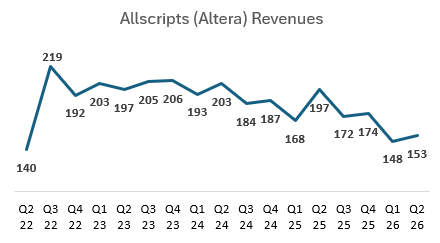
Remember that CSU is about achieving high IRR. Again, they don’t prioritize organic growth, IRR depends on speed of cash inflow — basically time value of money.
Altera was acquired in May 2022 for $670m, financed by $335m of non-recourse debt and cash $335m. LTM Altera produced $104m of free cashflow (FCF), and over its lifetime under CSU it has generated $400m. It already paid off the cash outlay!
To exceed 15% IRR in 10 years, Altera can afford to perform badly because significant FCF came in early:
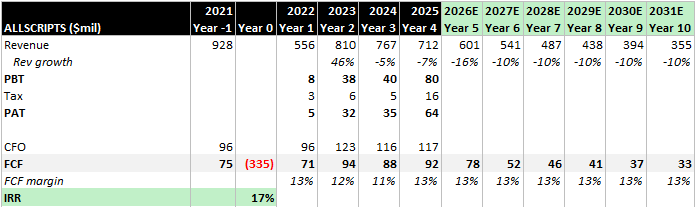
Despite being a declining asset, the IRR for Altera is on track to pass the hurdle rate.
Moving to the AI hot-topic, management’s message was consistent, practical, and candid. Rather than positioning AI as a risk/opportunity, Mark Miller simply stayed true to the decentralized nature of CSU:
You can build products fast, but selling them is a whole other thing. In most cases, we are using a blowtorch to light a cigarette. […]
What we are not doing is running an AI program out of head office. Our business unit managers understand their verticals far better than we do, and they are making those calls themselves at their own pace, funded out of their own P&Ls. We are not going to give you an AI target, an AI revenue line, or an AI timeline. If we start reporting numbers like that, we will start managing to it.
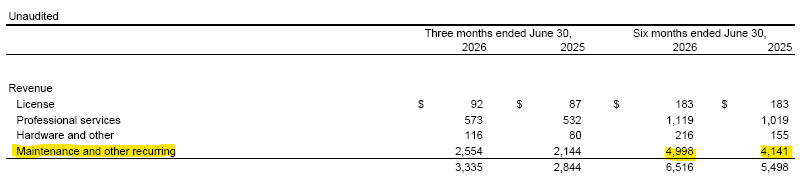
So, AI is indeed very powerful today, but it actually means little for CSU’s customers. These are small businesses who care more about consistency than new features. Creating incredible software was never the business model, but solving customers’ problems is the reason why maintenance recurring segment is 77% of total revenues and grew +20% YOY:
The finance team has created a new account code to track AI expenses. It’s a small operational detail that shows management wants to get visibility on their expenses.
Because of how CSU incentives focus on IRR they won't aggressively innovate, unless they have confidence that a new feature can sell. CSU typically waits for their customers to request something before building it.
In this context it makes sense why AI doesn't have much of an impact yet, as most small businesses with limited budgets wouldn’t know what to request from AI.
Capital Allocation
An important point from the earnings call was that hurdle rates are unchanged. On the back of that assurance, we are seeing higher pace of capital deployment.
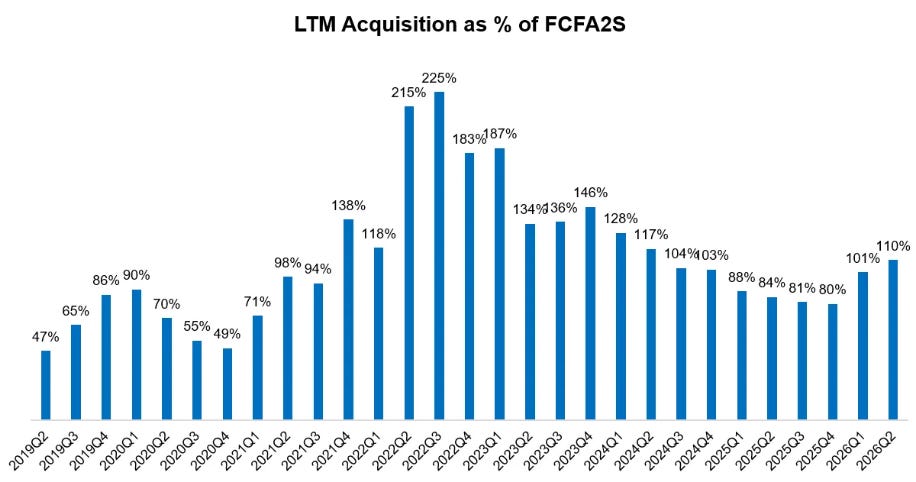
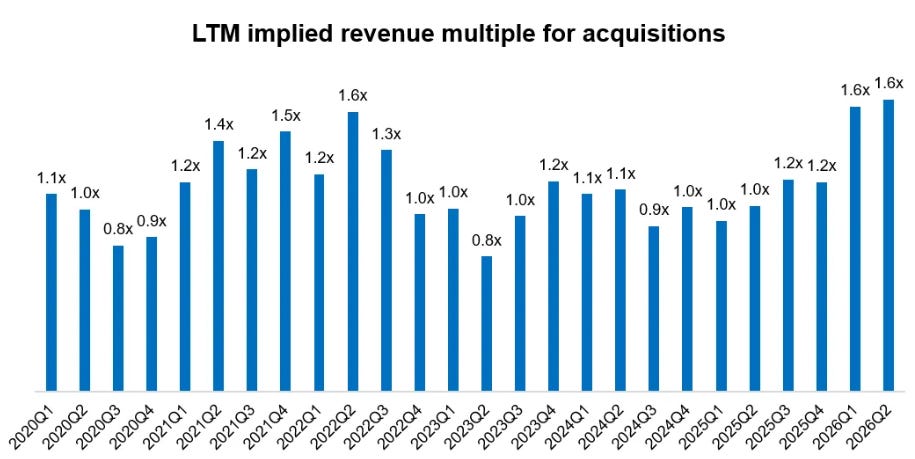
We are also seeing higher prices paid, particularly 4x revenues for DerbySoft (travel tech & digital marketing company). This is much higher than the typical 1—1.5x revenues multiple.
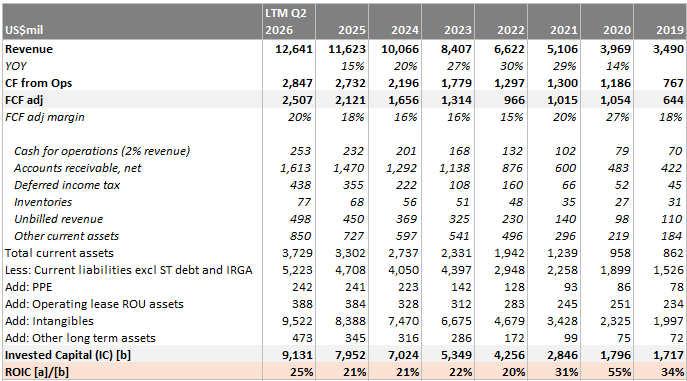
We should check the ROIC. It is very encouraging to know that the invested capital base grew from $2.8b to $9.1b in the last 5 years, yet ROIC is still comfortably above 20%.
Adjusted FCF of $2.5b is a record high growing +20% YOY with 20% margins:
On private market software valuations, CIO Bernie Anzarouth reminded us that prices are still not matching public software companies:
I think the competition is still very robust. No one is giving up on vertical software, whether it is large or small. We are seeing some weaknesses at the high end in pricing, but it is still very competitive. So it is not like we are increasing our win rates or anything like that. It is same old, try to get as much as we can.
He also noted that the wave of private equity roll-ups funds that emerged 5 to 10 years ago are starting to reach end-of-lifecycle, and CSU expects to eventually absorb some of those portfolios as sponsors exit.
Overall, we think it was a good earnings report. At current market cap of US$47b, the starting FCF yield looks good at 5.3%, so we are maintaining our ~10% allocation at $2788/share (click here for more valuation details).
Details on Lumine
We want to shine some light on the +1% organic growth of Lumine, let’s look at the revenues breakdown:
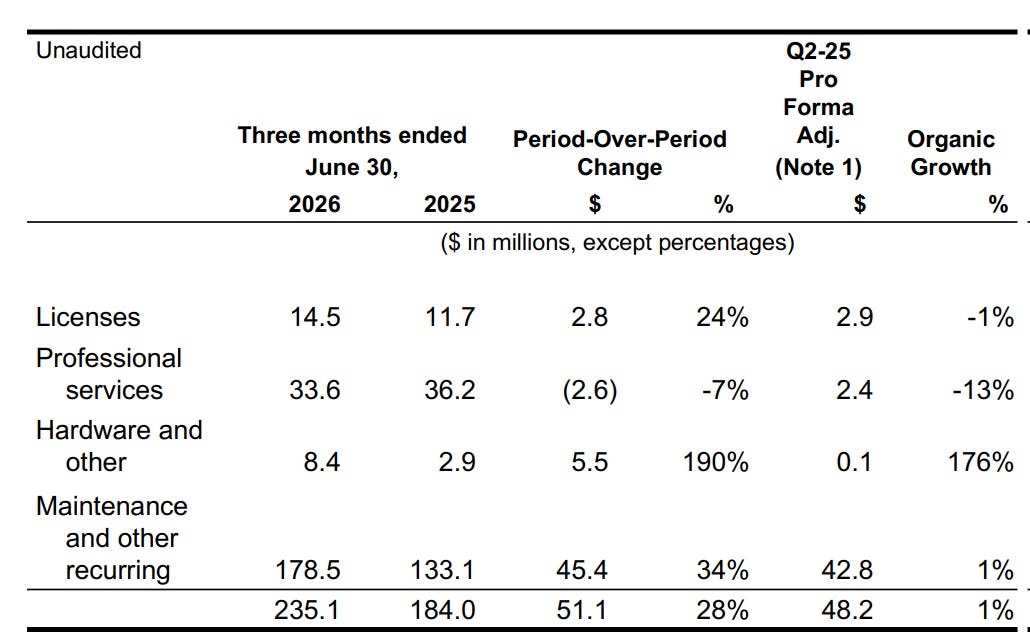
Maintenance and recurring segment is the bulk of total revenues. Great news, growth was +34% YOY. This is high margins, high scale type of sales.
Professional services fell -7% which is actually also good news. Because this segment involves low margins, low scale consulting work.
We should think quality over quantity!
Lumine’s playbook is to buy carve-outs, make operating improvements, and reap the margins expansion. Then, use the resulting cashflows to reinvest into more acquisitions.
A good example is the recent Synchronoss acquisition. In Q1, margins compressed as Lumine took on a bloated cost structure from Synchronoss. This caused general and admin (G&A) costs to increase +95% YOY.
What happened in Q2?
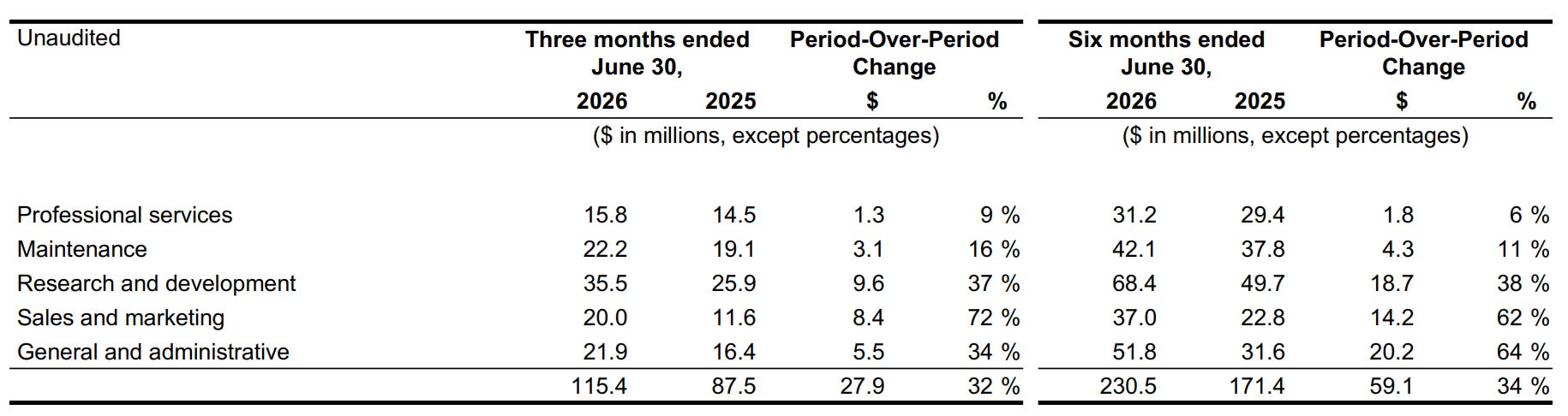
G&A costs only increased +34%, this is a good sign that Lumine is doing well in cost restructuring.
Capital deployment is also very high:
Synchronoss $309m
Imagine Communications $136.8m
Quortex $96.8m
That’s a total $543m deployed so far. Compare it to Lumine’s market cap of $4.9b and you start to see the potential future returns.
To fund #2/3 deals, Lumine used $110m on its corporate credit facility, leaving $220m drawn against $360m total capacity. That still leaves $140m for further acquisitions for the rest of this year.
Due to the additional debt, FCF decreased -17% YOY to $60.4m. Interest paid increased to $4.2m from $3.9m, and transaction costs on debt (essentially zero in the prior year) hit $1.9m this quarter.
Working capital absorbed $20.3m, driven primarily by $8.4m decrease in payables.
We should check that these costs eventually normalize as acquired businesses start to return cash.
Historically, FX-neutral organic growth decreases after acquisitions, then recovers with 2 to 3 quarters.
WideOrbit (Q1 2023)
Motive and Axyom.Core (2024)
Synchronoss (Q1 2026)
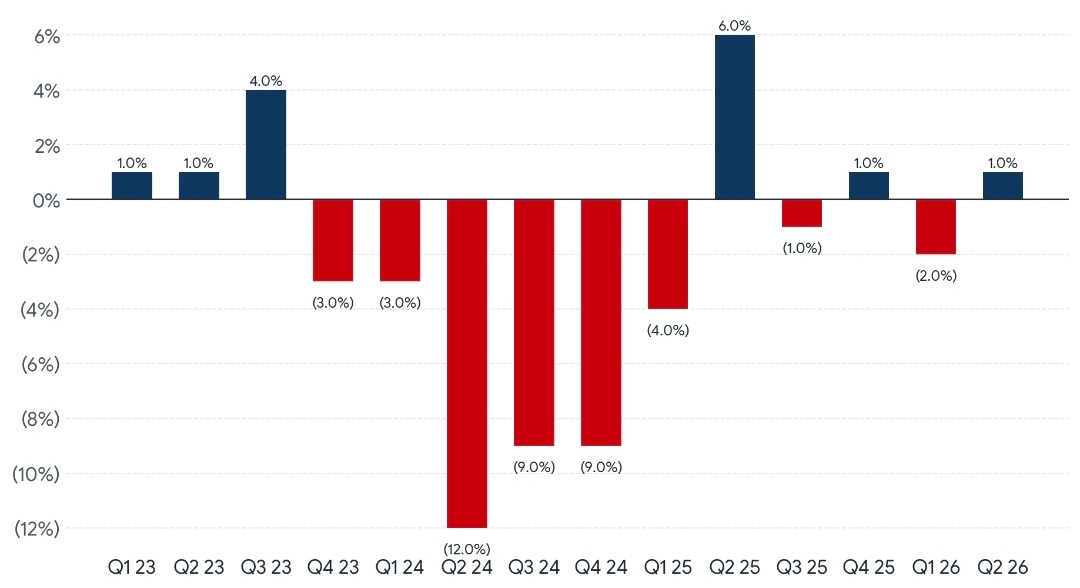
Of course, being a spin-off from CSU, the strategy is similar — prioritize IRR on cash deployed. If Lumine continues to do carve-outs at this pace, organic growth will remain perpetually depressed.
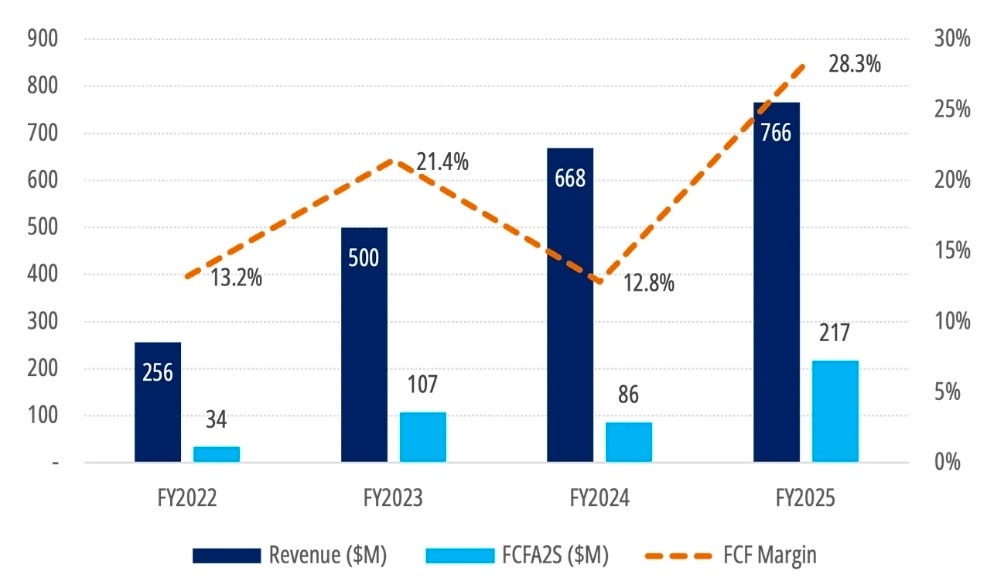
This is not a concern if ROIC is high. So far, the results are very encouraging:
This company looks like a boring business with low margins. But once I finished reading your articles from the beginning, I felt so excited that I met a solid compounding opportunity.
Great post thanks for sharing!
2 questions,
How is (a) calculated in your ROIC calculation? If I assume its adj FCF 2507/9131 = 27.46%
In your ROIC calculation, whats the assumption behind the 2% of revenue cash from operations?
Thanks.