
Study: Pachinko
History
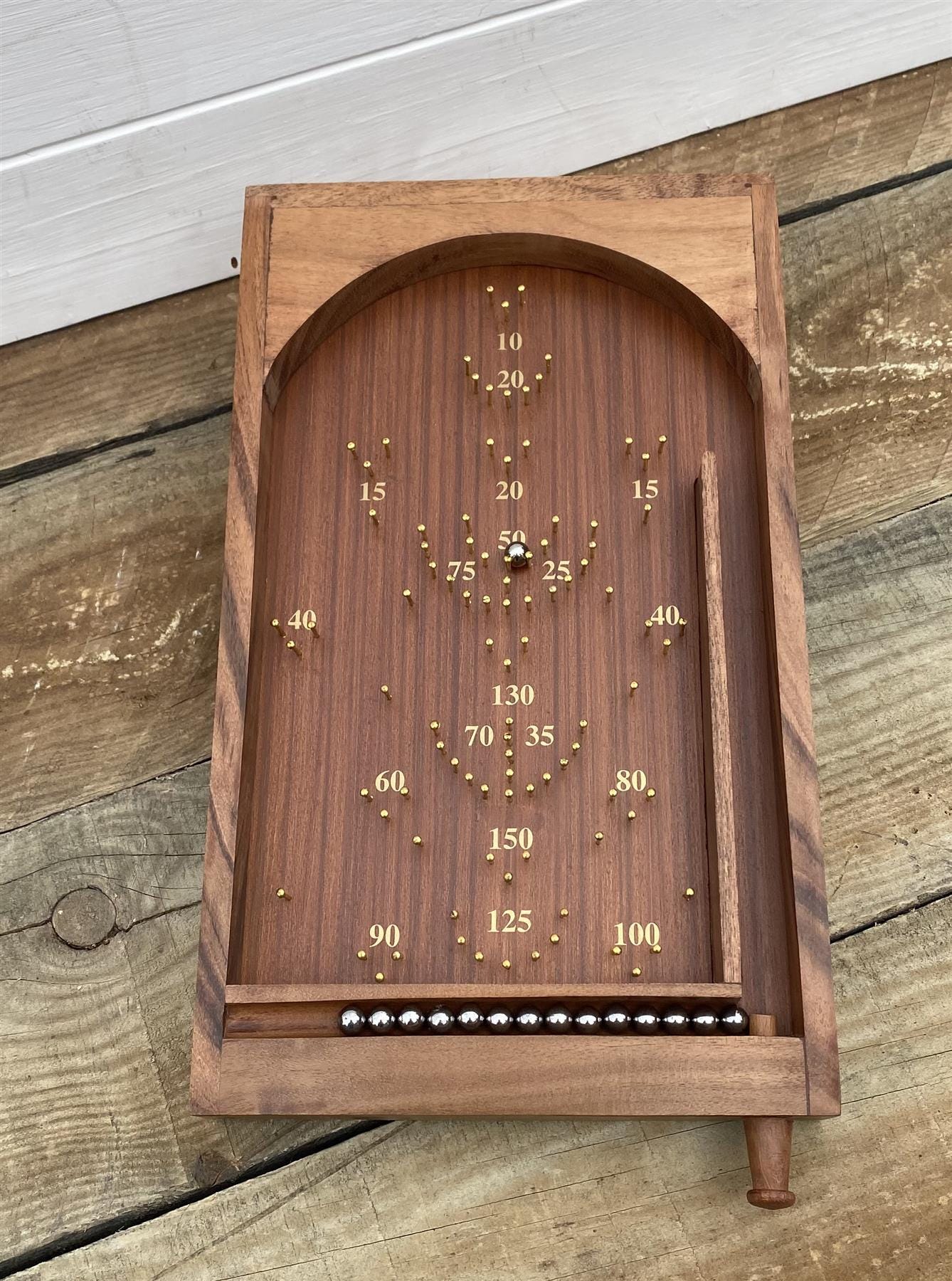
There are different stories about the origin of the modern Pachinko. It is believed to have originated from the game machines imported from Europe and America, such as the Corinth and Bagatelle, between 1912 and 1926:
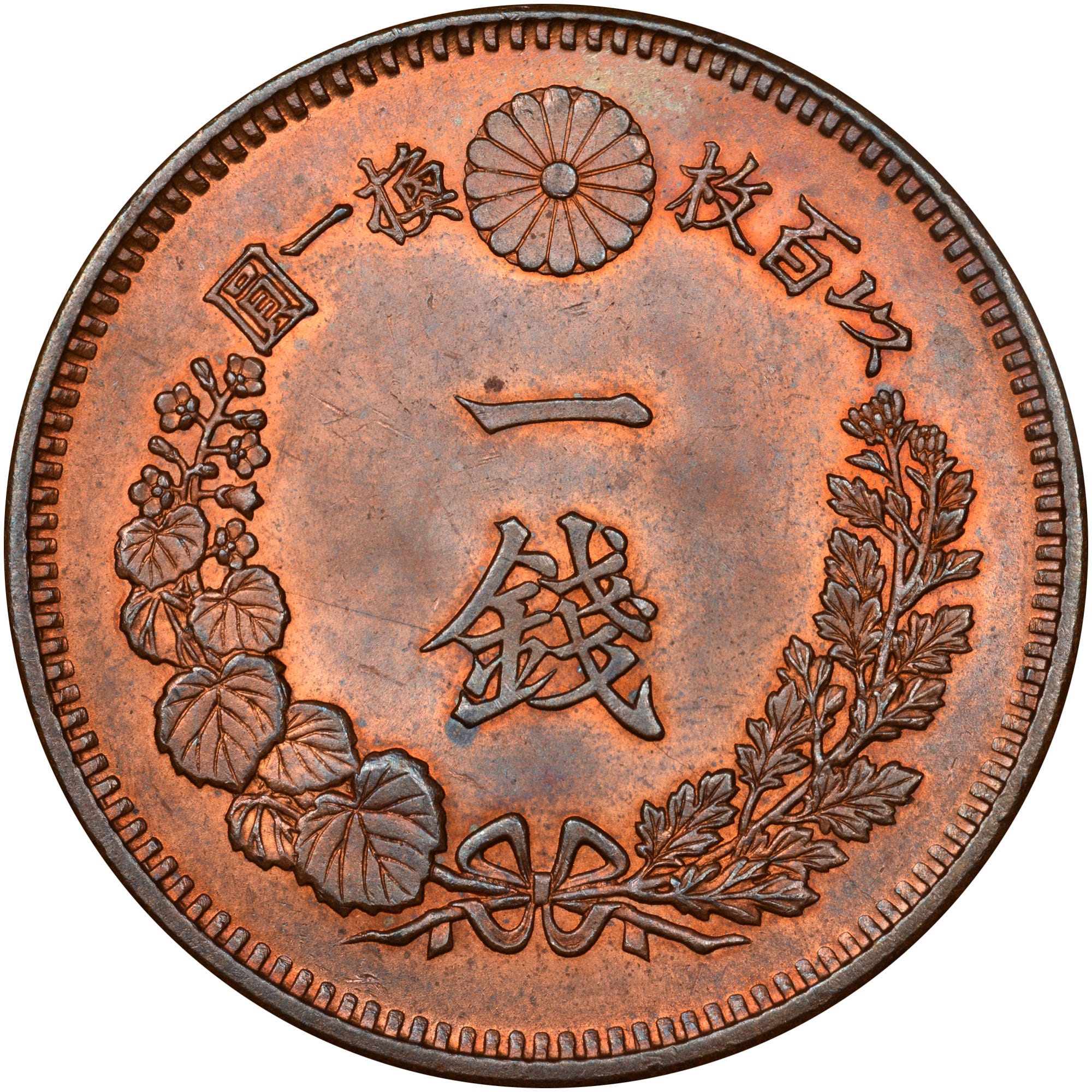
Originally, such game machines were traded by stall keepers. They started business using them at ennichi (縁日), a special day related with some Japanese deity. Beginning in the mid 1920s, game machines on which the player flipped 1-sen copper coins became popular. The Japanese government banned such games because flipping the coins with the Chrysanthemum Throne engraved on them would insult the Imperial Family.
So the common practice became using tokens or balls. To attract the working adult population, game prizes changed from candies to cigarettes. However, after the Pacific War, there was a shortage of metal, even temple bells and household pots were offered to the war effort. As a result, Pachinko balls were also sacrificed and the industry was regarded as useless.
Post WW2, between 1945 and 1954, Takeichi Masamura who is even now revered as the “god of Pachinko” developed a pin arrangement called the Masamura Gauge. This would become the basis of the modern Pachinko board.
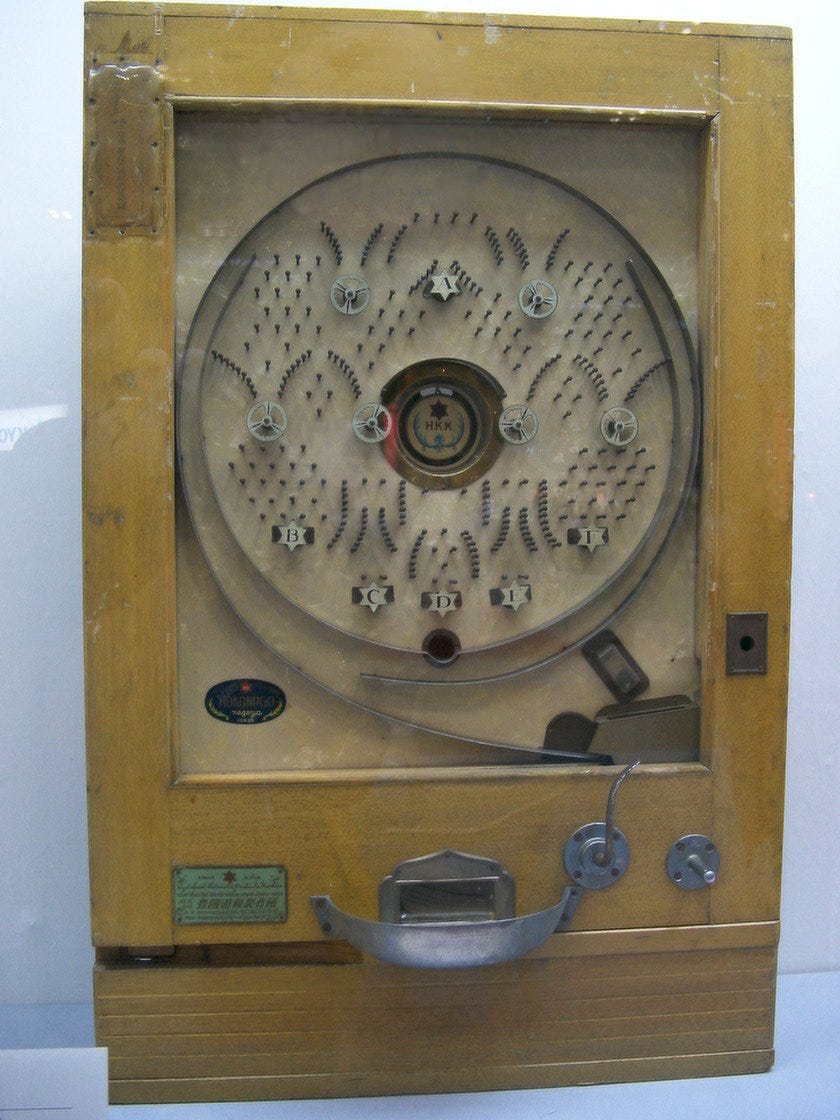
The Masamura Gauge transforms the old-fashioned monotonous Pachinko machine, which was designed to make balls simply cascade between pins, into a thrilling and surprising game machine, contributing to the first Pachinko Boom.
During the early 1950s, the renpatsu-shiki (連発式, successive shot) pachinko machine which sent balls automatically from the ball tray was developed. It succeeded the tanpatsu-shiki (単発式, single shot) pachinko machine. At that time, it was possible to shoot 140 to 160 balls per minute, making Pachinko even more popular. At the peak, more than 45,000 Pachinko parlors operated in Japan.
Renpatsu-shiki excited the gambling spirit which led to the rise of unauthorized dealers and gambling addictions. Public criticisms rose and the government imposed a ban on renpatsu-shiki in 1954. In 1955, Pachinko parlors were forced to use single shots, as a result Pachinko parlors declined to below 10,000.
As time went by, technological advances improved the cost structure of the Pachinko industry. Cars were also getting widespread in the mid 1960s and more suburban Pachinko parlors became possible. Electronic devices such as motor-operated handles for shooting balls and electronic circuit boards were introduced.
Despite these efforts, for more than 20 years, the number of Pachinko parlors had remained flat after the renpatsu-shiki ban.
In 1980, Fever Pachinko machines were launched, “Fever” referred to the jackpot. Players used a knob to control ball speed, aiming for a hole that triggers a digital slot machine on an LCD screen. When the “Fever” mode was activated, the machine increases the odds of winning subsequent jackpots.
This brought back the gambling spirits and during this period the Japanese economy was booming in a real estate bubble. Pachinko parlors increased by hundreds a year, creating another boom.
Today there are mainly 2 types of machines:
Metal ball: Launch a metal ball aiming to land inside a small hole that activates the jackpot function.
Pachislot: Uses digital toke s instead of physical balls.
Like most casinos, players use cash in exchange for balls/tokens. Credits are loaded into a prepaid card and when players are done, they are given a prepaid card that stores unused balances and winnings.
For unused balances, they can immediately get cash refund on the same day. For winnings, they can exchange for prizes.
Since gambling is illegal in Japan, Pachinko operates in this legal loophole where players exchange winnings for prizes. These prizes can be consumer goods, but most people want cash. However, they can’t just give out cash, so players are given mini gold/silver slabs which they take to a store outside to exchange for cash. These exchange stores are usually just outside of the parlor.
Types of Companies
Prepaid Card Systems
There are 4 main prepaid card system providers listed in Japan:
Gamecard Holdings (PE 8x)
Mars Group Holdings (PE 8x)
Glory Ltd (PE 20x)
Daikoku Denki (PE 6x)
When players win a lot of money, they receive a lot of metal balls to move around. Usually people will request assistance from a staff. Companies like Gamecard make the prepaid card systems attached to smart Pachinko machines. It makes the game less labour intensive and makes switching machines much easier for players. The current trend is for more smart machines and its a positive for card system companies.
Favourable economics include high margins recurring fees and high switching costs.
Machine Producers
Pachinko machine makers are much larger than card makers. These are the main listed producers:
Sega Sammy (PE 31x)
Sankyo (PE 8x)
Heiwa (PE 15x)
Tsuburaya Fields (PE 5x)
Universal Entertainment (loss making)
There are also many private producers that compete in this space. The market share of any producer swings from year to year depending on whose title releases are popular. Therefore, Pachinko machine makers compete on intangibles such as IP, entertainment value and nostalgia. For example, Sega Sammy is known for Hokuto No Ken. Sankyo and Tsuburaya Fields are known for Evangelion.
Look at the wild swings in machine utilization of Sega Sammy depending on popularity of its IP:

Some machine producers own the IP while some are licensed. The very popular IP tends to stick to certain producers if they had previous successes. When a popular IP is released, Japanese will flock to the new machines to try it out.
Parlors
Most Pachinko parlors are privately owned. There are only 2 publicly traded parlors:
Dynam Japan Holdings (PE 10x)
Niraku GC Holdings (PE 6x)
From 2009 — 2023, the number of Pachinko parlors decreased from 12652 to 7083, but the average number of machines per store increased from 356 to 484.
This can be explained by the trend of declining “101-300 machines”, offset by the increase in “501-1000 machines”:
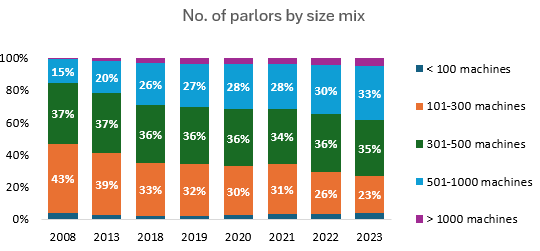
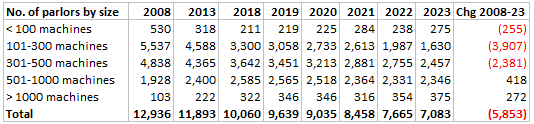
The resilient mix of very small and very large parlors shows 2 interesting economics:
Very small parlors (<100 machines) win by convenience. They are small and can be located in very niche areas.
Very large parlors (>501 machines) win by optionality. When popular IP comes, they can replace a small fraction of total machines creating a reason for players to visit. More machines means more variety; anyone who has gambled before knows that people migrate between machines for “luck change”.
Mid-scale parlors are stuck in a unfavourable position in terms of convenience and optionality. To replace 30 machines from 300 machines is risking 10% inventory — very different economics from a store with 1000 machines (3% inventory risk). When they do make a concentrated bet on a new IP and it flops, it can have a major impact as the investment is a large % of machine inventory.
Of course, very large parlors have economies of scale compared to very small parlors.
In summary, the mid-sized parlors are being out-competed due to poor business economics.
Declining Opportunities
The entire Pachinko industry is in decline. In 2023, Pachinko machines in Japan generated revenues of JPY8.2t, while Pachislot had JPY7.5t. The total revenues of JPY15.7t was less than half the level from 20 years ago.
The industry has tried to attract young players with “Smart Pachislot” released in 2022. It circulates balls within the machine without the need for players to touch the machine.
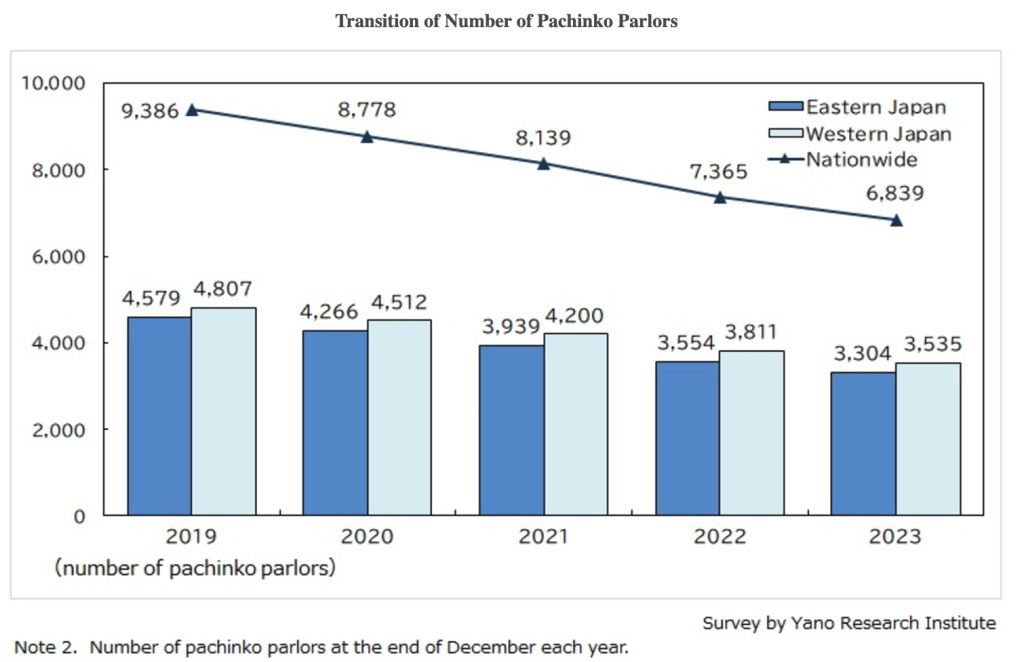
Estimates point to a decline in the number of Pachinko parlors to 5900 by year 2028:
So where is the opportunity?
Despite Pachinko being in a state of decline, the margins are still predictable. Industry-wide operating margins are above 10% in normal years and over 20% in great years.
A good year can be caused by things like the issuance of new Japanese banknotes in 2024 which required hard/software sales to support them. Once the upgrades are complete, the margins will drop back down to normal levels.
We think that Pachinko businesses will remain cash flow positive for many years due to Pachinko being the only “legal” mode of gambling in Japan, before Osaka’s integrated casino resort opens in 2030.
If this is true, then opportunities are in capital allocation; take the cash generative Pachinko business and reinvest into other non-related areas.
For example, Heiwa makes Pachinko machines but they have also took the cash flows and invested into golf courses. Heiwa, through its subsidiary Pacific Golf Management, has acquired many golf courses in Japan and actually owns the most number of golf courses in the world by a single company. It holds ~14% of all golf courses in Japan.
Heiwa’s Pachinko dependable cash flows help to pay the debt used for golf course acquisitions.
Japan’s Experiment: Osaka Integrated Casino Resort
Japan is set to launch its very first integrated casino and resort in Osaka in 2030. Japanese citizen must pay JPY6000 to enter, while foreigners can enter for free. This model is similar to MBS in Singapore.
If the Osaka casino turns out to be a success without increasing Japan’s gambling problem, it can be a boon for the Pachinko industry since a relaxation of gambling rules would directly revitalize Pachinko.
Consider that Pachinko players must play for hours just to win a few thousand JPY. This doesn’t attract gamblers with deep pockets. The system is designed to prevent addictions and large financial losses.
The other way this could turn is that Japan only allows foreigners to gamble in Osaka’s casino, a similar model in South Korea where citizens cannot enter local casinos. There’s a decent chance of this happening because no politician would suggest they are supportive of casinos being built.