
Study: Global Distribution Services
Preface
Constellation Software (CSU) in their recent Q4 2025 results and announced a 9.7% stake in SABRE.
SABRE is a publicly traded vertical market software (VMS) company in the Global Distribution Services (GDS) industry.
For those uninitiated, it’s hard to guess what is GDS. So, let’s explore the economics of this industry together…
Lazy Susan
In the 1950s, the way people booked flights with airlines was through a labour intensive reservation system where agents sat around large rotating tables filled with index cards representing flight seats. This rotating table was called “Lazy Susan” and each booking took up to 90 minutes to complete!
It had that name because the rotating tray for food, those used in chinese restaurants to turn dishes around, are called Lazy Susan.
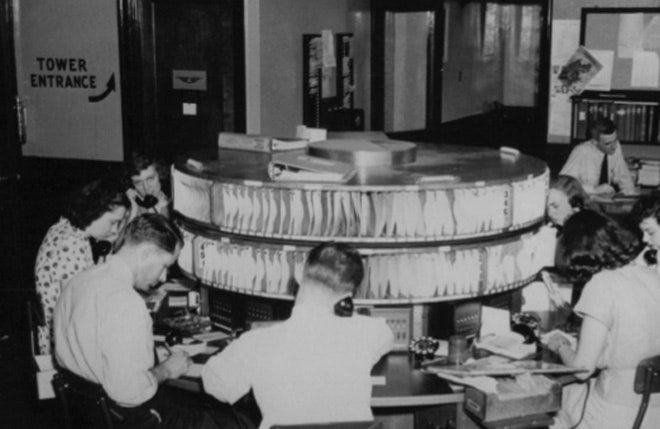
Airlines used to employ operators to do this job, sitting around circular tables with index cards. To book a seat, an operator would find the flight’s index card and mark it to indicate the booked seat, and write the flight ticket out by hand.
This slow workflow was a bottleneck when air travel became popular. To solve this issue, American Airlines had developed a computerized booking system in 1952, it allowed many people to look up flight information simultaneously but still required operators to manually do ticketing and talk to travel agents over the phone.
Enter IBM
WW2 saw the invention of the nuclear bomb by the US, but it wouldn’t take long until the Soviet Union got their hands on their own atomic bomb in 1949. This event triggered the world’s largest computer project to monitor North America’s airspace called SAGE (Semi-Automatic Ground Environment).
A few corporations were involved and IBM took on the hardware development and manufacturing. This project gave IBM a lot of money; between 1952 and 1955, 80% of IBM’s computing revenues came from SAGE. The system also spun off several technological innovations, one of them is the automatic flight reservation system.

In 1953, R. Blair Smith, an IBM salesman, and C. R. Smith, the president of American Airlines, were randomly seated next to each other on a flight. Their chance encounter would spark a dramatic change. A conversation that began with discovering their common surname would lead to the invention of the world’s first centralized airline reservation system.
After 7 years, they established SABRE (Semi-Automated Business Research Environment).
At that time, it was the largest real-time data processing system outside of the government, and was the first electronic system that processed millions of dollars per day. The whole project cost $40m.
Remember that all these took place before the Internet!
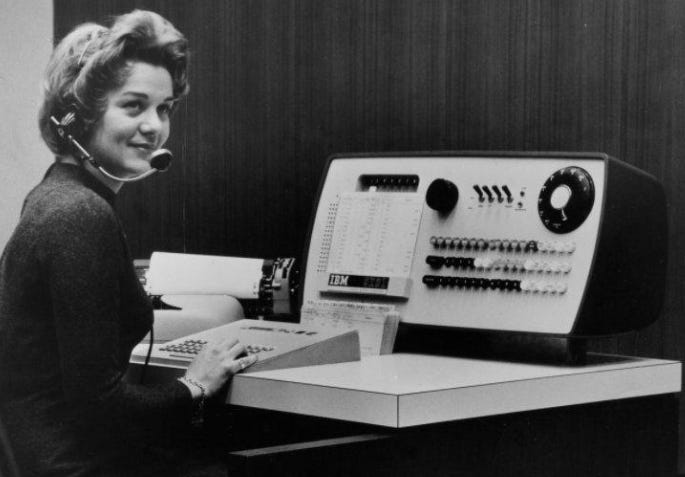
SABRE was a revolution. It reduced the booking time from 90 minutes to seconds, giving American Airlines a huge advantage. Other airlines jumped onboard and set up their own computer reservation systems (CRS).
Global Distribution Services (GDS)
After the invention of CRS, travel agents became the bottleneck.
Even though airlines could quickly do a booking, travel agents still took a long time to find the best deals for travellers. CRS providers then developed systems for travel agents for them to search flights from multiple airlines. This removed the need for phone calls.
The whole ecosystem was termed as Global Distribution Services (GDS).
Eventually, agents could use any GDS to book flights on any airlines. This led to intensified competition, because even though American Airlines owned SABRE, the system could be used to book another competitor’s ticket.
In effect, GDS became the two-sided network between demand (agents) and supply (airlines). This was powerful because the business model was relatively capital light and charged a fee from both sides of the network. Airlines is a volume game and nobody had any incentives to opt out of GDS network.
Today, you can think of GDS as a vertical market software (VMS). Three companies dominate this market:
SABRE (30—35% market share).
Amadeus (40% market share).
Travelport (22% market share).
GDS Syntax
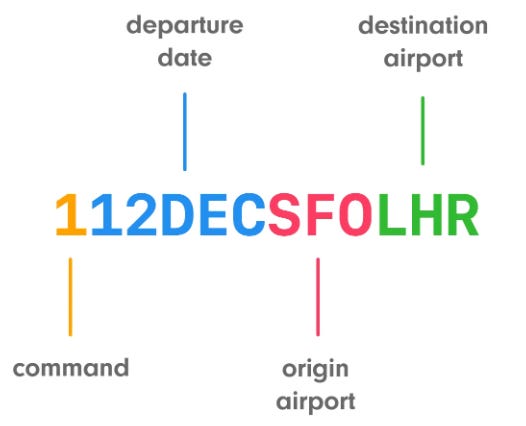
The GDS syntax is a command line that looks very antiquated:
The system will return something like this:
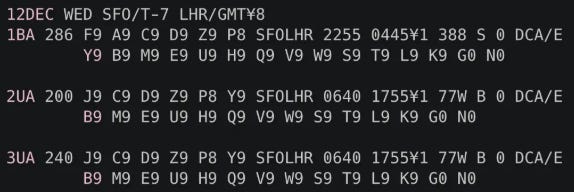
The first line summarises the search parameters:
12DEC WED: Departure date.SFO/T-7: The origin airport,SFO, which is in theT(Tango) time zone (GMT -7).LHR/GMT¥8: The arrival airport,LHR, which is 8 hours ahead of origin.
The remaining sections (2 lines each) show the available flights matching these parameters:
BA 286: The airline code and flight number (BA= British Airways).C9 D9 Z9 P8 …: The fare classes and the number of remaining seats on each,C9means there are at least 9 seats in fare classC.SFOLHR: The city pair (SFO= origin airport,LHR= arrival airport).2255 0445¥1: Departure and arrival time (depart2255; arrive0455+1 day).388: Equipment type (388= Airbus 380-800).S: Meal type (another command has to be run to decode this into one of the official IATA meal codes).0: Number of stops (0= direct flight).DCA/E: Airline’s level of connectivity with SABRE.
Seat Pricing
Since the GDS share information between demand and supply, it can be used to price flight seats too. Airlines want to charge the maximum of what each customer is willing to pay, but everyone has different reasons why they are flying and so selective pricing is needed.
The solution is to have seats at many different price points. You are familiar with the 3 types of seats that airlines advertise: First Class, Business Class, Economy.
But did you know that each of these is further broken down into multiple fare classes?
The fare class is what actually determines a seat’s price. It also determines factors like whether you can cancel or change your booking, and how many air miles you can earn.
A single flight might have 50 different Economy fare classes, with a price variance of over 10x between the highest and lowest. Each fare class has a limited number of seats. If you book early, you might get the cheap price in the lowest class. But book too late and you pay a high price for essentially the same seat.
Economics of GDS
The GDS business has high regulatory barriers, companies cannot simply enter the industry. Only travel agencies that are accredited by IATA can use GDS, and agencies face hefty fines if they make any errors using GDS.
Airlines can issue Agency Debit Memos (ADM) which are formal notices ranging from fare calculation errors to booking malpractices.
To prevent fines, OTAs (Expedia, Booking, Trip…) communicate with GDS using automated processes, which reduce their ADM fines related to human error.
The airlines business has thin margins and face high operating costs, so ADM fines are one way airlines recover some expenses. These fines are not insignificant. For example, Vietnam and Xiamen Airlines impose penalties like:
US$200 per passenger for booking in different GDS.
US$10 to US$15 per passenger for repeated cancellation/rebooking.
US$350 per passenger for availability breaches.
In the early days, GDS systems generated a lot of money for airlines. They provided a whole new distribution channel for flights, giving airlines a way to reach customers without directly marketing to them.
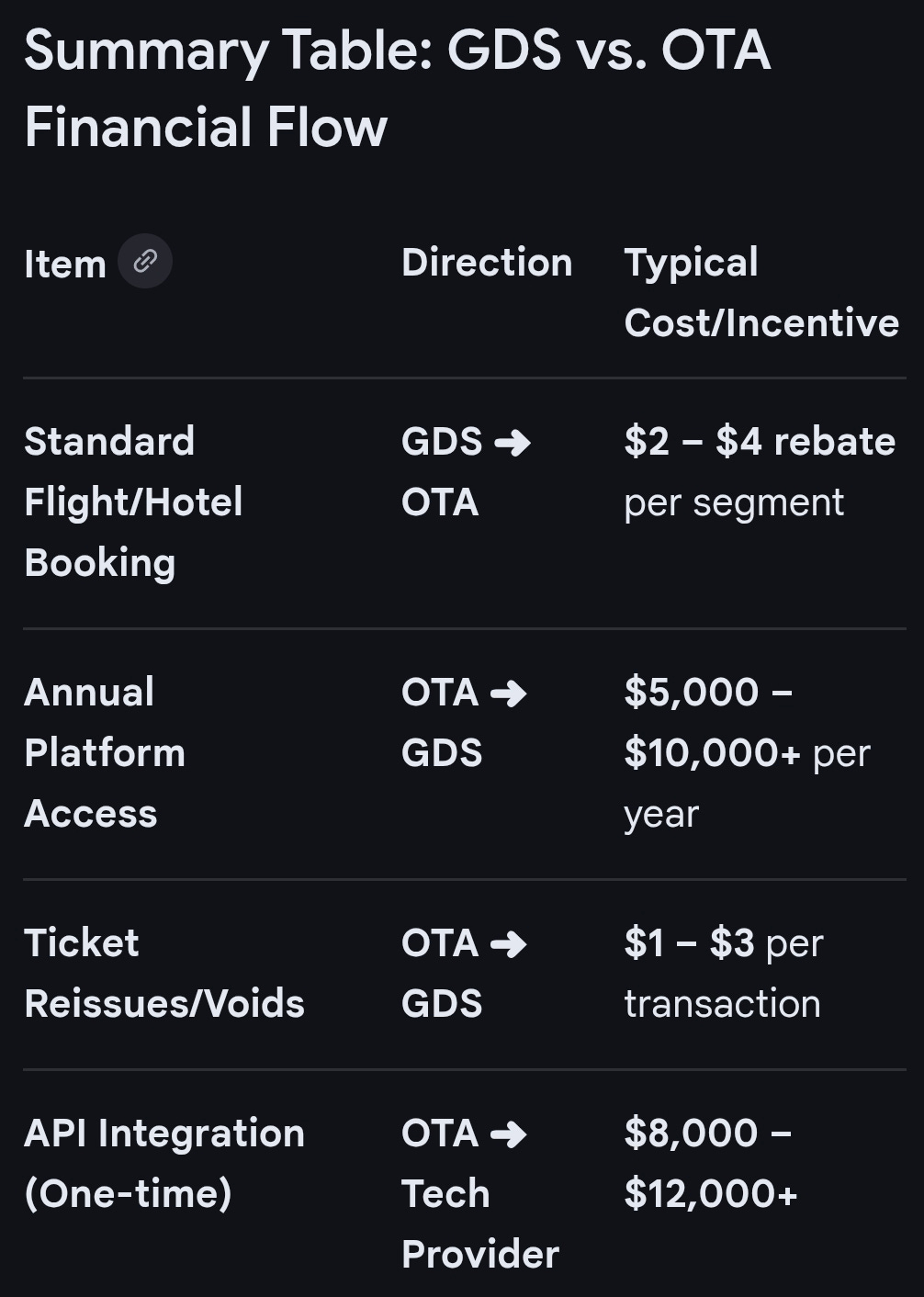
Airlines typically pay GDS fee ranging from $3 to $15 per booking. In a year this can rack up to billions of dollars.
OTAs pay depending on type of transaction:
As air travel became cheaper, airlines had to find new revenue streams like seat upgrades, priority boarding, and wifi. However, GDS is slow to change, their data format is the same since the 1960s and can’t support the custom content airlines want.
So many airlines went to create their own systems and direct marketing to reduce GDS reliance. Examples:
2015: Lufthansa implemented a €16 charge for bookings made via GDS rather than going directly to its website.
2017: Ryanair ended its GDS partnership with Amadeus.
2024: Frontier (low cost carrier) exited GDS with SABRE.
2024: Turkish Airlines exited GDS with SABRE.
Disruption to GDS
A fragmented airline industry where individual airlines run their own systems is never efficient. To keep up with demands, a new data standard called NDC (New Distribution Capability) was introduced in 2012.
Based on XML (Extensible Markup Language), NDC is much more flexible to support the customization that airlines need. This lets them sell flight add-ons with GDS bookings, and also show rich content (text, photos, videos) to customers.
Since XML is the standard format for internet communication, this makes it easier to build new applications too.
SABRE and Amadeus have both updated their systems to support NDC. They are still the middleware that enable agents and airlines to connect via NDC API.
SABRE provides access to NDC content from over 40 leading airlines through SabreMosaic. Their value proposition is simple and effective: SABRE handles technical integrations, NDC schema upgrades, and ongoing maintenance so airlines can focus on their core operations.
Lessons
Like any good VMS business, GDS/NDC is capital light, very sticky, mission critical, and hard to displace.
Airlines can’t ignore it because volume is the main driver of profitability — this economic reality will not change as long as air flight is commoditized.
Travel agencies can’t ignore it too, because the more content they can provide, the more transactions go through their platforms.
The original GDS existed more than 40 years before NDC came in 2012. But GDS switching cost is so high that until today, 14 years later, NDC hasn’t replaced GDS yet! In fact, the IATA monitors the adoption count, as of now only 82 airlines have NDC capabilities (IATA has 370 airlines members).
This NDC development is an important lesson when thinking about the AI disruption narrative in VMS world.
We have always said in VMS: Even if you can create a cheaper and better software, it doesn’t gaurantee that people will use it.
Transitioning from one standard to another comes with technology challenges to navigate.
The primary challenge is developing extensive legacy systems. Many travel management companies and booking tools, as well as the airlines themselves, are designed to work with GDS standards. These must be modified to accommodate the more modern NDC standard, which involves integrating APIs and ensuring all associated systems are compatible.
The second challenge is collaboration. For NDC to become standard across the full travel industry, stakeholders must adapt together. This requires collaboration between distribution partners, technology companies, regulatory bodies, and airlines. After it’s implemented, employees have to be trained on NDC.
"We have always said in VMS: Even if you can create a cheaper and better software, it doesn’t gaurantee that people will use it."
The SABRE-NDC duo seems to be a living example right in front of our eyes that a newer and shinier product doesn't always mean successful rapid substitution of the incumbent.