Study: Features of Amazon's Distribution Network
Inbound Cross Docks (IXD)
The first facility in Amazon’s distribution network is the IXD. They are the first point of contact with physical goods, so they are built close to ports and rail yards. Goods coming in for distribution come in different forms, and the purpose of IXD is to prepare items for the Fulfillment Centers (FC).
For FC to be highly efficient, they must not have inventory stacked up for more than 1 week. That’s where IXD play a sorting role such that the FC are not overwhelmed. These IXD employ between 2,000 to 2,500 workers.
The idea of “cross-docking” was pioneered by Walmart where bay doors are on both sides of the facility: container loads come in from one side, then goes into trucks on the other side. Thus, traditional IXD were not intended to be holding facilities.
National IXD (NIXD)
However, in 2024, Amazon reinvented its inbound network with the creation of National IXD (or NIXD). These are buildings which are much larger (1 million sq feet) compared to an average IXD (600k sq feet). These NIXD now precede the IXD, able to hold more goods while feeding the existing IXD network.
Amazon does this because of their efforts to become an end-to-end logistic service for its vendors. This was communicated in 2023 when they launched Supply Chain by Amazon. This means that smaller foreign vendors can compete more directly in the US through Amazon’s logistics.
Also, in an effort to cut down on shipping costs, Amazon has a regionalization plan which breaks up America into 8 regions. They aim to have as many orders fulfilled as possible within any given region, cutting down on the distance a package needs to travel and more specifically reduce its air cargo volume which is the most expensive way to deliver.
Before NIXD, a vendor might ship goods to a IXD, and then it would go to a nearby FC. If the goods happen to be on the other side of the country, then it would mean inefficient logistics. Putting NIXD in front of the process, it can parse incoming goods among the 8 regions and move goods in full truckloads to the relevant IXD, rather than deal with long range fulfillment.
The NIXD have accounted for the most amount of acreage growth in Amazon’s distribution network. In 2024, they added 21 NIXD out of total of 99 facilities, in terms of area it was ~23 million out of total 35 million sq feet.
The LA and Long Beach area are very important ports, they got 8 IXD out of 54 country-wide IXD, and 4 NIXD nearby. About 40% of all container imports in the US flow through these ports.
Fulfillment Centers (FC)
Sortable FC (SFC)
The SFC handle anything below certain dimensional and weight limits (~20 pounds). As long as the package is conveyable and processable, Amazon will send it to a SFC. The current development is to make all SFC into Amazon Robotics Sortable (ARS) FC. This is the incredible robotics advancement that Amazon did with Kiva Systems, which they acquired in 2012 for $775m.
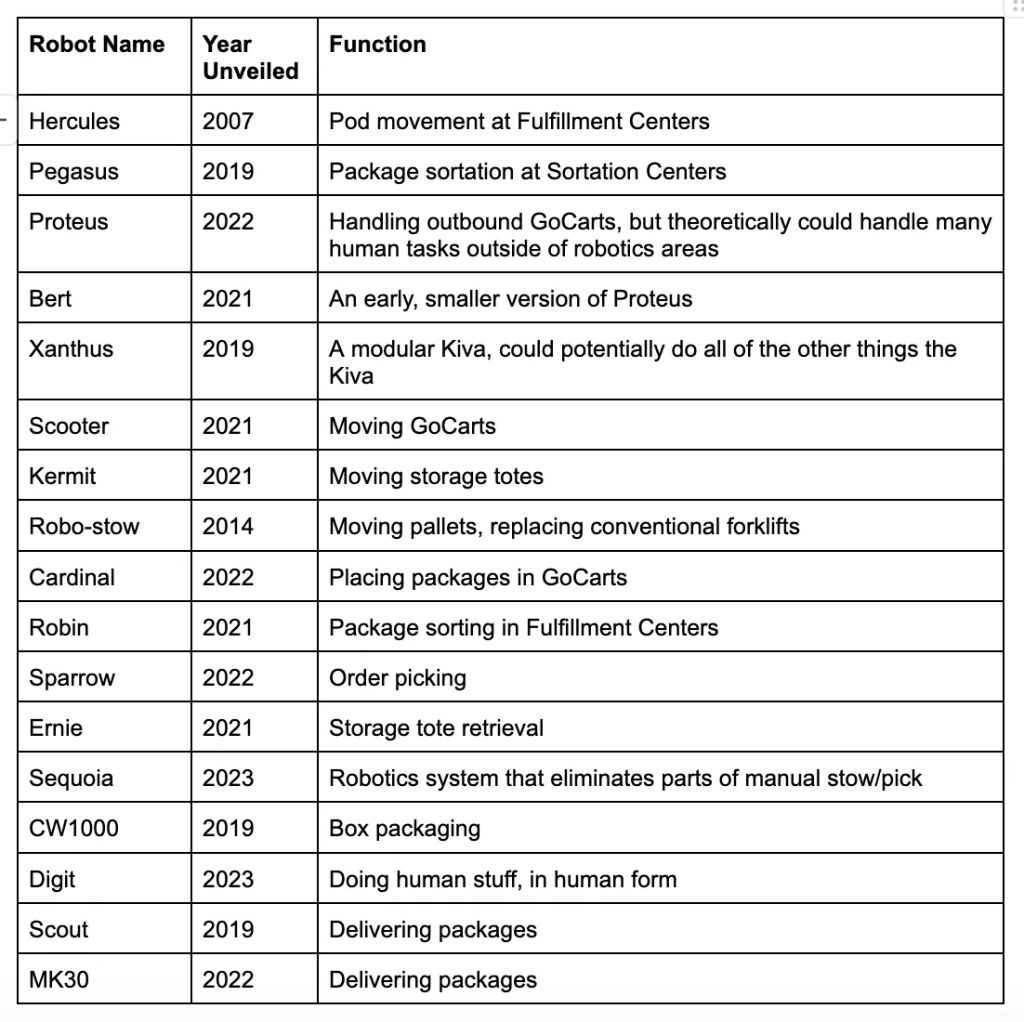
The Hercules robot can move stacks of inventory weighing up to 2,000 pounds and it recognizes its position by moving on the floor with QR codes. In a traditional warehouse, people keep all the same family of items together for easy retrieval, but at ARS FC new inventory is placed randomly in the stacks carried by Hercules because when items are spread throughout the stacks, the nearest robot can quickly grab the item when someone orders. This has made randomized storage very efficient and it is something that was barely imaginable just a decade ago.
Hercules saves workers a lot of time from having to walk and look for items in a particular order. As a results, there is significant productivity improvements after introducing robotics.
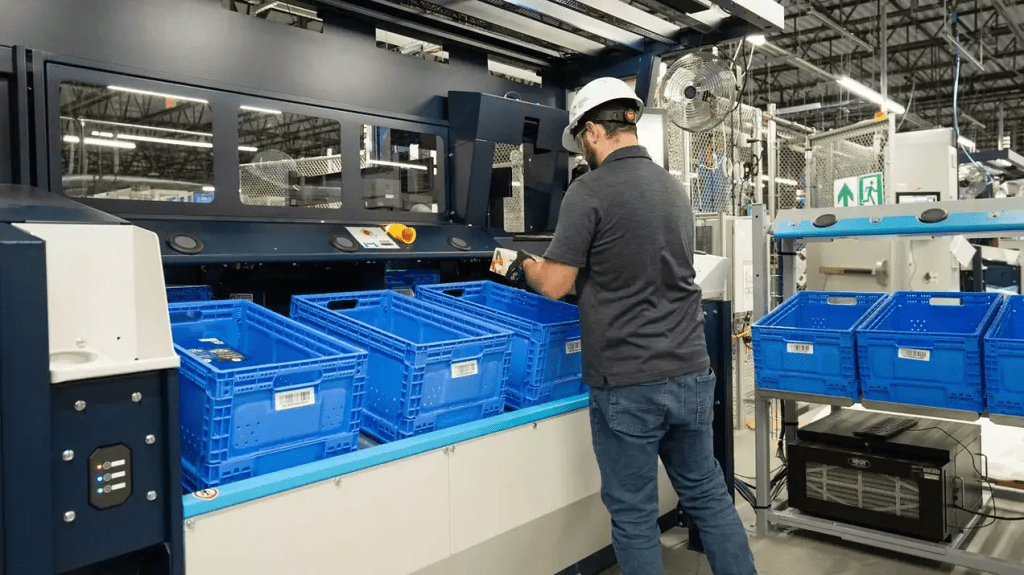
In 2023, Amazon deployed the Sequoia system at SHV1 FC in Shreveport, LA. Sequoia automates much (60%) of the picking and stowing role, but it requires the installation of new blue bins to operate:
Then just recently, in May 2025, they introduced Vulcan which is a new system that can work with the normal yellow towers:
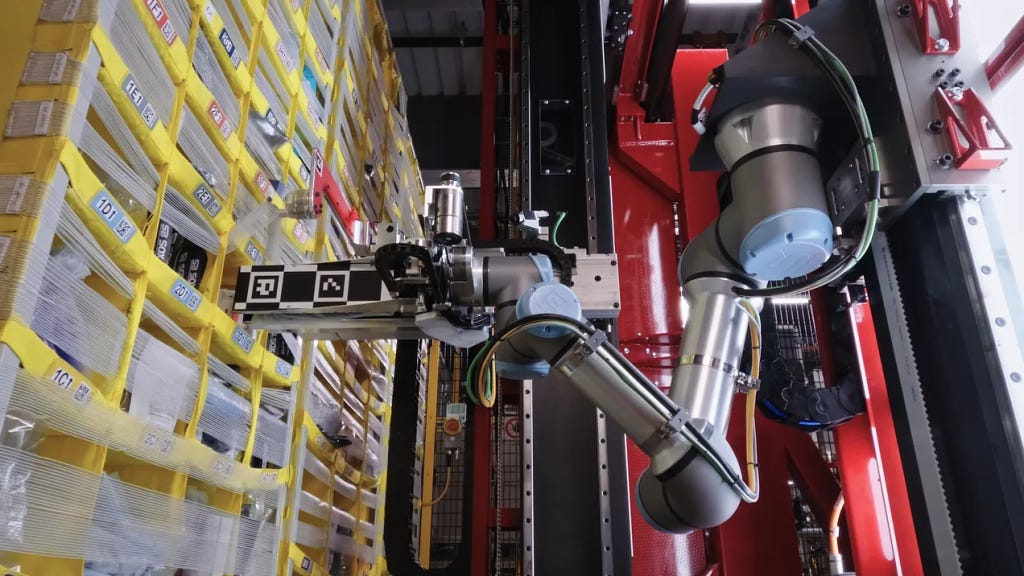
These yellow towers are moved around by Hercules but the blue bins are not. So Vulcan required less investment and operational disruption compared to Sequoia. This key advantage would likely mean further workforce reductions in FC.
Non-Sortable FC (NSFC)
NSFC deal with large items that are not processable at ARS FC. Automation hasn’t happen yet for this type of FC.
Sub-Same Day FC (SSD)
In 2021, Prime Now service was closed down after being launched in 2014 as a way for Prime members to get very fast delivery on a range of goods. SSD is the replacement for this service, delivering items within a day. By contrast, Prime Now hubs were very small (25k sq feet) while SSD are bigger (150k sq feet). Items fulfilled at SSD don’t go to separate facilities but are loaded directly into Amazon Flex drivers’ cars.
The existence of SSD is made possible because of the massive amounts of sales data from which predictive algorithms can pack the correct inventory in the SSD. These SSD are situated closer to populated areas than other FCs.
In fact, the whole NIXD, regionalization and SSD are the evolution of Amazon’s distribution network, they serve one purpose: to know what is the next purchase and to minimize delivery time.
XL Network
XL Networks deal only with big and bulky items (dishwashers, gas stoves etc.). These facilities often have fulfillment, sorting, and delivery functions all under one roof.
Fresh FC
These FC have cold storage capabilities to store perishable items for Amazon Fresh stores.
Sortation Centers (SC)
SC act as the “middle-mile” facility, sorting packages by zip code for efficient delivery. The objective is to get packages organized for local delivery by Delivery Stations.
Delivery Stations (DS)
The “last-mile” DS are where parcels are loaded onto vans to be delivered within a 45-mile service radius. They are located close to urban areas and are relatively small in size.
This last-mile delivery requires costly labour, which Amazon solves by getting different service providers to compete over contracts covering a certain volume for a DS.
Then there’s last-mile technologies. Scout, the autonomously guided sidewalk roamer, was decommissioned in 2022, the same year that Amazon began experimenting with drone delivery. Amazon is piloting drone delivery in Tolleson, AZ right now with its MK30 drones.
Air Hubs
Packages sent to Amazon Air Hubs, typically located near airports, are loaded onto Amazon Air cargo planes, where they generally go to one of a few larger hubs first. Then they fly out to their relevant sortation centers.
Without Air Hubs, some items will be stocked in a FC far away and the customer will need to wait for a few delivery days. For Amazon to keep up with the promise of fast delivery, they have to invest in airplane delivery, but this is also the most expensive form of delivery.
The Chaddick Institute for Metropolitan Development keeps track of Amazon Air developments, and in their report from March 2024, they noted that Amazon is simplifying their air network, reducing the number of flights but increasing overall tonnage capacity. This is a component of their regionalization strategy mentioned above.
They are also operating increasingly by a more traditional hub-and-spoke model, with Cincinnati/Wilmington growing in importance as their superhub, and Lakeland, FL and San Bernardino, CA growing as key regional hubs.
Robotics
The use of robotics have benefits of higher productivity, accuracy and speed, while saving on labour cost. This should translate to even lower prices for customers and widening the economic moat of Amazon.
For example, Amazon has robotic arms called Cardinal, Robin and Sparrow (people at Amazon seem to like birds). Both Cardinal and Robin pick up packages using vacuum suckers; the main difference is Cardinal can pick up heavier packages, while Robin is a faster sorter. Sparrow is a vacuum-sucking robotic arm. All these robots are designed to eliminate the individual human tasks.
Another example, interestingly humans are quite fast at picking but slow at packing. The CartonWrap 1000, developed by the Italian firm CMC, is used in some FCs and can box 700 items an hour, about 4-5 times faster than a human packer. It was piloted in 2019 at a Gen 12 FC in Shreveport, but it’s not clear how widely Amazon has adopted it.
Here is a list of robots used and tested in Amazon’s distribution network: