
Study: Capital-light Businesses during Inflation
Preface: Currently on vacation, and what better time to catch up on past readings? Ideas here are not original or new, most of it comes from extending the lessons from Warren Buffett’s letters.
History of the Great Inflation
The historical narrative of the inflation that took hold from the mid 1960s to early 1980s is often told with hindsight that Paul Volcker had the fortitude to raise rates aggressively to break inflation. However, people who actually lived through those years had no such hindsight and conventional wisdom was that high inflation would persist in the 1980s and perhaps indefinitely.
Long term treasuries yielded above 15% in 1981 in anticipation of years of high inflation. When inflation started to decline, interest rates remained relatively high for many years as people remained skeptical.
Today, the 10 year yields around 4.5% which is comparable to yields seen in the mid-1960s and remains very low from a historical perspective. Many charts published in the financial media seem to start around 2005, which creates the false illusion that current rates are historically high.
In the 1980s, anyone who predicted that the 10 year treasury would eventually yield under 1% in 2020 might have been thought of as a lunatic.
Even Warren Buffett was surprised by the taming of inflation during the 1980s based on comments in his shareholder letters. In 1987, Buffett was still expecting a return to higher levels of inflation when he wrote about his distaste for long-term bonds, predicting “much higher rates of inflation within the next decade.”
In this article, we will focus on Buffett’s comments regarding the advantage of owning capital-light businesses with pricing power during inflationary times.
False Comfort
For years the traditional wisdom – long on tradition, short on wisdom – held that inflation protection was best provided by businesses laden with natural resources, plants and machinery, or other tangible assets (‘In Goods We Trust’). It doesn’t work that way. Asset-heavy businesses generally earn low rates of return – rates that often barely provide enough capital to fund the inflationary needs of the existing business, with nothing left over for real growth, for distribution to owners, or for acquisition of new businesses.
Warren Buffett, 1983 letter (appendix)
Generations of Benjamin Graham’s disciples have started with the balance sheet when analyzing a business. The quest for companies trading at less than book value, or better yet, below net current asset value, has long been viewed as the cornerstone of intelligent investing. This was true for Warren Buffett for a long time and he had great success with investments such as Dempster Mill during the partnership years, and this is what led Buffett to acquire control of Berkshire Hathaway itself.
Of course, aside from liquidation scenarios, the analyst must closely examine the income statement over many years to be satisfied that the enterprise is capable of earning an adequate return on equity. A poor business incapable of earning an adequate return on equity will justifiably see its stock trade below book value since buyers will demand an adequate return on their investment. In contrast, a great business that delivers a return on equity far in excess of the average business can be expected to trade far above book value.
With Charlie Munger’s help, Warren Buffett began to shift his attention toward intangible assets in the early 1970s. As Munger pointed out later, it is difficult to move away from an approach that had worked so well for so long:
I don’t love Ben Graham and his ideas the way Warren does. You have to understand, to Warren — who discovered him at such a young age and then went to work for him — Ben Graham’s insights changed his whole life, and he spent much of his early years worshiping the master at close range. But I have to say, Ben Graham had a lot to learn as an investor. His ideas of how to value companies were all shaped by how the Great Crash and the Depression almost destroyed him, and he was always a little afraid of what the market can do. It left him with an aftermath of fear for the rest of his life, and all his methods were designed to keep that at bay.
Charlie Munger, 2014
What worked so well for Benjamin Graham in depression-era markets, and continued working well for Warren Buffett as he started his career in the 1950s, would not work nearly as well in the inflationary environment of the late 1970s. In his 1983 letter to shareholders, Buffett contrasts asset-heavy enterprises with companies that have significant intangible assets and minimal need for tangible assets:
In contrast, a disproportionate number of the great business fortunes built up during the inflationary years arose from ownership of operations that combined intangibles of lasting value with relatively minor requirements for tangible assets. In such cases earnings have bounded upward in nominal dollars, and these dollars have been largely available for the acquisition of additional businesses. This phenomenon has been particularly evident in the communications business. That business has required little in the way of tangible investment – yet its franchises have endured. During inflation, Goodwill is the gift that keeps giving.
Warren Buffett, 1983 letter
Economic goodwill is not an asset that can be estimated with great precision. When accounting goodwill exists on a balance sheet, it is the result of a business acquisition that was made for a sum greater than the identifiable assets of the acquired business.
In 1983, accounting goodwill was subject to amortization over 40 years. However, as Buffett explained in the letter, the economic goodwill of an excellent business is more likely to grow over time than to shrink.
Many businesses with significant economic goodwill have no accounting goodwill on their balance sheet. For example, a start-up that generates economic goodwill (eg. brand value) over time will not have any balance sheet account for goodwill. It is only when a business is acquired that accounting goodwill will appear on the balance sheet of the purchaser.
It seems intuitive that one would want to own businesses with a large amount of tangible assets during inflationary times based on the idea that those tangible assets should be worth more after taking the effects of inflation into account. But favoring businesses with a great deal of tangible assets just because they are visible on the balance sheet is a false comfort.
See’s Candies vs. “A Mundane Business”
By 1983, Berkshire Hathaway had owned See’s Candies for over a decade and Warren Buffett reflected on the company’s economics in the appendix to his 1983 letter to shareholders. The unexciting title of the appendix is “Goodwill and its Amortization: The Rules and The Realities” which probably deterred many readers from proceeding.
When Blue Chip Stamps acquired See’s Candies in 1972 for $25m, See’s had $8m of net tangible assets and was earning $2m after tax. When Berkshire paid $17m over net tangible assets, this generated $17m of accounting goodwill that was amortized into expenses over many years.
Obviously, it would have been wonderful to purchase a business earning $2m after tax for just $8m. However, the ability of a business to earn 25% after tax on net tangible assets obviously indicated the presence of valuable economic goodwill. Although Warren might have considered paying $25m for a business earning $2m to be a rich price, Charlie was more willing to consider intangible assets and was strongly in favor of the purchase.
Warren explained the purchase rationale as follows:
In 1972 relatively few businesses could be expected to consistently earn the 25% after tax on net tangible assets that was earned by See’s – doing it, furthermore, with conservative accounting and no financial leverage. It was not the fair market value of the inventories, receivables or fixed assets that produced the premium rates of return. Rather it was a combination of intangible assets, particularly a pervasive favorable reputation with consumers based upon countless pleasant experiences they have had with both product and personnel.
Such a reputation creates a consumer franchise that allows the value of the product to the purchaser, rather than its production cost, to be the major determinant of selling price. Consumer franchises are a prime source of economic goodwill. Other sources include governmental franchises not subject to profit regulation, such as television stations, and an enduring position as the low cost producer in an industry.
Warren Buffett, 1983 letter
In 1983, See’s earned $13.7m after taxes on $20m of net tangible assets. In other words, See’s went from return on tangible assets of 25% (1972) to 68.5% (1983). As Buffett points out, this indicates the presence of economic goodwill far larger than the original cost of accounting goodwill.
See’s produced extraordinary results during a period of high inflation, as we can see from the following table from the 1983 shareholder letter:
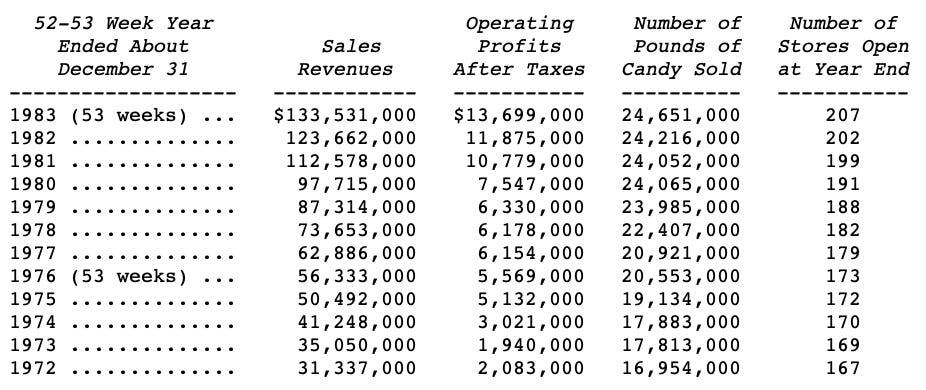
It is remarkable that See’s generated $31.3m of sales in 1972 using $8m of net tangible assets. Go forward in 1983, it made $133.5m of sales using just $20m of net tangible assets. We can see from the table that See’s had very strong pricing power throughout this period. The implied price per pound rose from $1.85 in 1972 to $5.42 in 1983. Although physical volume of candy sales slowed toward the end of the period, price increases continued to deliver enhanced profitability.
Buffett presents readers with a thought experiment comparing the purchase of See’s Candies in 1972 to a hypothetical “mundane” business:
Let’s contrast a See’s kind of business with a more mundane business. When we purchased See’s in 1972, it was earning about $2 million on $8 million of net tangible assets. Let us assume that our hypothetical mundane business then had $2 million of earnings also, but needed $18 million in net tangible assets for normal operations. Earning only 11% on required tangible assets, that mundane business would possess little or no economic goodwill.
A business like that, therefore, might well have sold for the value of its net tangible assets, or for $18 million. In contrast, we paid $25 million for See’s, even though it had no more in earnings and less than half as much in ‘honest-to-God’ assets. Could less really have been more, as our purchase price implied? The answer is ‘yes’ – even if both businesses were expected to have flat unit volume – as long as you anticipated, as we did in 1972, a world of continuous inflation.
To summarize in a table:
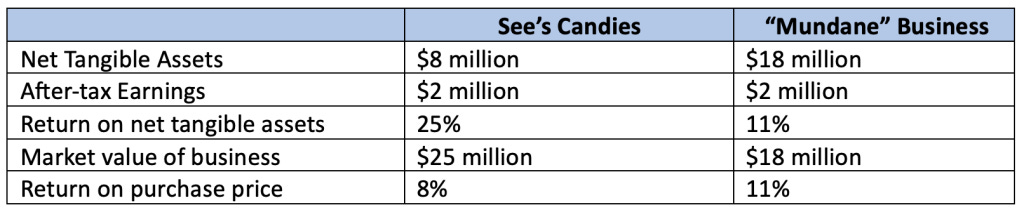
It is doubtful that an investor rigidly applying Benjamin Graham’s principles would buy either company, but if forced to choose, such an investor would almost certainly prefer the mundane business given that it could be purchased at book value, implying a larger margin of safety, and provided a higher initial return on the purchase price.
Your initial reaction when reading this section might be to think: the missing element is that See’s could be expected to grow while the “mundane” business might not. However, Buffett explains how See’s represented greater value in “a world of continuous inflation” even if both businesses were expected to have flat unit volume.
If we assume that inflation causes general price levels to double, how would this affect these businesses? They would both need to double nominal earnings from $2m to $4m to represent flat earnings in real terms. If each business could maintain the same unit volume while doubling prices, profits would also double assuming that margins stay the same.
To double earnings to $4m both businesses probably would have to double their nominal investment in net tangible assets, since that is the kind of economic requirement that inflation usually imposes on businesses. A doubling of dollar sales means correspondingly more dollars must be employed immediately in receivables and inventories. Capital expenditures in fixed assets will respond more slowly to inflation, but probably would double over time too. All of this inflation-required investment will produce no improvement in rate of return. The motivation for this investment is the survival of the business, not the prosperity of the owner. We summarize the thought experiment below:
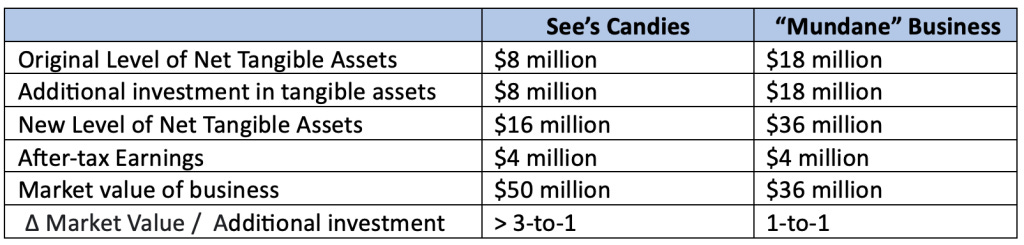
Both See’s Candies and the mundane business double net tangible assets in order to double after-tax earnings. However, See’s only requires an incremental $8m of investment while the mundane business requires $18m. Under this scenario, we can expect that the market value of both businesses to also double.
See’s only invested $8m in incremental net tangible assets to generate $25m of incremental market value. In contrast, the mundane business invested $18m to generate $18m of incremental market value.
Why can See’s convert $8m of additional investment into $25m of market value?
There’s 2 ways to think of it:
1. Economic goodwill doubled from $17m to $34m, but this required not a single dollar of incremental capital investment. The value of the goodwill kept up with inflation but required no capital investment.
2. See’s had higher return on tangible assets and so it takes less investment to produce the same returns.
Conclusion
See’s Candies was not only a dream business for Berkshire from an economic perspective but represented a real-life case study that changed Buffett’s approach to capital allocation in the 50 years that followed. Of course, Charlie Munger’s insight played a major role in bringing about this transformation.
In his 2007 letter to shareholders, Buffett reported that See’s generated $383m of sales with pre-tax profits of $82m. Remarkably, the capital required to run the business was only $40m. Only $32m of incremental capital had to be invested between 1972 and 2007 to produce the growth. Cumulative pre-tax profits was $1,350m on the initial purchase price of $25m, with all of that cash sent to Berkshire to acquire other businesses. Unfortunately, companies with the economics of See’s Candies are rare:
There aren’t many See’s in Corporate America. Typically, companies that increase their earnings from $5 million to $82 million require, say, $400 million or so of capital investment to finance their growth. That’s because growing businesses have both working capital needs that increase in proportion to sales growth and significant requirements for fixed asset investments.
A company that needs large increases in capital to engender its growth may well prove to be a satisfactory investment. There is, to follow through on our example, nothing shabby about earning $82 million pre-tax on $400 million of net tangible assets. But that equation for the owner is vastly different from the See’s situation. It’s far better to have an ever-increasing stream of earnings with virtually no major capital requirements. Ask Microsoft or Google.
Warren Buffett, 2007 letter
See’s is a tremendous business but has proven to be quite limited in terms of growth opportunities beyond the west coast. But as a wholly owned business of Berkshire, it has functioned as a cash cow for Berkshire to make acquisitions, such opportunities would not have existed if See’s was left alone as a single entity.