
Preface
Recently, we wrote about Anthropic’s leaked S-1 and tried to explain which parties control the economics of this AI frontier lab which created the very useful and famous product Claude.
There we argued that Anthropic is not a business propped up by its investors, but it doesn't feel like it can extract most of the economics for itself. The strategic investors (Amazon/Alphabet) have more bargaining power even though Anthropic founders have voting rights (50.1% Class F shares).
Now that their S-1 has officially came out, let's look at some interesting details.
Cash Burn
The balance sheet has quite a sum of cash sitting at $134b ($112b cash equivalents + $19b short term investments + $3b restricted cash).
Anthropic raised $141b of total capital, which means they only used $7b in the company's lifetime to reach their current state. Merely 3 years ago they had $41m revenues, now in H1 2026 they recorded $16b — the pace of growth is unprecedented!
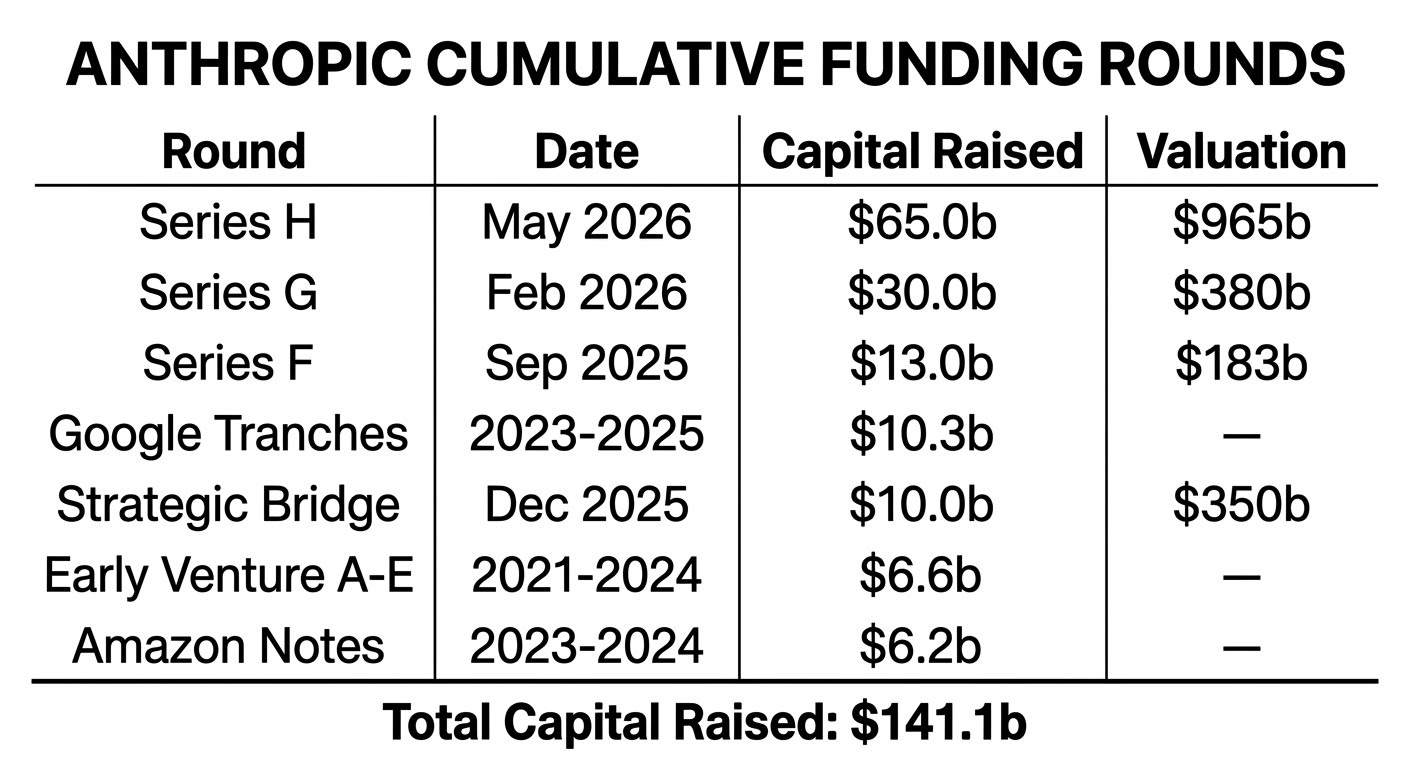
How did they raise this capital?
On the balance sheet there is $108.6b convertible notes payable. But this is not debt, in fact Anthropic has not drawn any interest bearing debt yet from their $77b Note Purchase Agreements (NPA), these facilities carry a typical 9% interest rate (paid-in-kind by adding to the principal) and feature conversion rights into equity at a 10% discount relative to recent public share pricing.
Now, the convertibles are instruments that don’t have a price, but instead are valued to a future funding round.
This is rational because startups cannot ask investors to give them cash now without discount. Obviously, Anthropic was a riskier business at infancy, and investors must be compensated.
For some of the investors, especially Amazon, they funded a lot of capital through convertibles. There are a few reasons why traditional preferred shares was not used:
The investors are publicly traded companies subjected to regulators scrutiny on control over related parties.
Anthropic wants to limit voting rights of these investors.
Convertibles are senior to preferred equity in the capitalization stack. If Anthropic went bust, the investors ranked higher in claims.
Over time, as more funding rounds are raised, those notes “convert” into equity. For Amazon between 2023—25, they raised $11b and $5b has converted to equity with $6b outstanding.
The $6b outstanding notes was recorded as a $109b liability, the value skyrocketed because it is a function of Anthropic’s valuation. The May 2026 Series H round valued Anthropic at a $965b!
Alphabet has stopped investing through convertibles, instead it went for direct equity tranches.
If we reconcile the funding sources:
$128.6b non voting preferred shares (converts to Class A with economic rights but no voting at IPO).
$11.3b convertible notes.
$0.6b common shares.
$0.7b pre-2023 rounds.
Add those up and we arrive at $141b capital raised. Yes, Anthropic really used only $7b to achieve today's scale!
Gross Profit Margins
On the surface Anthropic reports 85% gross margins which is very high considering that it needs to fund free-tier users and pay distribution fees to Amazon/Alphabet.
Most of you should know this already if you read the S-1. There's no presentation for gross profits:
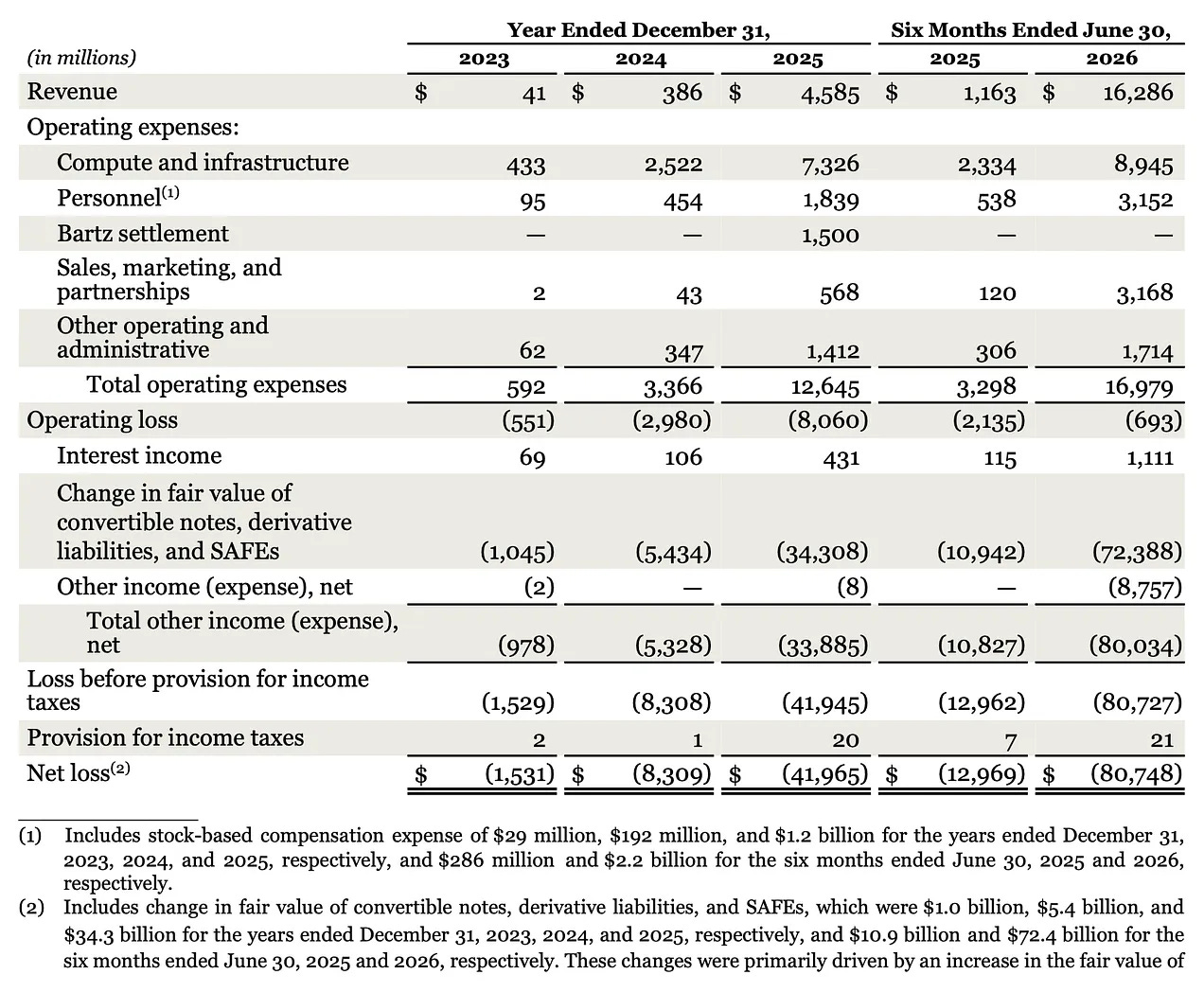
Instead, they subsumed COGS into operating expenses. COGS is disclosed in Note 8.
COGS is lower for H1 2026 against FY2025, despite much higher revenues. R&D (training) and Sales & Marketing (paying their partner’s share of revenue) are up, but COGS is down.
The likely reason is due to Anthropic using compute capacity from SpaceX at a reduced price. The arrangement will scale up significantly, with Anthropic committing to compute spending through 2029 reaching $1.25b—$3.1b per month as capacity fully deploys.
Recall that Anthropic pays Amazon/Alphabet twice:
Leased compute.
Partner distribution fees for products sold through cloud.
Back to Note 8:
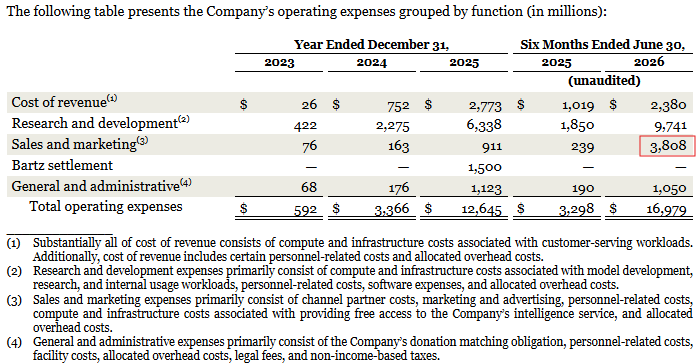
COGS is $2.4b. But there are 2 items in S&M of $3.8b which we think should be classified as COGS:
Partner distribution fees $2.7b.
Computer cost for free-tier users $0.8b (derived from remainder after deducting direct marketing $273m).

If we add back both items, COGS would be $5.9b, and gross margins would fall from 85% to 64% — still high but not software-like levels.
CAPEX
As of June 30, Anthropic has signed $587b in compute leases and minimum purchase commitments that haven’t begun. It has since signed $245b more, resulting in $832b of future compute costs. Eventually these costs will hit the P&L over time, and profitability can look ugly since the suppliers of compute are also competitors who can force Anthropic into onerous terms.
That's why Anthropic is planning to spend alot on compute infrastructure going forward. Currently, their CAPEX for H1 2026 is very low at just $482m. But that's because all their compute is expensed off. Hence, don't take the current free cashflow profile as indicative of the future.
Net Loss Accounting Noise
The $80.7b net loss is entirely driven by mark-to-market non cash movements.
$72.4b comes from a valuation change on Amazon’s convertible notes which showed up as an increase in liabilities on the balance sheet. As mentioned earlier, this is the funding from earlier years now revalued upwards because Anthropic is more valuable.
Remainder $8.7b comes from a mark-to-market change on forward commitments Anthropic made to sell Amazon/Alphabet $15b of Series G-2 preferred at $259/share (January Series G price) as part of the March and April 2026 note purchase agreements.
Ignoring all that accounting noise, Anthropic actually had a positive 8% GAAP operating margin in Q2.
However, we don't expect operating profits to continue because Anthropic has not ramped up compute yet based on their huge amounts of committed compute spend. We think Anthropic released the S-1 at a stage where they managed to show that the business model can be profitable at maturity, so don't be surprised if they fall back into operating losses again.
There’s only so much revenue they can make from selling API and subscriptions like Claude Max to enterprises. For revenues to continue accelerating, Anthropic would need to come up with new cases beyond coding.
The good news is that compute costs are falling quickly from 225% of revenue last year to 48% in Q2.
But this could be due to timing differences:
Prepaid hosting services provided by hyperscalers. Instead of investing cash, they give Anthropic credits to use compute.
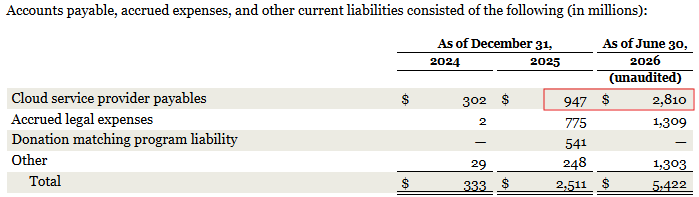
Cloud service provider (CSP) payables are growing. Anthropic books its compute capacity 12 to 18 months in advance.

Good catch on the $6b of Amazon notes carried at $109b. Amazon's own Q2 10-Q values the same $6.2 billion of Anthropic notes at $97.9 billion, while Anthropic carries them at $108.6 billion, so the two sides of one instrument are $10.7 billion apart. That gap matters, because the rise in this liability is the whole $72.4 billion fair-value charge behind the first-half loss. I lined the S-1 up against Amazon's, Alphabet's and Broadcom's filings here: https://equibles.com/research/anthropics-s-1-checked-against-amazon-google-microsoft-and-broadcom-filings
Data: Anthropic's S-1 and Amazon's 10-Q, processed by Equibles.