
Study: AI & Software Companies
Solutions Value Graph
This topic is really popular these days: What is the ultimate impact that AI will have on software businesses?
To answer this question, we should understand that the reason why businesses exist in the first place is to solve problems for customers. The one which is best at solving problems will retain the most value.
As a customer, you solve problems in 3 ways:
DIY: Use a vendor’s tools and do it yourself.
Outsource: Transfer the problem to a vendor.
Cooperate: Work together with a vendor.
This means that businesses that reside in these 3 solutions (DIY, Outsource, Cooperate) will retain different surpluses from their customers.
It’s easy to illustrate with examples:
Problem: You are hungry. What are your solutions?
Solution #1 (DIY): Buy raw materials from the supermarket and cook yourself.
Solution #2 (Outsource): Go to a restaurant.
Solution #3 (Cooperate): Buy pre-made meals but still have to cook/heat it yourself.
Obviously, Cooperate is the smallest market among the 3 solutions.
Problem: You need transportation.
Solution #1 (DIY): Buy and own a car.
Solution #2 (Outsource): Public transportation and ride-sharing.
Solution #3 (Cooperate): Rent a car without ownership of it.
Again, we see the Cooperate market is the smallest. These are the stats for transportation spending in the US for 2025:
New cars sales $620b.
Public transport $96b, ride-sharing $21b.
Car rental market $48b.
Therefore, most of the time, the highest value is sitting in DIY and Outsource. The logic is that Cooperate requires customers to still operate on the problem but grants no full control nor full delegation, so some of the surplus must be retained with the customer and not the business.
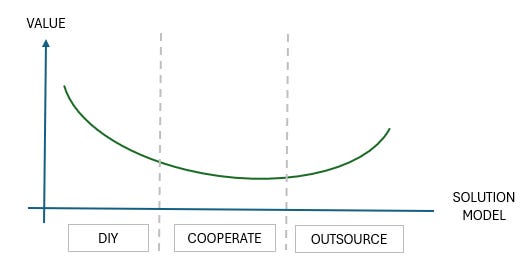
Noticed we said “most of the time” because software is an exception to this model. Let’s think about the following problem where software is involved:
Problem: Your company wants to manage its financial data.
DIY: Own the system of records and accounting logic (eg. SAP).
Outsource: Third party who prepares financial statements for you (eg. BDO Global).
Cooperate: Produce financial reports with vendor’s tools (eg. Salesforce Tableau, or some other BI tools).
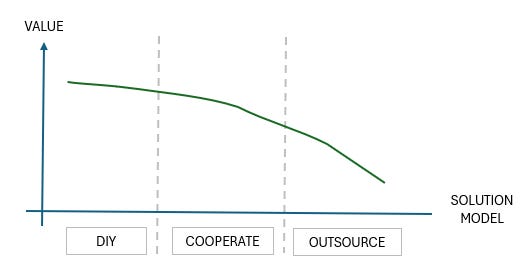
Now, software only works when there’s good data, so it’s unique in the sense that all 3 solution models depend on the system of records and business logic for source of truth. In this case, the Outsource solution becomes the least valuable since it’s furthest away. The value graph is different:
Enter AI
How AI will alter this software value graph?
We think that AI mostly affects the Outsource solution model. The companies belonging there are known as Business Process Outsourcing (BPO). Since AI allows them to innovate and replicate functionalities with less effort, they will steal value from the Cooperate models. Because Cooperate companies neither integrate into the system of records, nor take the workload off their customers by being fully outsourced.
In the end, we think AI will change the software value graph into something that looks like any typical industry:
To understand why companies in the Cooperate model lost value, let’s think about who is responsible for solution failures.
It is very clear that in both DIY and Outsource models, the party responsible for failure is either yourself or the third party vendor. When the error is identifiable to someone, then the solution is easy to call upon. However, when errors happen in the Cooperate model, you don’t really know immediately who to blame. For example, wrong financial analysis could be due to dirty data, or wrong scripting logic, or inadequate software functionality…
When such a situation occurs, if the customer thinks that AI can empower them solve the problem, then they would either go DIY or Outsource. In other words, the software tool that requires cooperative effort from both parties will lose value.
For example, Monday.com is a task management software in the Cooperate model. Before AI, it would be costly to replicate and maintain Monday.com but now it’s cheaper, and some large companies might consider doing that in-house or outsource.
Vertical SaaS
A special mention for vertical SaaS, as a group, we don’t see any existential threat because most of them are in the DIY model. That said, it is likely that we see increasing number of Outsource vertical software solutions; competition reduces profit margins.
With increased go-to-market speed, new entrants can first identify specific pain points and invent AI-powered solutions, then build just enough integration with the system of records (SOR) for the AI model to work, eventually displacing incumbents that once owned the SOR.
We see many AI point solutions recently:
Magic School: AI solution for K12 schools aimed at solving teachers’ burnout from repetitive tasks. Recently raised $45m Series B.
Anthrophic: Automate legal work such as contract reviewing, non-disclosure agreement triage, compliance workflows, legal briefings and templated responses.
Hippocratic: Healthcare patients facing AI voice agents. Solving call management manpower issues.
Being the SOR used to be an unassailable moat, but AI will change the value dynamics. Therefore, it is imperative that incumbents who have the SOR advantage should quickly improve on AI solutions.
Conclusion
If our views are right, then AI is redistributing the software value curve and not reducing it. There are individual companies which are vulnerable to this change, especially those in horizontal SaaS sitting in the Cooperate model.