
History: Samsung
1938: Founding of Samsung
Samsung was founded by Lee Byung-chui (이병철) (“BC Lee”) in 1938 as a Korean trucking business. It transported goods dried-fish, locally-grown groceries and noodles across Korea.
The company’s name was formed from the Chinese characters 三星, which means Three Stars. The name must have been partly inspired by Japan’s Mitsubishi’s, which in Japanese is called 三菱, which can be loosely translated into Three Diamonds. Samsung has sought to emulate the large Japanese conglomerates and to overtake them eventually. It would become one of the first family conglomerates in the country.
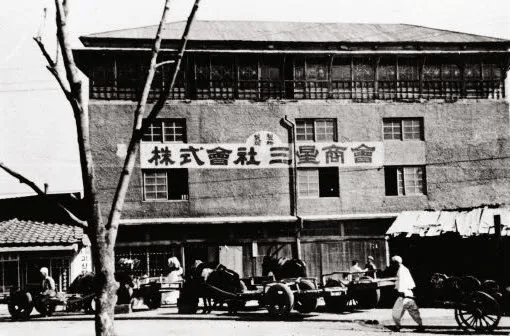
As time went on, BC Lee increasingly focused on securing key licenses and contracts from the government, at that time government contracts fetched big profits. BC Lee moved from Daegu to Seoul and formed a close relationship with Korea’s post-war dictator Syngman Rhee (이승만), who ruled Korea from 1948 to 1961. One of the first government contracts that Samsung was awarded was as a foreign currency recipient. It allowed Samsung to import raw materials such as wool and transform them into finished products like clothing.
After woollen mills, BC Lee turned to sugar refining. He used the profits to acquire shares in a bank in 1957, an insurance company, a department store and an university. As early as the 1950s, BC Lee was said to be the richest man in Korea.
BC Lee prized lifelong loyalty to the company and took a very cautious approach in each new hire. He would sit in on almost every employee interview (about 100,000 interviews in total during his career). His philosophy was:
Be prudent in hiring someone… but once you’ve hired them, be bold in entrusting them with tasks.
Samsung became obsessed with cultivating lifetime generalists, so-called “Samsung Men”. They would be shuffled around the different departments according to the whims of the HR department.
Over the next few decades, Samsung would develop a near-military style management approach, with orders from the top-down and a reluctance to challenge management.
When Park Chung-hee (박정희) took over Korea in a military coup in 1961, BC Lee saw an opportunity to get new government contracts. Park Chung-hee wanted to turn Korea into a modern manufacturing giant to compete with Japan, and so he turned to organisations such as Samsung to reach that goal. As a result, Samsung became a tool to build up a domestic manufacturing industry.
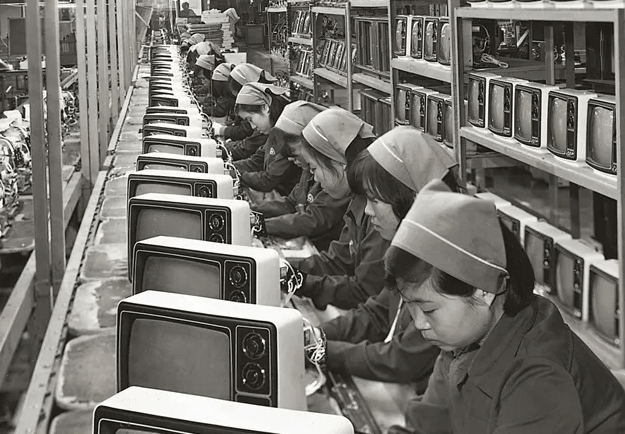
In the following decades, Samsung ventured into consumer electronics. In the early stage, it tried to reverse-engineer competitors’ products, starting with black-and-white television sets.
1974: Expanding into Semiconductors
In 1974, Samsung’s then-CEO Kang Jin-ku received a phone call from a California entrepreneur called Joseph Sudduth. He was a part-owner of Korea Semiconductor, a new joint venture set up by him and a Korean businessman. The JV had fallen on hard times, and Joseph Sudduth asked if Samsung could bail him out.
This was the start of Samsung’s foray into the semiconductor business. Internally, the managers warned against the acquisition as they felt that chips were expensive to produce and risky. They were also competing with the best Japanese companies with subsidies from their government.
During the first decade, the semiconductor business was a huge cash drain on Samsung. By then, BC Lee’s third son, Lee Kun-hee (이건희), had gotten involved in the business. He was very bullish on semiconductors and convinced his father that semiconductors were the future. It would become one of Lee Kun-hee’s greatest contribution to Samsung over the next few decades.
Samsung opened its first semiconductor fabrication plant in 1983. The company built it in only 6 months rather than the industry standard of 3 years.
But foreign visitors to the plant at the time were not impressed at all. It was placed in the middle of a small-town village, with farmers driving rice cultivators next to what was supposed to be a high-tech semiconductor fab.
Samsung employees being hardworking and relentless had managed to get technology training from America’s Micron, and while they were there, they tried to memorise every diagram they saw and recreate them back in the hotel room. Then they gave gifts of pottery to Japanese executives at a competing manufacturer called PSC in exchange for the opportunity to buy their equipment. It took a lot of hustle to even get in the door.
In the following 5 years, from 1983 to 1988, Samsung went from one generation behind the Japanese in DRAM to just 6 months behind.
1987: Lee Kun-hee Takes Over
BC Lee died in 1987. After his death, Samsung was reorganised into 5 business groups:
Samsung Group (electronics)
Shinsegae (retail)
CJ Group (food, chemicals, entertainment, logistics)
Hansol Group (paper, telecom)
Joongang Group (media)
Lee Kun-hee took over Samsung Group, which would later become the heart and the most successful part of the organisation.
Unfortunately, people didn’t have a lot of hope for Lee Kun-hee. He had originally wanted to be a film director or start a movie studio but was dragged into the family business by his father.
He actually wasn’t very much involved in Samsung, and spent most of his time at home. He didn’t even take calls from Samsung executives. For the first few years as a Chairman, he hardly came to the office. But in 1992, he finally realised that Samsung was in trouble:
From the summer of 1992 until that winter, I suffered from insomnia… I was feeling desperate, as though Samsung, beyond simply having to give up a business or two, might completely wither away. I never slept more than four hours in those days. Instead of my usual big appetite, which would only be satisfied with three portions of bulgogi, I barely managed to eat a meal a day. That year, I lost more than 10 kilograms.
Although Samsung was deteriorating, Lee Kun-hee’s executives wouldn’t tell him the truth as he was too far removed from the business to get to the problems. So instead, he installed hidden cameras and microphones across Samsung offices and factory floors and was shocked at what he found.
These investigations culminated in a corporate trip to Frankfurt. On this trip, he lashed out at his executives, telling them that they “need to change everything except their wives and children”. He wanted designers to become creative, globally aware and creating profitable products.
To reinforce his message that quality control had to be improved, he organised a massive bonfire where he threw in US$50 million worth of sub-quality Samsung products to be burned while publicly shaming his executives.
The trip to Frankfurt later become known internally as the “Frankfurt Declaration” and was one of the key turning points in Samsung becoming a serious contender in the global consumer electronics industry.
Becoming more active in Samsung, Lee Kun-hee would later replay recordings of his voice for years in company buildings as a continuing reminder of the mandate of every Samsung employee. It went something like that:
At Samsung, we must adhere to three credos:
Faulty products are our enemy
Faulty products are the root of all evil
If we produce a faulty product three times, we must take it upon ourselves to resign
Next, Samsung began distributing a document called “Change begins with me”. An executive called it “Chairman Lee’s blue book”; a reference to Chairman Mao’s little red book, hinting that Samsung’s new leadership style was not that different from communism.
However, the methods actually worked and Samsung enjoyed a great deal of success in the following decades, becoming the largest producer of memory chips in 1992. Then in 2002, it became the largest manufacturer of LCDs. And eventually, it entered the mobile phone business.
1980s – Early 2000s: Modern Multinational Company
Compared to other major Korean companies, Samsung survived the 1997 Asian Financial Crisis unharmed. The only exception was Samsung Motors (automotive segment) which went bankrupt and had to be 80% owned by Renault for ~$550m in 2000. It was renamed Renault Samsung Motors and became Korea’s third largest manufacturer within 10 years of operations. In 2020, Renault and Samsung ended their brand deal with Samsung receiving royalties from Renault for use of its name.
In the late 1980s, Lee Kun-hee wanted Samsung to expand internationally. It had been selling phones in the protected Korean market at very high margins and never felt a need to expand to the highly competitive American and European markets.
The first step in this expansion was to hire foreign employees and to ship local employees out. He sent his niece, Lee Mie-kyung (이미경) (Miky), to the US. She was in her thirties and had a flair for film and the arts. Her job was to find a marketer who could help build Samsung’s brand and presence in America. She concluded that since Motorola controlled the mobile phone market and Sony controlled televisions, then Samsung should enter the US with microwave ovens instead.
Fun fact: Miky was the executive producer of the South Korea’s award winning film “Parasite”. She is the vice-chair at Samsung’s CJ Group.
In 1983, it cost General Electric (GE) $218 to make a typical microwave oven. It cost Samsung only $155. Breaking the costs down per oven, it is astonishing:
Assembly labour cost GE $8 vs Samsung $0.63.
Supervision, maintenance, setup cost GE $30 vs Samsung $0.73.
Materials cost GE $4 vs Samsung $0.12.
Line and central management cost GE $10 vs Samsung $0.02 (!)
Samsung workers were paid less but delivered more. And once their volume increased, Korean costs could go even lower.
At this point Samsung had developed a habit of copying the designs of others, this scattered Samsung’s brand image all over. A culture change was needed to have their own distinctive design language.
Lee Kun-hee’s son Lee Jae-yong (이재용) (“Jay”) became involved in Samsung in the late 1990s. Jay was eager to participate in management but needed a success story with which to prove himself. So he jumped into the internet sector, starting e-Samsung in May 2000, investing in several Korean start-ups.
It became a massive disaster, e-Samsung went bust within a year. The broader Samsung Group ordered nine affiliates to bid up the share price of e-Samsung and relieve Jay of any personal financial damage. After these errors, Jay took on a lower profile, but would eventually become the CEO of Samsung in 2022.
2004: Encounter with Apple
Around the year 2000, in order to enter into the mobile phone business, Samsung set up an R&D centre in Warsaw. However, the real breakthrough for Samsung didn’t come until much later. It was the smartphone that would drive Samsung to become the largest phone manufacturer in the world.
In 2004, Steve Jobs visited Samsung. He wanted them to supply Apple with NAND chips for the iPod. And 2 years later, he came over to Korea desperate for Samsung to help them supply a tailor-made chip for a new unknown product called “the iPhone” with a deadline of just 5 months. An Apple engineer later admitted that the iPhone would never have been released in time unless Samsung had got involved.
In 2005, Andy Rubin, the founder of Android believed that the future of mobile phones should be in an open-source operating system that could be used by any manufacturer. He and his team pitched this to Samsung but was rejected. On the other hand, Google’s founders, Larry and Sergey, recognized the potential in Rubin’s vision and bought the entire company for $50m.
The launch of Android in 2008 provided a point of entry for Samsung to become a major phone manufacturer. In June 2009, Samsung launched the Solstice line of devices, later renamed to Samsung Galaxy.
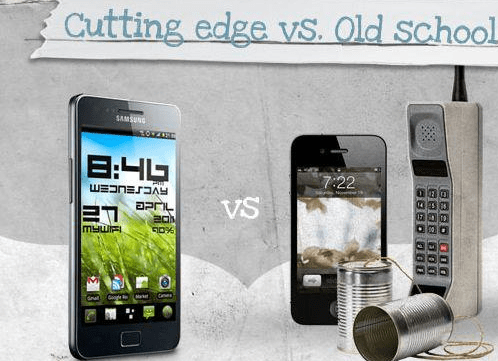
Steve Jobs would go on to criticize Samsung publicly by calling the Galaxy Tab a “copycat” after Apple released iPad 2. When Jobs died in October 2011, Samsung executives thought of this as their best opportunity to attack the iPhone. They worked aggressively to demystify the perceived Apple ecosystem advantage and tried to show how consumers can easily switch to Android to have a more personalized experience. The attack included a Facebook page that compared Galaxy S2 with iPhone 4:
Lee Kun-hee would die 3 years later in 2014 from a heart attack.
Current: Lee Jae-yong
Jay’s focus in the current era is more on incremental improvements rather than anything revolutionary. He thinks that hardware is Samsung competitive advantage. He also sold off Samsung’s corporate jets and got rid of its sluggish chemical and weapons industries. All the proceeds have been reinvested into Samsung’s core smartphone business instead. Dividend pay-outs have also been greatly increased since Jay took control.
Jay’s approach is very different from his father who favoured a top-down approach. Instead, Jay travels to company offices around the world and has meals with workers at company canteens. The fact is that Samsung is a far different company than its Silicon Valley peers. It doesn’t have Silicon Valley’s rebellious, counter-culture origins. That makes it even more crucial that the top leadership is steering in the right direction.
Over the past few years, Jay has been implicated in corruption scandals, accused of offering financial support to former President Park Geun-hye in return for business favours. He was also accused of market manipulation concerning the acquisition of Cheil Industries to cement his control of Samsung Electronics. Jay was eventually convicted to 2.5 years in prison, however the South Korea’s President Yoon Suk-yeol pardoned Jay after serving 18 months in jail.
In fact, the Samsung leaders each have some scandalous events:
Lee Byung-chui (Samsung Group founder): 1966 Saccharine smuggling incident. A fertilizer company owned by Samsung attempted to smuggle 55 tons of saccharine into Korea by disguising it as building materials. Lee Byung-chull stepped down after the incident and his first song Lee Maeng-hee took over leadership.
Lee Kun-hee (Samsung Group chairman): In 1995, sentenced to 2 years in prison for the President Roh Tae-woo slush fund scandal. He also received presidential pardon in 1997.
In 2007, another slush fund worth KRW5 billion was used for lobbying, sentenced to 3 years in prison and again received presidential pardon in 2009.Lee Jae-yong (Samsung Electronics vice chairman): In 2016, accused of offering financial support to President Park Geun-hye’s confidante in return for business favours.
In 2017, arrested for bribery, perjury and embezzlement.
Regardless, today Samsung is a large conglomerate, with more than 50 companies in various industries, including shipbuilding, electronics, fashion, advertising, food and a hospital.
Its Samsung Electronics produce around 20% of Korea’s total exports (mainly smartphones and semiconductors), and the group’s revenues now represent ~22% of South Korea’s GDP. It has become such an integral part of society that many South Koreans today call their own country “Republic of Samsung”, with a love-hate relationship between the products and employment Samsung creates versus their criminal history.
The family holding company is Samsung C&T:
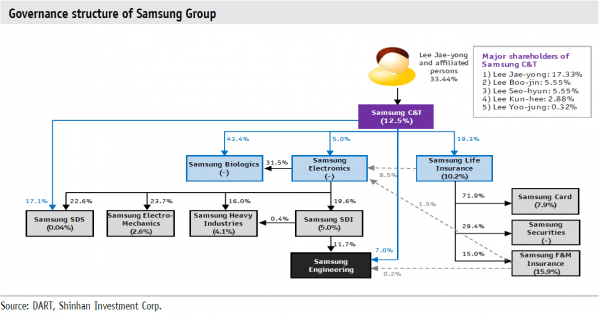
Below Samsung C&T, you will find the following listed subsidiaries:
Samsung Electronics (005930): smartphones, memory chips, displays, home appliances, TVs, telecom equipment
Samsung SDI (006400): smartphone / EV / ESS batteries
Samsung Card (029780): credit cards
Samsung Life (032830): life insurance
Samsung Fire & Marine (000810): property & casualty insurance
Samsung Heavy Industries (010140): shipbuilding
Samsung SDS (018260): IT consultancy
Samsung Engineering (028050): engineering consultancy
Samsung Securities (016360): investment banking
Samsung Biologics (207940): biopharma contract development and manufacturing
Hotel Shilla (008770): hotels