
History: Rolex
Founding Story
We know Rolex today as one of Switzerland’s most famous and iconic companies. But its founding didn’t take place there, instead it was formed in London by Hans Wilsdorf and his brother-in-law Alfred Davis.
Hans Wilsdorf was of German nationality born in Bavaria in 1881. He worked in the neighbouring country of Switzerland making watches, after gaining some experience he moved to London in 1903. Wilsdorf spent two years in London working for a Swiss watchmaker and then decided to set up his own watch business.
The new company he created with his brother-in-law was uncreatively named Wilsdorf and Davis. They opened up shop in Camden, north of Central London, and initially acted as a wholesaler for London jewelers.
They would import high-quality Swiss movements, put them in cases, and deliver them to jewelers across the city who would then stamp the dials with their own names. This strategy worked well in the beginning, and the company was soon ready to start selling watches under its own brand.
Creating a Brand
There are a few anecdotes about why the name Rolex was chosen their own brand. One of the practical reasons was that “Rolex” was short enough to fit on watch faces.
There are plenty of other five-letter combinations that can be stamped onto a watch face, but Wilsdorf saw some powerful qualities about the word Rolex.
Rolex was easy to pronounce in nearly all languages, had a luxurious air about it, and according to him, sounded like a watch being wound. The company went through a couple of iterations in regard to its name throughout the 1910s, but in 1920 one version finally stuck: Rolex SA.
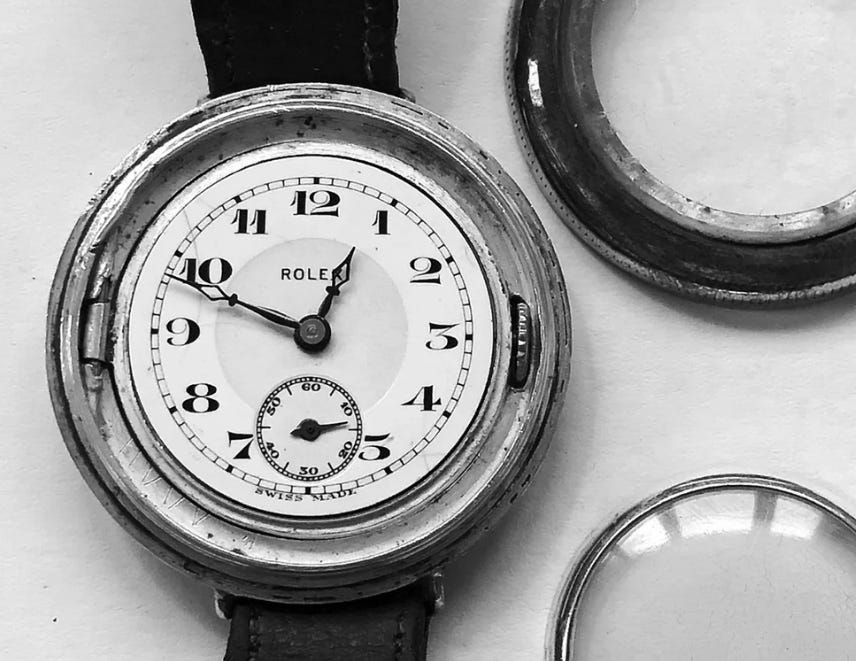
Wristwatches for Everyone
In the dawn of the new century, wristwatches were designed to be worn on bracelets for women. The fashion for men was pocket watches, also watches were a symbol of high societal standing, people who had watches were wealthy and influential people. But Wilsdorf was convinced that the wristwatch had a future among the general public, not just with the aristocratics. While the societal and fashion norms of the time were one roadblock to navigate around, there was another more practical problem to solve: accuracy.
During that time, pocket watches were more accurate than wristwatches in telling time, due to the fact that most manufacturers had far more experience in those types of movements. Using the skills and knowledge gained in the Swiss watchmaking industry, Wilsdorf set out to change this.
He modified one of the movements produced by Rolex’s supplier, Aegler, then he put it in a case and sent it off to Bienne, Switzerland for it to be tested and rated by the Official Watch Rating Center (OWRC). It passed all tests with flying colors and was awarded the first-ever certificate of accuracy for a wristwatch.
This achievement wasn’t enough for Wilsdorf who obsessed over accuracy and quality. In 1914, he sent a Rolex watch to the Kew Observatory, the UK organization tasked with rating marine chronometers for the Royal Navy. At the time, it was the largest and most powerful navy in the world, and none of its ships were able to navigate without having accurate time-keeping. This meant that the tests carried out by the Kew Observatory were extremely stringent.
Watch rating agencies in Europe usually tested watches for only two weeks, but the Kew Observatory went through 45 days of testing. The outcome was great, Rolex was the first wristwatch ever to be awarded the highest certification by the Kew Observatory. Before this point, only marine chronometers had been able to meet the requirements needed to be granted the best possible certificate. Once his watches were proven to be as reliable as the clocks used to navigate the most powerful battleships in the world, Wilsdorf was satisfied. Naturally, the two certificates were used extensively in the marketing of Rolex watches.
The next hurdle would be to convince the public to ditch pocket watches, and the catalyst came in the most unexpected way.
Synchronizing Warfare
28 June 1914 was the day that Archduke Franz Ferdinand of Austria, and his wife, were assassinated in Sarajevo. This was the spark that started World War 1.
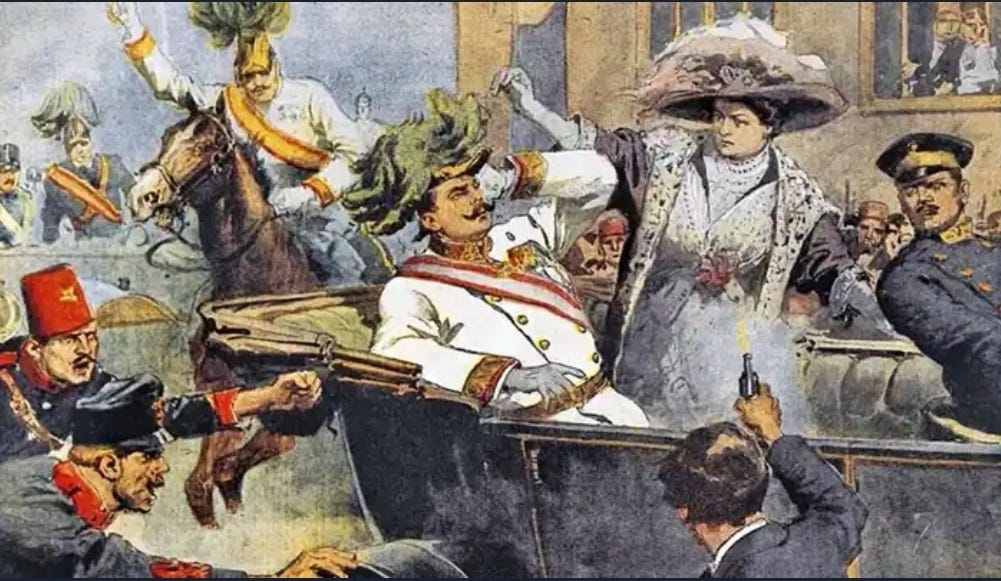
Before this, watches were a luxury item, but in a war, things are about to change dramatically.
When the greatest powers in Europe went to war with one another in the summer of 1914, they brought with them a host of new inventions: machine guns, artillery, razor wire, airplanes, and eventually the most gruesome of them all: poison gas. While the tools of war had evolved and become more intricate and deadly, the troops were stuck in the past. In the first months of the war, cavalry was still used, none of the armies equipped their soldiers with helmets, and some officers did their fighting wearing white satin gloves.
However, innovation during war increases the odds of survival and armies soon realized that they needed to provide soldiers with a better way to tell time. Trench warfare was a key feature in WW1 especially on the Western Front of France and Belgium. As armies grew in size, they needed a tool for large scale coordinated attacks. One way of doing this was using synchronized watches, with officers guiding their troops forward in planned time intervals. Fiddling with a pocket watch while carrying a rifle is a sure way of getting killed.
Hans Wilsdorf saw this opportunity and produced watches that were strapped to the wrists of officers, allowing them to quickly glance down to know the time. These came to be known as “trench watches”. After the war, the soldiers who had become accustomed to the trench watches continued to wear them upon returning home. This was how the wristwatch became an everyday essential for everyone.
Moving to the Alps
Rolex did well during the war and, despite the nationality of its founder, equipped the British army with durable watches throughout the conflict. The Armistice of Compeigne came into effect on 11 November 1918 at 11a.m. and marked the defeat for Germany, although WW1 was over, Rolex soon faced a problem of post-war tariffs.
War efforts were incredibly expensive, and while Germany was to pay reparations to Britain there was a desperate need for capital to run and rebuild the economy. The policies that impacted Rolex were import tariffs on luxury goods and export taxes. Facing unreasonably high costs of doing business in Britain, Wilsdorf moved his company into Switzerland, in many ways this felt like returning home.
Back under the Swiss Alps, Wilsdorf next mission was how to improve the brand and marketing strategy for Rolex. According to him: “only great marketing is needed to make a company successful”.
Waterproof Rolex
In the early 1920s, watches were not made waterproof. Pocket watches had the advantage of not getting wet because they were stored in the breast pockets. Wristwatches, however, were exposed to the elements.
In 1926, Wilsdorf engineered a brand new Rolex case called Oyster. It featured a completely screwed-down case back, and a screwed-down crown, effectively sealing the watch from moisture and dirt. The original Rolex Oyster was available in 28mm and 32mm models with either an octagonal or cushion-shaped case, both taking inspiration from the Art Deco movement of the time. The bezels were even beautiful, featuring a fluted, coin-edged pattern. Originally, the fluting had nothing to do with aesthetics and was purely functional, as it enabled watchmakers to grip the bezel and screw it down to the middle case.
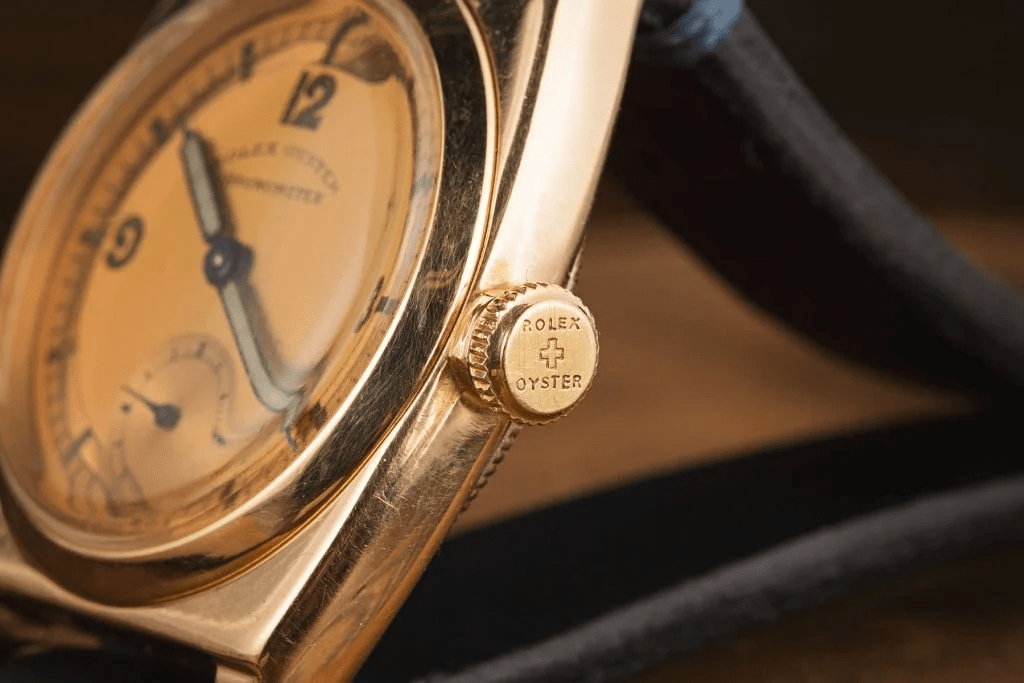
The new Rolex Oysters were submerged in aquariums and displayed in shop windows with their watch hands steadily ticking, it was a fascinating sight. But while this certainly impressed those who walked by jewelry stores, it wasn’t quite as impactful as what one English swimmer was about to do with a Rolex Oyster strapped around her neck.
The First Brand Ambassador
Mercedes Gleitze had become the first British woman to swim across the English Channel after trying eight times. In the days following her record, a woman stepped forward and claimed to have done it faster than Gleitze in a previous year. This would eventually be proven to be a complete fabrication, but the damage to the perceived legitimacy of the record had been done. Gleitze was convinced to swim the channel again in what was to be dubbed the “vindication swim”, and Wilsdorf saw a golden opportunity to market the new Rolex Oyster.
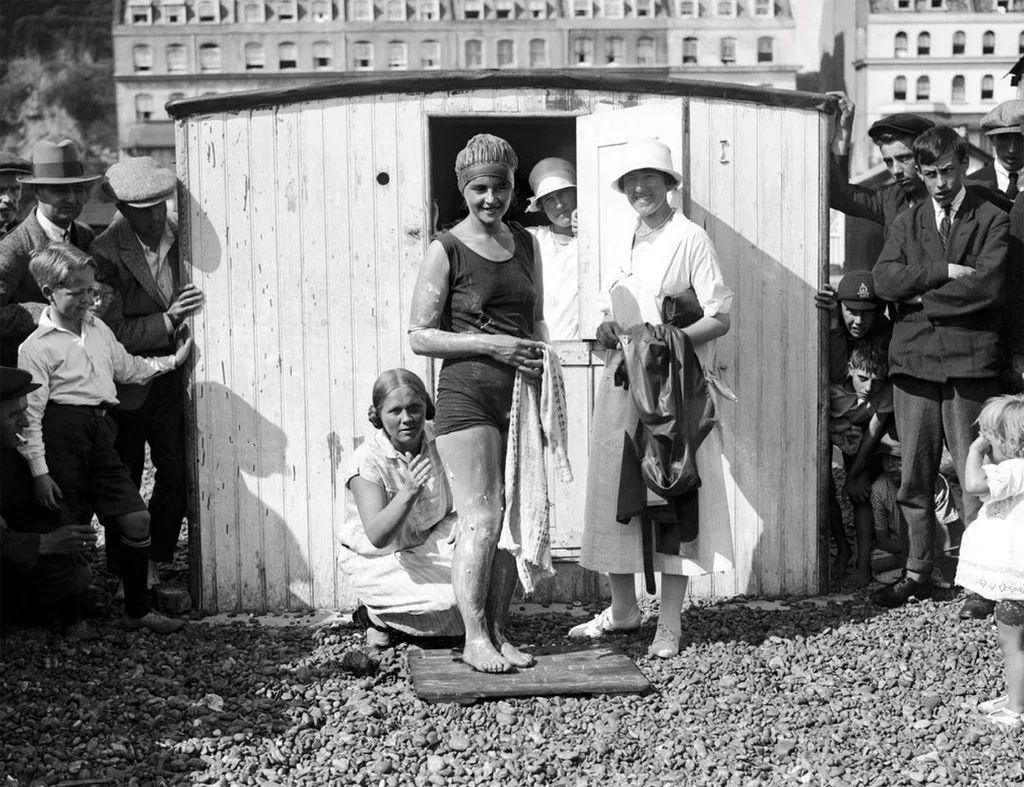
In a freezing October morning of 1927, Hans Wilsdorf would find just what he needed to fire up his marketing campaign. He sponsored Gleitze with a Rolex Oyster on a necklace which she wore on her swim.
Unfortunately, all of her eight prior attempts were done in summer, but in October the water was very cold and after ten hours in the water, she started to drift in and out of consciousness. The support boat pulled Gleitze out of the water, although she had failed this attempt, her endurance of the cold convinced all that the original record was ratified.
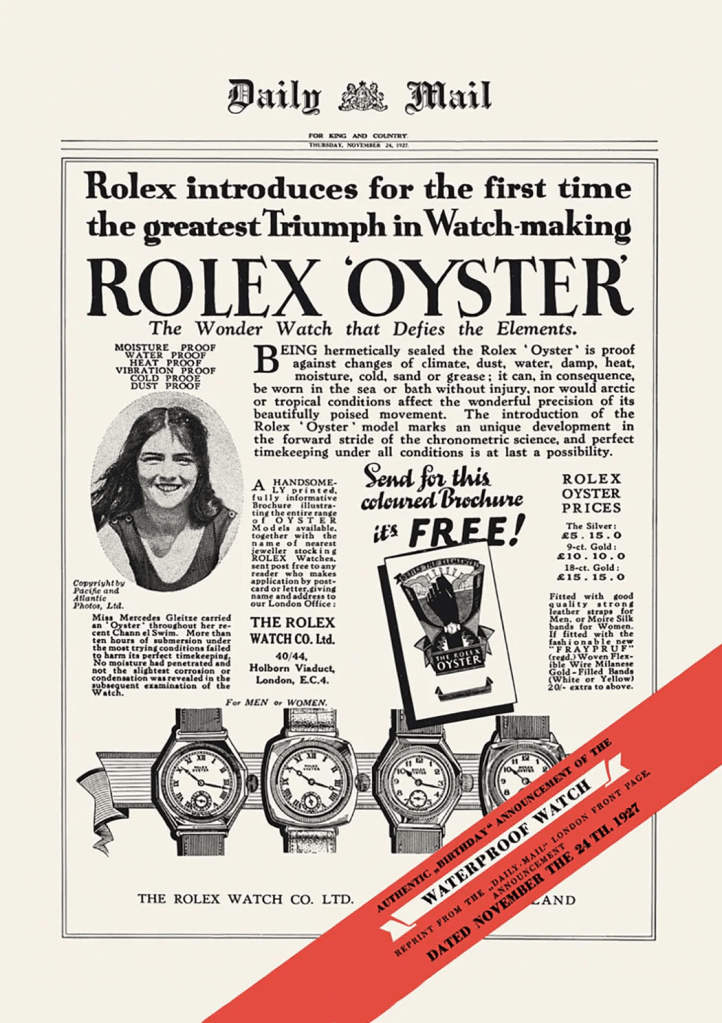
Next thing they did was to inspect the Rolex Oyster and it was declared to be in perfect working condition. The following day, Wilsdorf took out an advertisement on the entire first page of The Daily Mail featuring pictures of Gleitze, various Rolex models, and instructions on how to order a brochure.
This was how Mercedes Gleitze became the first Rolex brand ambassador.
War, again
As time went on, Rolex continued to enjoy success and became more expensive too. In 1936, Aegler entered an exclusive partnership with Rolex and would only supply its movements to Rolex. This would continue until 2004 when the two entities eventually merged.
Soon World War 2 broke out and Rolex watches saw combat once more. However, prices of Rolex watches became too expensive and supply was not enough to be used by the infantry. Instead, Royal Air Force (RAF) pilots famously purchased Rolex watches as they found their issued watches to be unreliable.
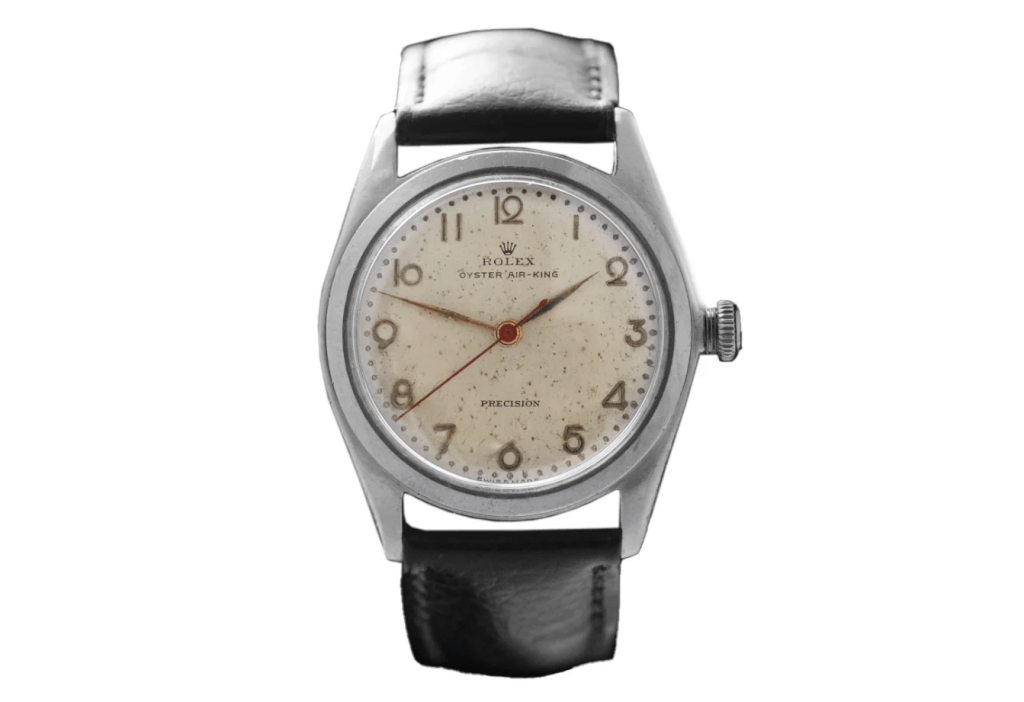
Britain was the second nation (after the Italians) to use combat divers during WW2, deploying them in both reconnaissance and defensive tasks, which ranged from surveying beaches prior to amphibious landings.
Many of these tasks required accurate timekeeping and, as the few handmade Longines watches in use were hardly enough to fulfil the needs of the British forces, the Royal Navy sought a timepiece to equip its divers. Rolex had a head start, as its Oyster case was pretty much the only truly waterproof watch available at that time. And when it introduced the Submariner in 1954, the British forces ordered some for testing. However, by the time the bureaucracy had caught up with the ordering, Rolex already had a better watch in production. This was both larger and had a heavier case with a much larger Oyster crown, giving it increased depth capability to 600ft, much greater than any diver had gone previously.
While Wilsdorf was German by nationality, this did not appear to be where his loyalty lay. Upon hearing that his watches were being confiscated from Allied members once they arrived in prisoner-of-war camps, he publicly announced that any Allied member held as a prisoner-of-war could write to Rolex in Geneva and order a watch with payment deferred until after the war.
As Switzerland was neutral during the war and the watches were technically still owned by Rolex, the Germans couldn’t confiscate them without violating Swiss neutrality. While it is unclear how many watches were ordered, it’s believed to be roughly 3,000. Wilsdorf had no way of ensuring that he would receive payment for these watches when the prisoners were eventually released, which meant that he was prepared financially write these watches off.
The upside was that Rolex watches served as morale boosters in the camps and gave the company a positive reputation.
Hans Wilsdorf Foundation
In 1944, Hans Wilsdorf wife died from a brief illness. He had no children and sought a way to ensure Rolex survival after his death. The solution he came up with was the Hans Wilsdorf Foundation. It was set up as a charitable foundation and undertook various philanthropic projects while Wilsdorf was still alive. Upon his death, all of his shares would be inherited by the foundation and it would become the sole owner of Rolex SA.
In 1960, Wilsdorf died and gave his 100% ownership stake in Rolex to the foundation. Today, the foundation still owns and controls Rolex and donates much of its income to charity and social causes in Geneva. There is no law requiring financial disclosure and Rolex pays no corporate tax as a result of being a charitable organization.
Until today there is only one Rolex owned retail shop in Rue de la Fontaine, Geneva. The company has expressed no intentions in the retail business and it is only interested in manufacturing watches. Rolex partners with retailers to sell watches indirectly.
Diversification
In 1946, Hans Wilsdorf founded Montres Tudor SA with an idea to capture more of the market without damaging the pricing power and image of Rolex. After WW2, Rolex watches became known as a luxury product and the war had hurt the company financially, so it had to find a way to increase sales.
The solution was to manufacture watches under the Tudor brand aimed at the middle market. These watches utilized Rolex bracelets and cases but used cheaper movements and were stamped with Tudor on their dials. The decision paid off and in the following decades, Tudor thrived among consumers looking for a luxury experience at a more attainable price.
Tudor is still a subsidiary of Rolex, but in recent years the two companies have made a concerted effort to disassociate with each other in the minds of consumers. Tudor sits at the “entry-level” of luxury watches and has found a distinct design language and brand identity.
The Marketing Strategy Evolves
The post-war years were the most important decades in Rolex’s history. The war was over, sales were pointing in the right direction, and it was time to expand their offerings. Between 1950s and 1970s, Rolex introduced the Submariner, Explorer, Daytona, and GMT Master. All of these watches are still part of the company’s product portfolio today and have been immensely successful.
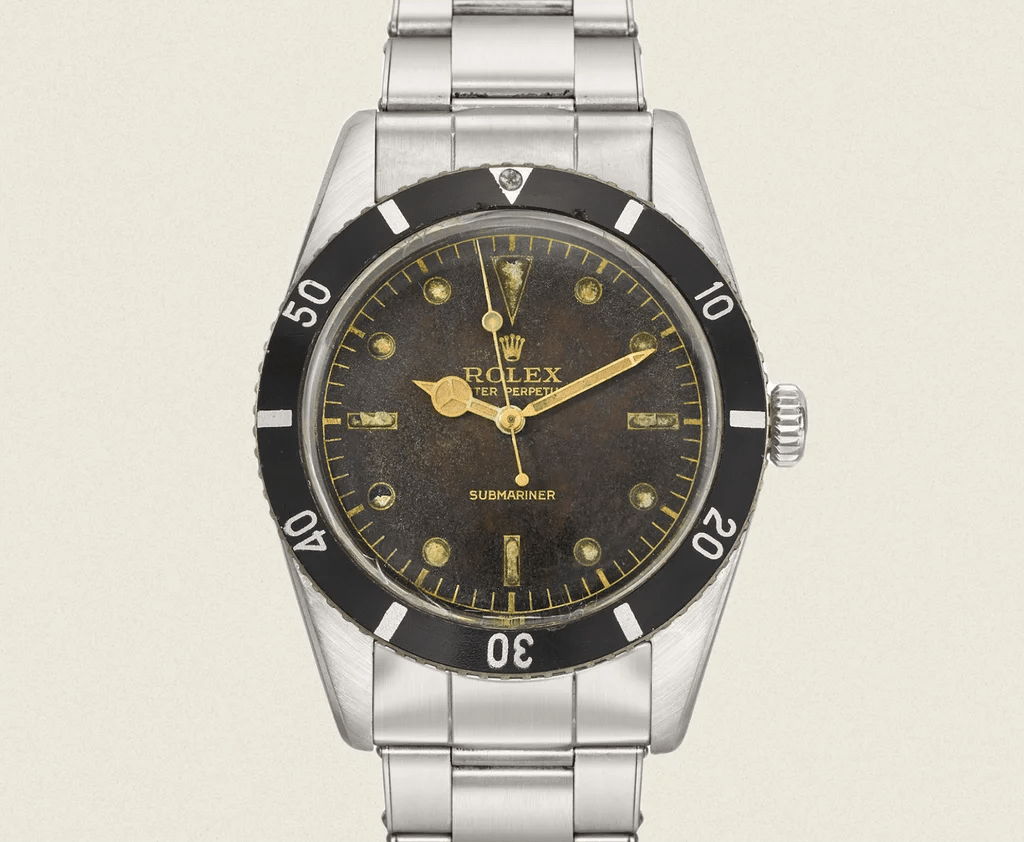
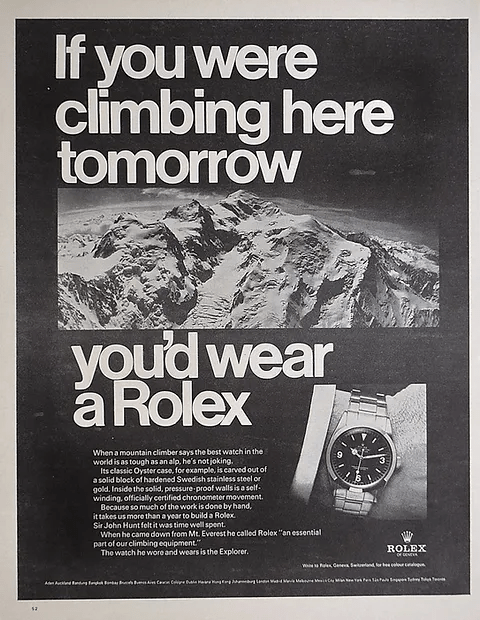
During this time Rolex continued to ramp up its marketing and brand building efforts. Instead of marketing for quality, it pivoted to focusing more on the people wearing Rolex watches.
Rolex was associated with successful businessmen and a companion tool for explorers, adventurers and people who did daring feats. For example, the campaign of Rolex Explorer and the first summit of Everest by Sir Edmund Hillary and Tenzing Norgay. Both mountaineers were equipped with Rolex watches and upon their return back to England for their publicity tours, they stopped in Mumbai where Rolex threw them a massive party, handed out watches and signed them to become ambassadors.
Another example was the first-ever dive to Challenger Deep, the deepest point in the Pacific Ocean. Jacques Piccard and Don Walsh piloted the submersible Trieste to the bottom of the Mariana Trench in 1960, and they did so with a purpose-built Rolex strapped to the outside of the vessel. Following their harrowing dive the Rolex was inspected, and just like when Mercedes Gleitze had spent 10 hours in the English Channel, it was declared to be in perfect condition.
The effect of these marketing campaigns are difficult to quantify in numbers, but it created a perception of Rolex that still stands today; the watches are accurate, durable, and can be trusted to continue to function regardless of the conditions.
Quartz Crisis
A quartz watch operates using an electronic oscillator regulated by a quartz crystal, which allows for highly accurate timekeeping. Unlike mechanical watches, quartz watches are powered by a small battery. The battery sends an electrical current through the quartz crystal, causing it to vibrate at a precise frequency.
These vibrations create a stable and consistent oscillation, which is detected and measured by the electronic circuit inside the watch. The circuit then divides the frequency of the vibrations down into a single pulse per second. This pulse drives a small stepper motor, which moves the watch’s hands forward in precise one-second increments, or in a digital display.
Quartz watches are much cheaper to produce, the cost to maintain them is very low, and they are much better at keeping time.
While watchmakers had known about the possibility of using quartz to power watches, nobody had figured out a way to implement it in a wristwatch. Disruption came during Christmas of 1969 from a team of Japanese engineers who released the Seiko Astron. Marketed as the world’s first quartz watch, this put the Swiss watchmaking industry into fire.
The Seiko Astron came into the market in 1969, and consumers now had the choice between buying expensive, intricate mechanical watches or could choose a modern, cheap, and accurate watch. The Quartz Crisis, as the Swiss watchmaking industry would later call it, disrupted traditional manufacturers.
Many small-scale watchmakers who had previously been able to export and sell their watches at modest prices saw their customer base completely disappear over just a few years, as quartz watches undercut them completely. By the end of the 1970s, quartz watches had passed mechanical watches in popularity.
The Swiss watchmaking industry didn’t know how to respond. Switzerland was a nation of watchmakers, and producing high-quality mechanical watches was an incredibly important part of the country’s national identity.
Combined with the fact that the Swiss were so exceptionally skilled at what they did meant that many traditional companies were slow to embrace quartz. The outcome of this mindset was tragic. During the late 1970s, nearly 1,000 Swiss watchmakers went out of business.
Enter the Swatch Group
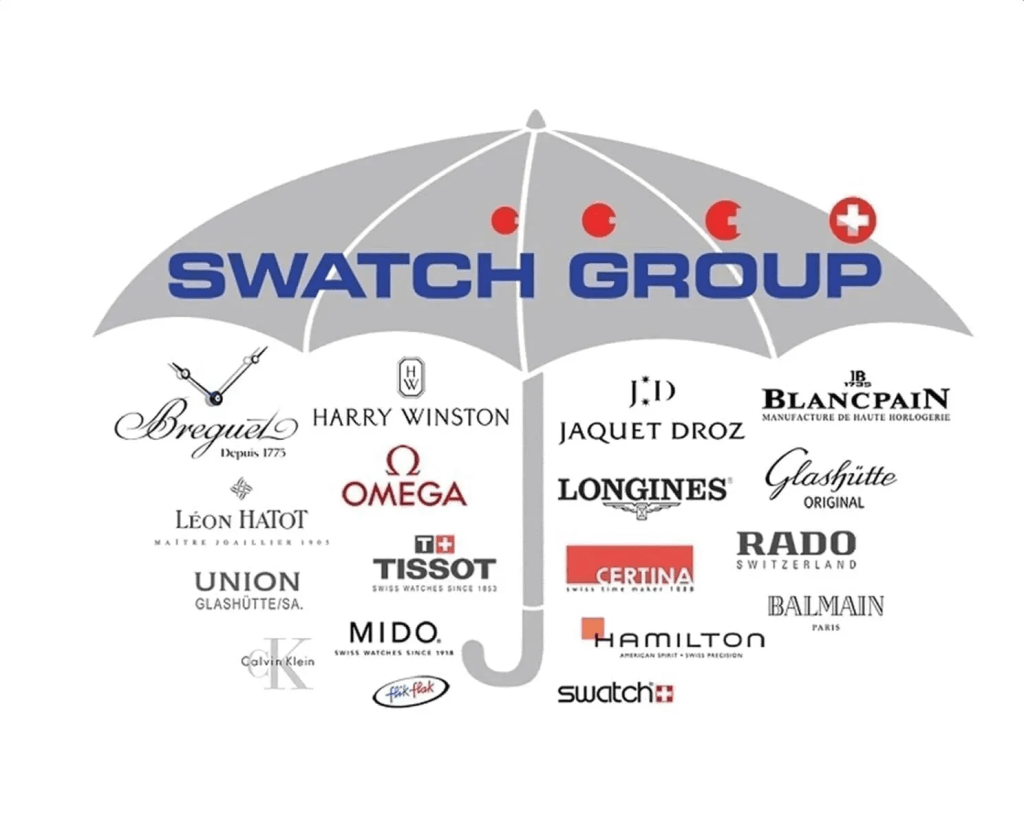
To solve this crisis, the Swatch Group was founded as SMH (Société de Microélectronique et d’Horlogerie) in 1983 through a merger of two companies: ASUAG (Allgemeine Schweizerische Uhrenindustrie AG) and SSIH (Société Suisse pour l’Industrie Horlogère). ASUAG had been the largest producer of mechanical watch parts in the world, and SSIH was a group that owned brands such as Omega, Tissot and Lemania.
The merger collected Switzerland’s most popular watchmakers and the largest movement manufacturers in the world under one umbrella, allowing all involved parties to cut costs and become more effective in their operations. The situation had been so dire that SSIH had become insolvent and had been seized by its creditors (mainly Swiss banks) in 1981, despite the fact that it was Switzerland’s largest watchmaker by volume.
Through determination, a healthy dose of goodwill from patriotic Swiss banks, and some private investors, SMH was created. And in 1983 they introduced the Swatch watch, which turned out to be wildly successful. These small watches came in colours, were cheap and accessible, and powered by quartz.
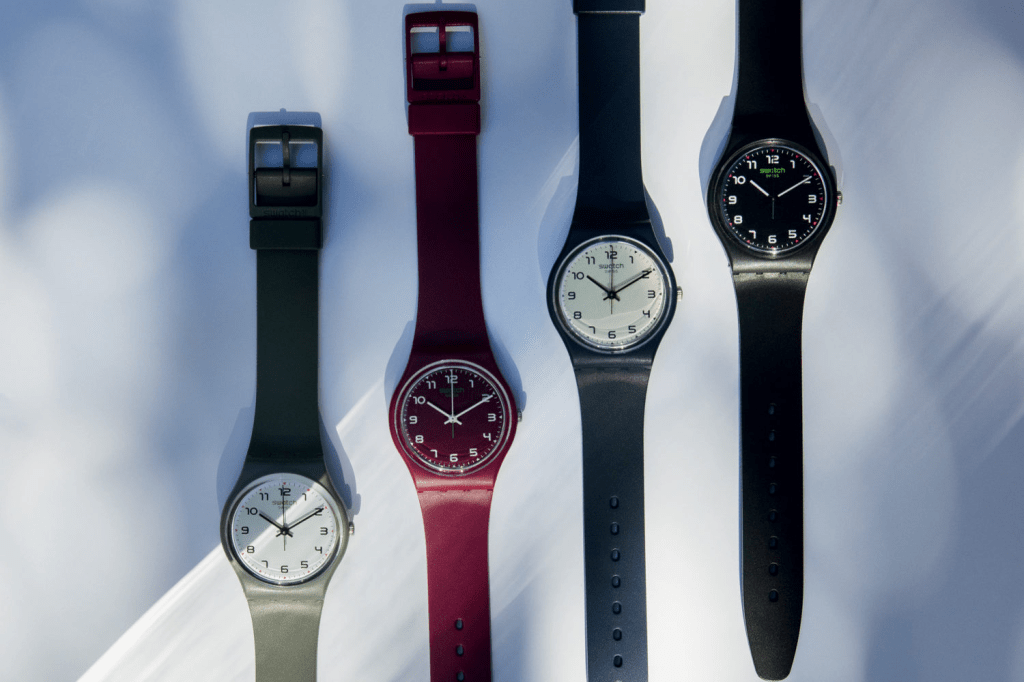
The Swatches would go on to become incredibly popular, and the profits were able to keep traditional manufacturers afloat. It is an amazing lesson to learn the power of technological disruption that forced the pivot into plastic quartz-powered watches, in turn saving the Swiss watchmaking industry. Today, the Swatch Group is the largest watch company in the world!
Leadership after Hans Wilsdorf
After Han Wilsdorf died in 1960, the leadership role was passed to André Heiniger. He had been a close friend and confidant of Wilsdorf and had been responsible for developing the South American market. He took over as CEO in 1962 and led the company for 30 years with great success.
Rolex had been recognized as one of the most skilled and meticulous watchmakers in the world for decades. The quartz crisis provided more reason to lean towards a luxury strategy. Marketing campaigns soon started to focus on the romanticism, craftsmanship, and legacy that Rolex possessed.
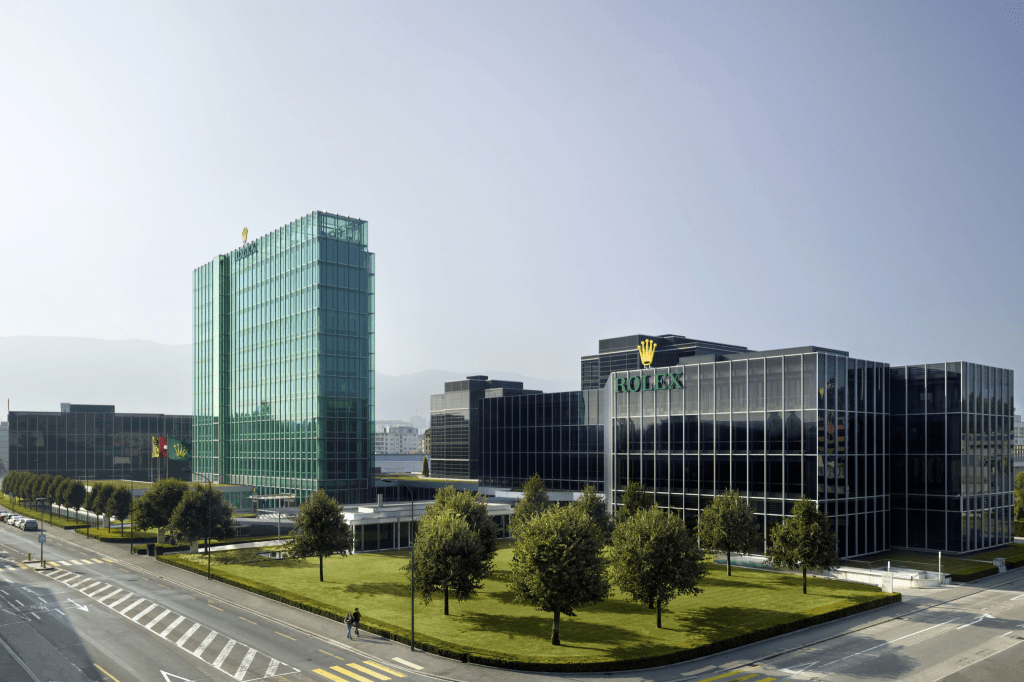
André Heiniger passed the role to his son Patrick in 1992. He worked on vertically integrating Rolex, owning and controlling all parts of manufacturing. There are four different manufacturing facilities, all located in Switzerland:
Final assembly, quality control, and global headquarters
Movements manufacturing
R&D and case-making
Production of dials and gem setting
The factories are themselves marvels of engineering and architecture, and the global Rolex Headquarters consists of 10 floors in total, with 5 of them hidden underground. These underground chambers are one of the most secure and secret parts of Rolex, and employees can only access rooms that are critical to their specific line of work.
Even the smelting of alloys and gold is made at their own foundry, recruiting the best scientists in the world to oversee production.
High Quality Standards
Rolex is known for and prides itself on perfection in its products. The testing and quality control are incredibly detailed.
The process looks different for all models but goes through roughly all of the same steps. The watches are tested for their water resistance in purpose-built pressure chambers, with a 25% extra margin. For example, the Rolex Submariner is rated for 200 meters of water resistance but is tested down to 250 meters to make sure that everything runs correctly. The watches are checked for timekeeping in a number of different positions over the course of several days. Watches are photographed, left in place for 24 hours, and then photographed again. If they are off by as much as a second, it will be sent back for adjustment.
Rolex has also built custom machines to help them out in their testing. For example, they built a machine that can open and close a clasp 1,000 times over a matter of minutes to ensure that everything works as it should. They also have a sorting machine for gemstones and jewels that identify fakes or undesirable stones.
It is reported that less than 0.1% of all watches show problems and have to be sent back. Assuming that the estimation of Rolex sales number per year is 1.2 million, it would mean that less than 1,200 watches per year fail quality control.
Rolex defines Luxury
When looking at some of the most successful luxury brands in the world (Hermes, LVMH, Ferrari), several things stand out as shared and defining characteristics: a long and storied history, exclusivity, quality, and status. Rolex checks the boxes on all of these.
Heritage is an important factor to Rolex’s success. While it didn’t invent many of the things that made it famous, it popularized them. The demand for Rolex watches far exceeds supply, and its quality and craftsmanship is unmatched. Rolex only associates itself with the most prestigious sporting occasions in the world such as Wimbledon, The Masters, Monaco Grand Prix etc. It partners with the Vienna Philharmonic Orchestra, sponsors the Academy Awards, and supplies explorers and scientists with watches.
If we strip away all of its history, sponsorship, and associations, we are still left with a mechanical watch. In this day and age, when everyone has a smartphone in their pocket, doesn’t that make the logic of spending thousands of dollars on a mechanical watch – the very definition of luxury?
Well done. This was a great read.
Also, fun facts: Hillary and Norgay did not wear Rolex to the top of Mt. Everest and Don Walsh did not know Piccard had strapped a Rolex to the outside of the Trieste. If he had known, he would not have allowed it.