
History: Ferrero Group
Intro
The richest Italian is Giovanni Ferrero, no prizes for guessing which business he runs. It’s in his family name: Ferrero.
He’s the grandson of Pietro Ferrero (1898 – 1949) who was the founder of Ferrero SpA. Today, the Ferrero Group is the world’s third largest chocolate maker. At the mention of “Ferrero”, many famous brands come to mind: Kinder Surprise, TicTac, Nutella, Ferrero Rocher… Last fiscal year it made €18.4b in revenues, employs more than 40,000 people with 37 production plants across more than 50 countries.
Nutella, the hazelnut spread, is the most important product and accounts for 20% of total sales. Let’s go through a brief history of Ferrero…
Hazelnut + Chocolate
The very first prototype of “Nutella” was invented in 1806 during the Napoleon Wars. The story begins in Piedmont in northwestern Italy. This area is known for its centuries-old love affair with chocolate, it’s said that Swiss chocolate makers came to the region’s capital, Turin, to learn chocolate making.
Napoleon started a continental blockage against his foes in the United Kingdom, which ordered France’s allies to cease trade with the British. The embargo caused a sudden shortage of cocoa. As a result, Piedmont’s chocolate makers managed to discover that hazelnuts when roasted and ground with chocolate would not only help backfill cocoa, it would taste very nice too. It happened that high quality hazelnuts grew in the hills of southern Piedmont!
The next cocoa shortage would again happen in WW2. In 1946, Pietro Ferrero created a hazelnut-chocolate mix called “Giandujot”:
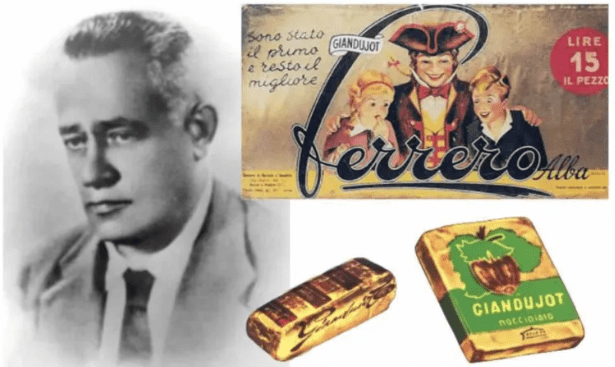
Pietro came from Alba, Italy where hazelnuts were plentiful. Its high fat content and nutty flavor complements bitter chocolate very well. Just 3 years after inventing the early version of Nutella, Pietro died at age of 50, and his brother continued to run the business until his only son, Michele, joined the company.
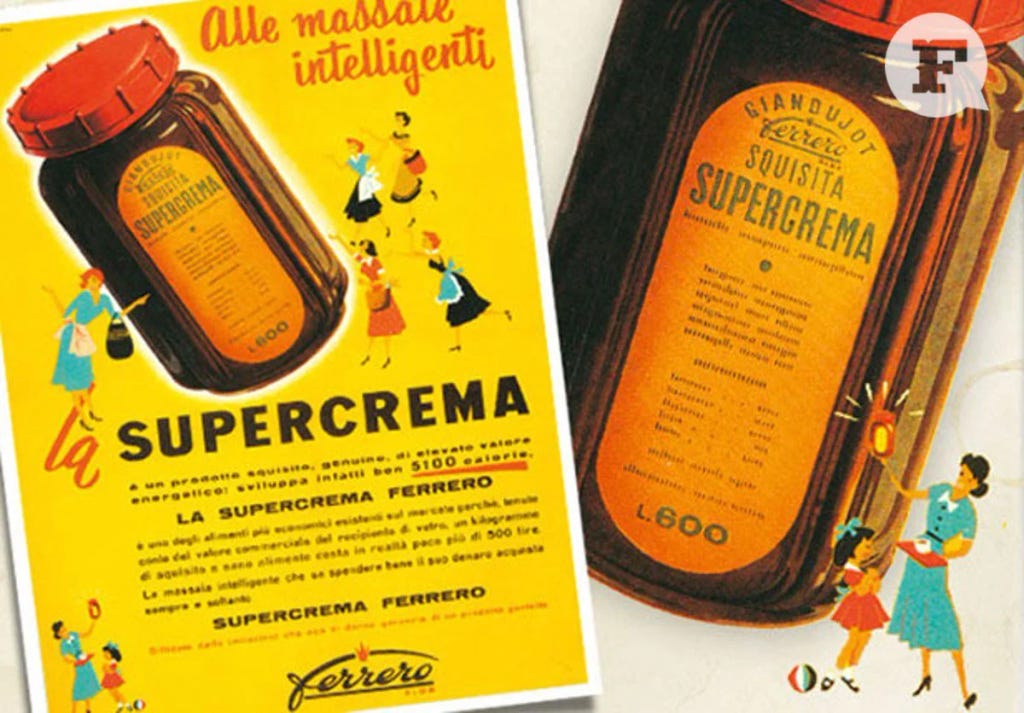
The company turned the popular Giandujot into a spread called Supercrema. They cleverly sold it in jars and pots, because during those times penny-pinched customers could reuse the containers. Rather than distribute it through wholesalers, they used an army of salesmen who went directly to stores to help keep prices low.
In 1957, Michele Ferrero took over and the hazelnut product would have one final rebrand in 1964. That year, the Italian government started to crack down on superlatives in advertisements. So Supercrema was renamed to Nutella.
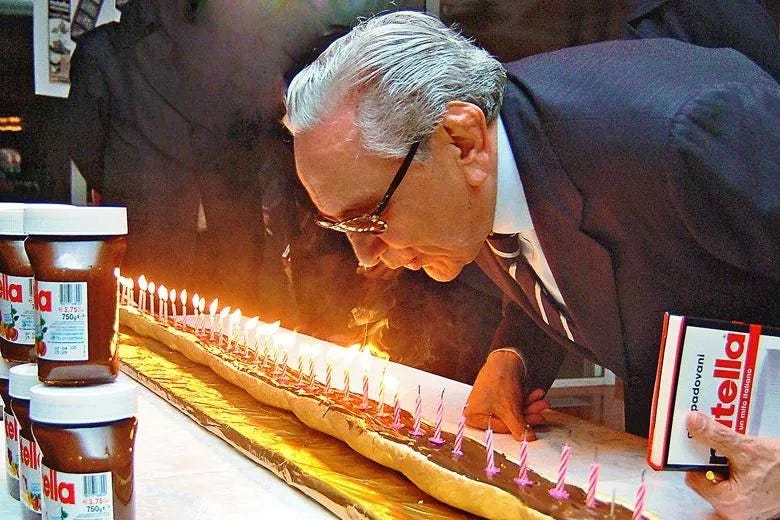
Michele Ferrero
Michele was no slack and pushed his father’s company to new heights. He was addicted to the game of inventing new candies and came up with these popular sweets:
Mon Cheri (1956): A cherry-liquor filled chocolate. Michele created a method whereby the chocolate would not absorb the liquor filling. It was a huge hit in Germany.
TicTac (1969): Little oval mints were named after the sound of opening and closing the container.
Kinder Surprise (1974): Michele wanted children to experience Easter everyday, so he create a toy-in-chocolate eggs.
The factory from which these hot-selling products were coming from was mostly closed to outsiders, while employees came from multiple generations of the same family who were loyal to Michele.
In an effort to safeguard Ferrero’s secrets, he told the workers in 1957:
I will not rest until I have secured a safe and peaceful future for your children.
The requirements to be a taste tester in Ferrero was no joke:
To be selected they must correctly identify the flavours of sweet, bitter, salty and umami… In another fiendish test, citric acid, kitchen salt, sugar and caffeine are dissolved in water. The tasters must then be able to place them in order of greatest concentration.
Women between 25 and 40 are best, although pregnant women are the most sensitive to taste. Candidates are then tested with raw materials such as milk, to see if they can identify the one that is less fresh.
We have to talk about the famous Ferrero Rocher which was launched in 1982 after spending 5 years perfecting the spherical wafer filled with hazelnut and covered with chocolate. This nut confection is known as praline.
The packaging is another masterclass. Nobody can forget the gold foil with a paper basket; the ritual to unwrapping it makes it feel special. Michele designed it after the Lourdes Massabielle Grotto in France, where he visited every year on pilgrimage (he was a man of deep faith, insisting on meditation every night):
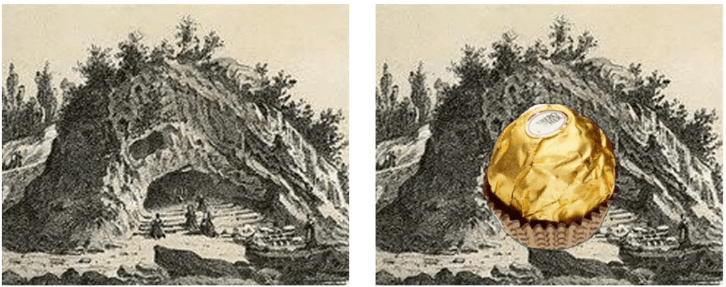
Ferrero sells 1/3 of its annual supply of Rochers during Christmas. In 2024, it was reported that their Alba factory could produce 24 million Rochers per day.
Michele is seriously obsessed about knowing why customers liked his products. He would get some supermarkets to agree to sell his products without a label, then have his employees wait outside the supermarket to offer compensation to the shoppers to be interviewed. The shoppers would then go to the office, where Michele hid behind a mirrored glass and listened to why they bought Ferrero chocolates.
Another trait of his was obsession with details. For Michele, it wasn’t enough to know where a lemon came from. He wanted to know at what altitude it was planted and whether it faced the sun or not.
By the 1980s, Ferrero was operating on a global scale with sales passing $1b. Michele attributed much of his success to keeping things within the family, resisting outside investors, and allowed the business to grow at its own pace. He also treated all his workers with care, supplying employees with heat from the factory for their homes, with sports facilities and lifelong health insurance. In 70 years, Ferrero never had a strike.
Michele held secrecy to a high level and only gave one interview during his lifetime. He would teach his sons to stay out of the spotlight and put the customer at the center every day:
Only on two occasions should the newspapers mention one’s name: birth and death.
Michele Passing the Torch
Michele married his secretary, Maria Franca Fissolo. This was in his proposal:
I will be extremely happy if you were to say yes to my proposal to marry. But think it over carefully, if you accept, you would marry a man who will always talk to you about chocolate.
Well, she said yes and they had 2 sons: Pietro and Giovanni.
Training began early, when Pietro was still young he would take him to the Alba factory, blindfold him and tell him to find the exit using his sense of smell.
Both brothers went to Brussels to be educated and then worked at Ferrero in different roles before becoming co-CEOs in 1997. At this stage, Pietro was 34 and Giovanni was 33, the company had sales of $5b a year.
Unfortunately, tragedy struck in 2011 when Pietro died from a heart attack while biking in South Africa at the young age of 47.
Then, in 2015, Michele Ferrero died in his Monaco home at the age of 89, fittingly and poignantly on a day dedicated to chocolates and love: Valentine’s Day.
The Ferrero website went dark on that day with only a simple tribute:
We are proud of you. Thank you, Michele.
Now the only family member left to continue the business was Giovanni, so he took full control and continued to reject any offers to buy his family business. He believe that the confectionary industry was headed for the same type of consolidation as the beer industry where 4 firms: AB InBev, Constellation Brands, Heineken and MillerCoors own 86% of the market.
Hence, he wanted Ferrero to be the front-runner, spending billions of dollars on acquisitions to expand Ferrero’s footprint in the US and UK:
Thorntons $177m (2015): An iconic UK chocolate brand (with all physical stores shut down since COVID).
Fannie May $115m (2017): The American chocolate maker was acquired from 1-800-Flowers.
Ferrara Candy $1.3b (2017): Acquired from private equity firm L Catterton.
Nestle’s US candy business $2.8b (2018): The Swiss consumer giant actually tried to acquire Ferrero Group but was rebuffed. In the end, Ferrero acquired Nestle’s classic American brands like Baby Ruth, Butterfinger and Crunch.
Kellogg’s Snacks $1.3b (2019): Another acquisition of popular US snacks including Keebler, Famous Amos, Mother’s and Murray and Little Brownie Bakers.
Burton’s Biscuit’s $426m (2021): The deal included Maryland Cookies, Jammie Dodgers and Wagon Wheels.
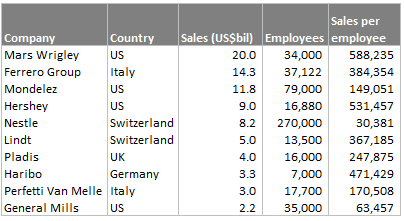
These are the top 10 candy makers in the world (2022 stats), Ferrero is only second to Mars:
Final Notes
Ferrero is the world’s largest buyer of hazelnuts, taking in about 25% of global supply. To secure this important ingredient, in 2014, they acquired a hazelnut factory in Turkey. However, there are controversies about the use of child labor, often Kurdish migrants, as over 70% of production comes from Turkey.
Ferrero went further and bought 2 of the largest hazelnut traders: Oltan Group (Turkey) and Stelliferi Group (Italy).
On September 2017, Giovanni stepped down as CEO and transitioned to the role of executive chairman. He and his family live in Brussels, Belgium, but he runs the company from Luxembourg, allegedly commuting via helicopter to get to work.
Today, Ferrero Group is run by Lapo Civiletti who is the first non-family CEO.
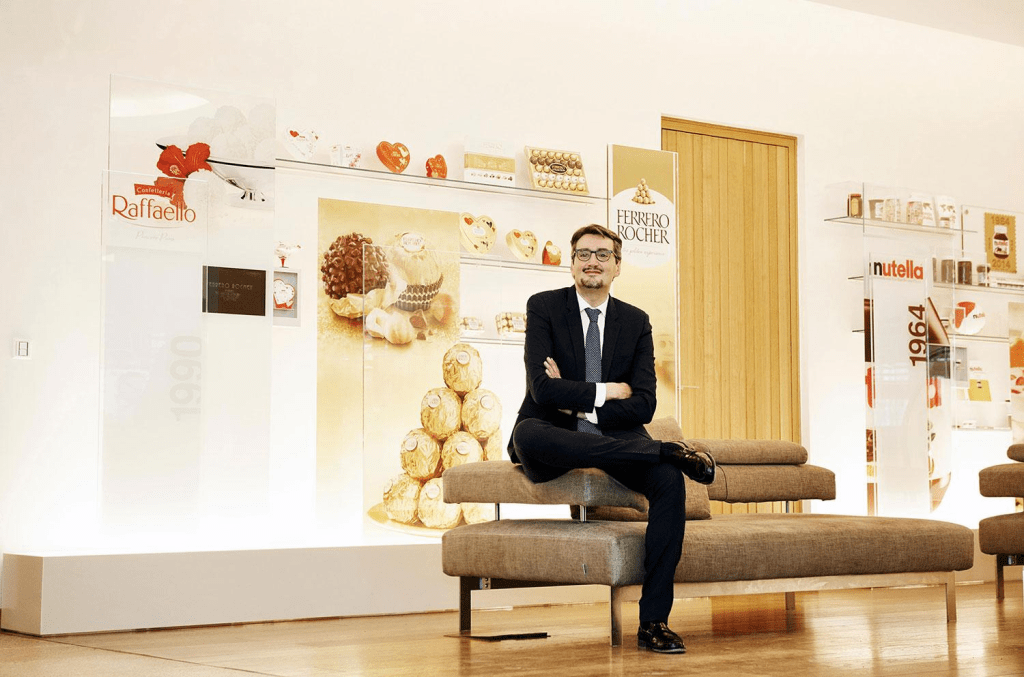
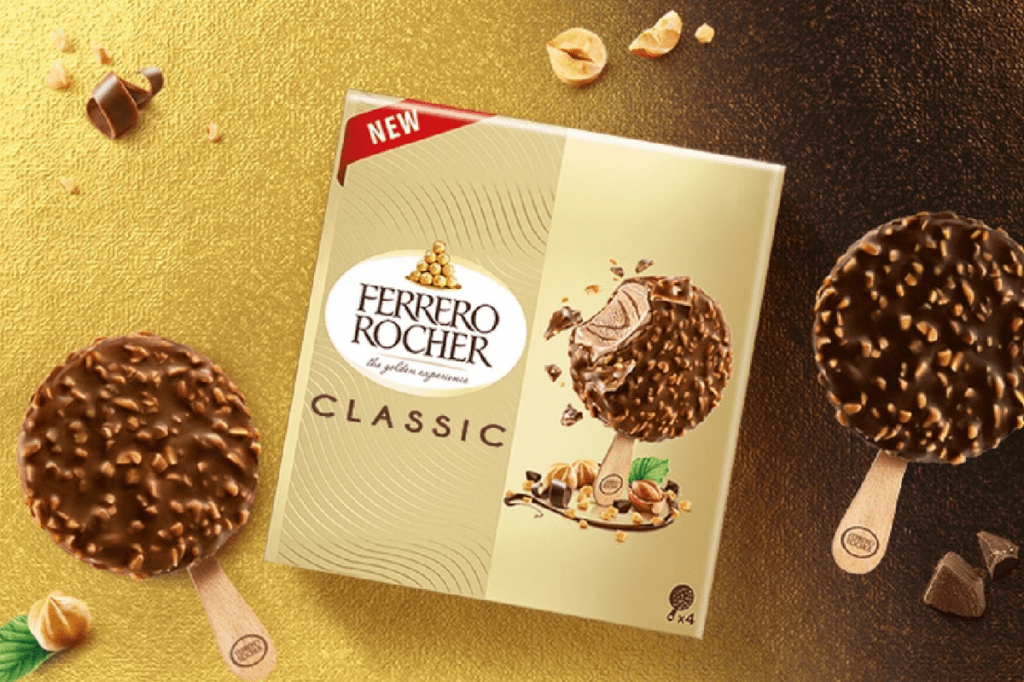
Recently, Ferrero Group is back to its inventive roots, in 2021 they unveiled its first ever ice cream stick and chocolate bar:
At the age of 61, Giovanni Ferrero net worth is estimated to be $40.7b. He is also a novelist who has published 8 books, his first novel was a 1999 paperback published by Goodreads called Stelle di tenebra (Stars of darkness).
Giovanni continues to inculcate the good values that drive a compounding business; taking care of your employees:
I strongly believe that attention to employees’ needs, to their families, to their life even when they quit working, cements a social cohesion that is mutually beneficial.
Giovanni Ferrero