
History: Creative Technology
Old Enough to Know
Who is old enough to remember sound cards that came with PCs?
When I was a kid, computer games had to be configured with the right sound card. Since SoundBlaster 16 was the best, I always chose it first. But then, there was always no sound, and I had to go down the list and pick a config that worked. At that time, I didn’t know what hardware was, it turned out that my computer didn’t even have the SoundBlaster chip — it took years to understand why I was a frustrated boy.
Back in 1990, the original SoundBlaster was introduced and it was the dominant sound card for consumer audio on the IBM PC.
The product was created by Creative Technology. It also made a flurry of sound cards, with SoundBlaster becoming the most iconic and ubiquitous. By 1995, it accounted for 70% of sound cards sold. Yet, Creative would make many bad business decisions and went into permanent decline.
Let’s walk through the rise and fall of Creative.
Enduring Childhood
Sim Wong Hoo (沈望傅) was born in the small tropical island of Singapore in 1955. Before 1965, Singapore was not an independent state yet and was part of the British colony, having survived the Japanese occupation in WW2. Later it was part of Malaysia before becoming a fully independent country.
Wong Hoo was the 10ᵗʰ child in a Hokkien family of 5 boys and 7 girls, he grew up in a village in Bukit Panjang called End of Coconut Hill (椰山尾). His father worked as a labourer in a factory and later as a provision shop attendant. To supplement the household income, his mother reared a variety of livestock, grew fruits and herbs, selling eggs from door to door.
Unfortunately, his father died when Wong Hoo was only 13, leaving his widowed mother to raise the family. Growing up poor, Wong Hoo had to sell eggs at the market before school and had no money for toys. So he picked up a hobby of playing the harmonica at age 11.
Wong Hoo went on to get his diploma in Electrical & Electronic Engineering in 1975 from Ngee Ann Polytechnic. In school, he arranged musical scores for the harmonica troupe and learned to play the accordion. But every time the troupe played his arrangements, the music did not come out right. Wong Hoo was not able to tell whether it was because his composition was poor, or because the troupe members who practised only once a week lacked competence.
So he was constantly looking around for something that could play his compositions exactly the way he had written them. Eventually, his encounter with a computer would spark an idea of making a music synthesizer.
But making this dream would take a few more years to materialize.
Young Entrepreneur
After graduating and completing national service (mandatory military service in Singapore), Wong Hoo worked as an assistant electronics engineer at various places.
He finally landed a stable job at a small petroleum exploration firm. Wong Hoo worked with an American to build a computerized exploration tool. It was a success and Wong Hoo took over the design of a second system on his own. Despite this, his itch for computer music was unbearable. So on the first day of the new year in 1981, whilst working on an oil rig, Sim Wong Hoo looked up at the stars and set a goal for himself that he would make a million dollars within 5 years.
At a tender age of 26, Wong Hoo quit his job surviving on $200 a month, dedicating his time on computer R&D.
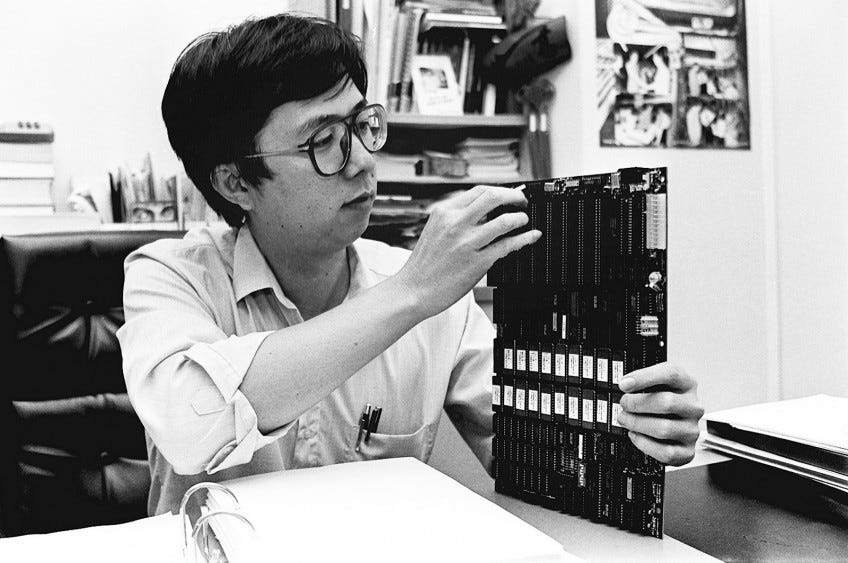
He teamed up with an acquaintance to open a tuition center offering computer classes. Wong Hoo just wanted to spend his time researching computer music and entrusted the business to his friend. However, he was left in the lurch when his partner vanished with a load of debt, leaving gangsters to loot the school of its furniture.
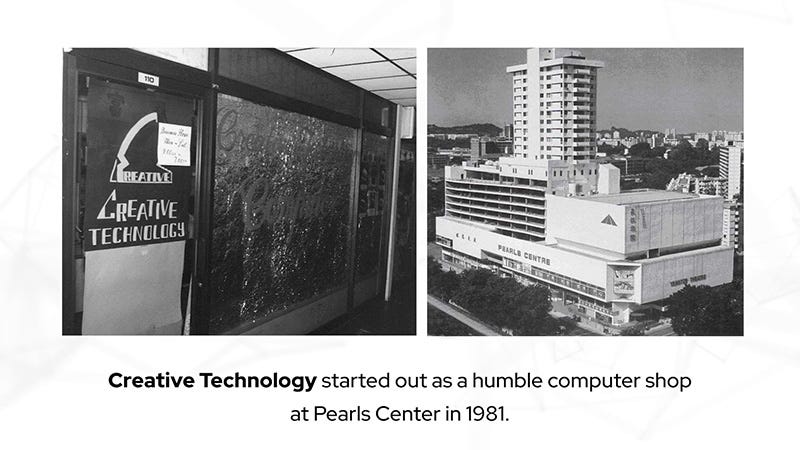
Then on July 1981, Sim Wong Hoo founded Creative Technology with his childhood friend Ng Kai Wa. Former accordion classmate, Chay Kwong Soon, came on as second co-founder in 1986.
They rented an office in a 440sqft shop at Pearl Centre (now demolished) with Wong Hoo’s savings of $10,000. To build capital, he gave computer tuition lessons, sold computer products and was a part-time teacher at a private computer school.
With admirable determination, Creative introduced the first PC to be designed and manufactured in Singapore named Cubic 99 in 1984. At this time, IBM PCs were sweeping across America, but in Asia the Apple II was popular.
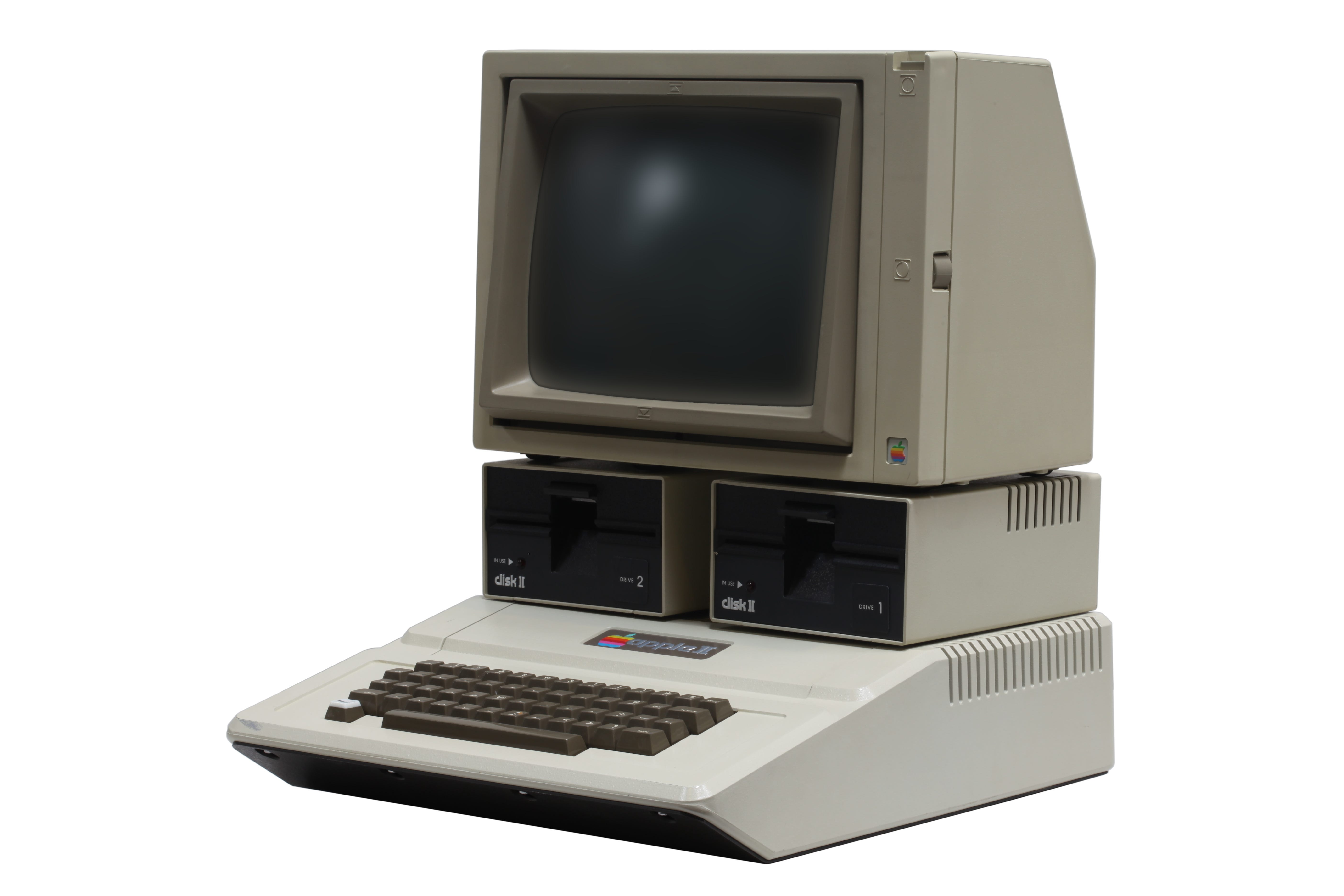
The Apple II in the early days was unusually open. People could just open the chassis up and study its components. More importantly, these components could be bought off the shelves. Tinkerers started to build their own Apple II clones. One of the reasons why the PC industry grew in Singapore was because the country had shops selling pirated software and components.
The Cubic 99 was somewhat a clone, with similar performance but cheaper and had the ability to process chinese characters. It had one disk drive and sold in 2 models: 64K at $1,350; 192K at $1,895. Equipped with dual CPUs, it could run software from both Apple’s operating system, as well as a disk operating system CP/M (Control Program for Microcomputers).
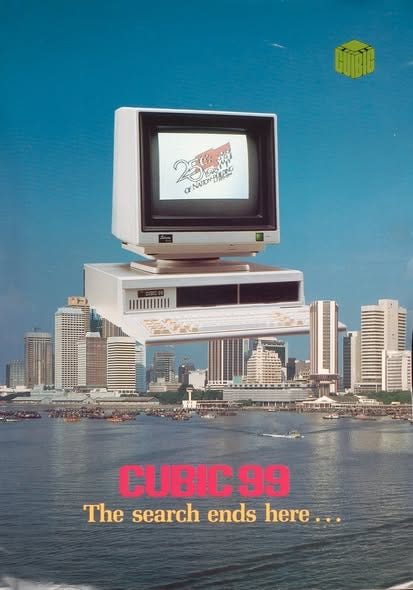
The biggest selling point was that Cubic 99 could speak. The computer could actually speak out basic commands! The idea was to help programmers not look at the screen by just listening to commands.
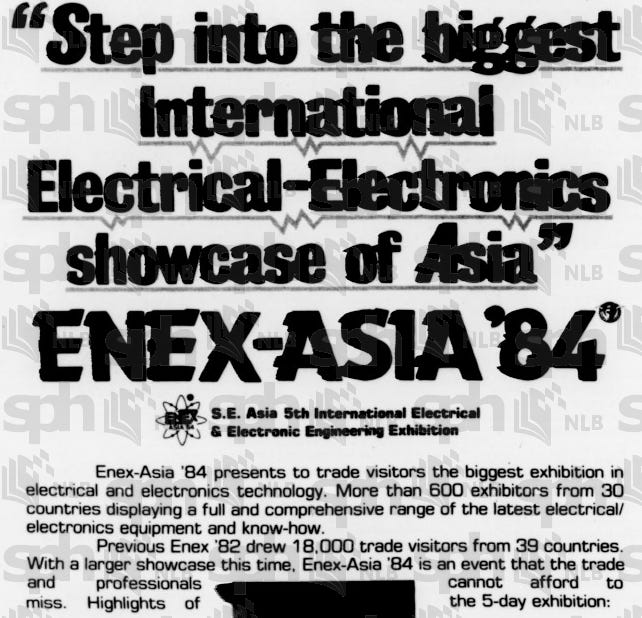
Breakthrough came during the October 1984 ENEX Asia exhibition held at former World Trade Center (now HarbourFront). Creative was selling one computer every four minutes on the last day, they sold a total of ~5000 units.
Two years later, in 1986, Creative announced Cubic CT, a computer with multimedia and multilingual capabilities. This was positioned as IBM compatible with better colour graphics and audio board for music. To cater for Singapore’s chinese speaking market, they had a system to execute commands in chinese.
However, sales was poor and Sim Wong Hoo lamented that Singapore was too small to support R&D efforts.
Advent of Sound Cards
IBM PCs launched the Personal System/2 (PS/2) line in 1987, introducing 3.5-inch floppy disk and VGA graphics. They became widespread across the world, these PCs came with a simple speaker that produced a single square wave, meaning that it could flip between 2 states — on and off.
It had no volume control and sounded like a beep. Its purpose was to alert users of errors. IBM never thought of doing more because business users didn’t care about sounds. But clever programmers learned how to trigger the speaker to combine rapid pulses of different lengths to produce sophisticated tunes. This method is called “pulse width modulation”.
Since the motherboard featured 5 to 8 internal expansion slots, people could build sound cards to create richer audio played via external speakers. So in 1987, IBM marketed a sound card compatible with its PCs capable of producing MIDI style music. However, this sound card sold at an expensive price tag of $600, half the cost of the whole PC itself.
Furthermore, the market for PC sounds was limited to gamers and it was a very small market in the late 1980s. So IBM’s sound card didn’t take off.
The first sound card breakthrough was from AdLib, a Canadian manufacturer of sound cards founded by Martin Prevel. The company released AdLib music synthesizer card in 1987, the hardware was simply a Yamaha synthesizer chip stuck onto the PC motherboard. But it contained a technology called FM synthesis, which allowed users to generate sine waves and modulate their frequencies to create rich sounds without using much compute resources.
The price point was only $200, offering a huge upgrade in audio quality and multiple channels of synthesized sounds. This caught the attention of American video game developer Sierra Entertainment which was known for pioneering the graphic adventure game genre. In 1988, they struck a deal with AdLib to support their next big game release: King’s Quest 4.
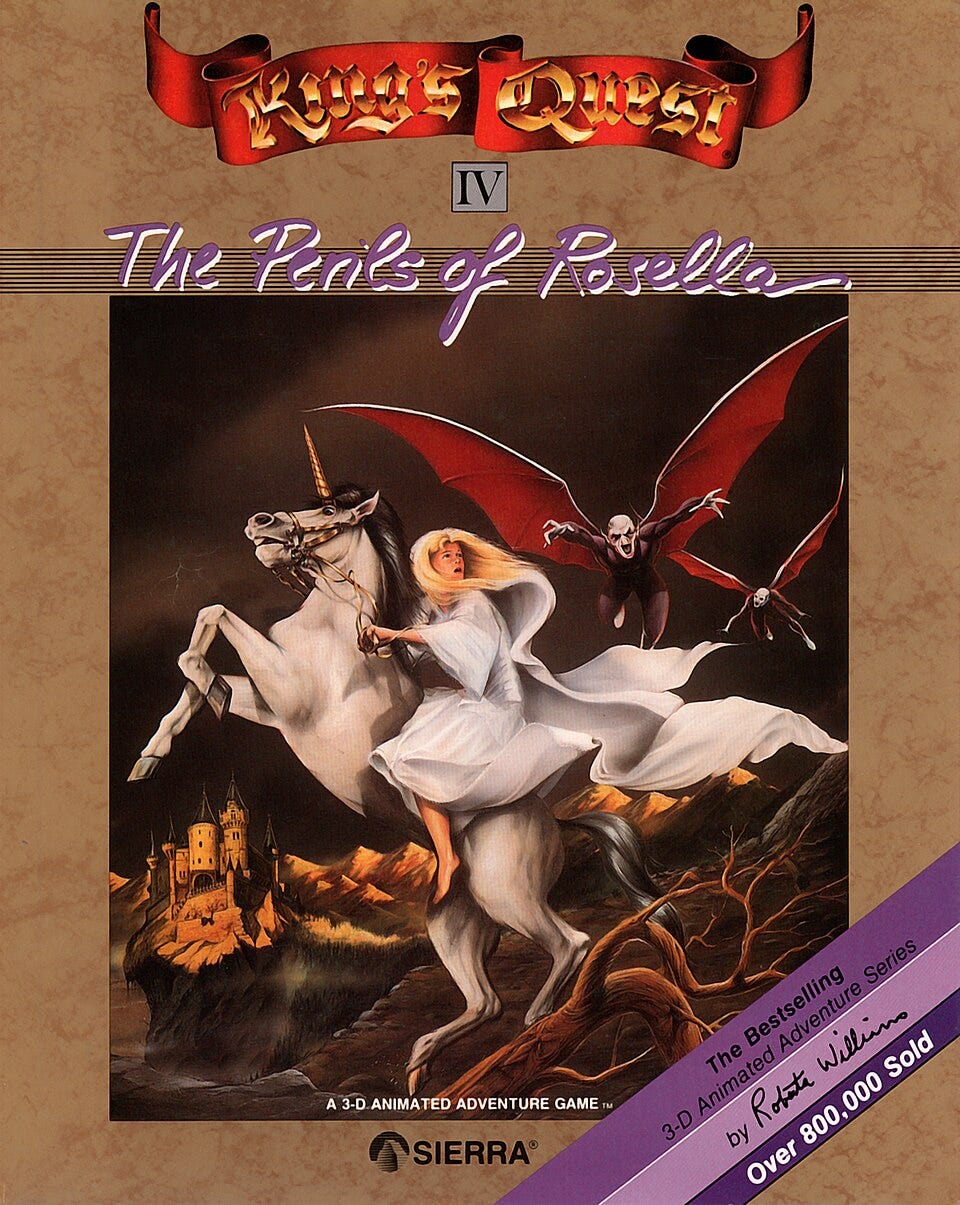
Sierra went to great lengths hiring composers William Goldstein and Jan Hammer for the music. Gamers who wanted the full experience had to buy a sound card, and most of them went for the cheaper AdLib.
Birth of SoundBlaster
Back at home, Sim Wong Hoo was no stranger to adversity and fortune would favour his hard work. In 1988, he decided to go to America, and told everyone that he would not return unless he made $1 million by selling 20,000 of their sound cards.
AdLib cards remained dominant and Creative Technology released their competing product, Killer Card, in June 1989. The name didn’t sound right and was renamed to SoundBlaster.
SoundBlaster had 2 advantages over AdLib:
AdLib can play a video game’s music but cannot play the sampled sound effects (booms, bangs, zaps etc.).
SoundBlaster added an in-built game port allowing users to connect a joystick saving players from buying a $50 adapter.
They debuted it at the Comex show in Las Vegas on November 1989.
It was a big hit. Wong Hoo recounted the event:
Michael Jackson stopped by for a whole 30 minutes… We sold about $100,000 of cards at Comex, people lined up in 20 queues in front of 3 cashiers in our tiny 300 sqft booth.
As a result, Creative reported $30m sales in 1989. From this, they sought to make SoundBlaster as the standard audio hardware for PCs. They went around raising money and incentivizing game developers by giving them free developer kits, consultancy and technical support.
AdLib fought back with its competing product, AdLib Gold, which used Yamaha’s newest chip and debuted in the 1991 Comex. They planned to launch a huge ad campaign but Yamaha didn’t ship them the new chips on time. Rumour has it that Creative was Yamaha’s biggest customer and caused them to delay the chips.
In 1992, Creative got a similar Yamaha chip and used it to launch SoundBlaster 16. It sold like pancakes, achieving a sales figure that Wong Hoo couldn’t imagine: over $1 billion — 1,000x his initial $1 million promise!
At this stage, SoundBlaster was 72% of global market share in 1992. The same year, Creative went public on NASDAQ offering 4.8 million shares at US$12/share. The IPO was 5.5x oversubscribed, bringing in US$37.5m for expansion plans and US$13.5m for the 3 founders.
In 1994, Creative listed on Singapore’s stock exchange raising S$230m.
Then in 1995, the 2 co-founders Ng Kai Wa and Chay Kwong Soon resigned wealthy and walked off into the sunset.
On the other hand, AdLib spent too much money on marketing and went bankrupt on May 1992. The Quebec government bought the assets and sold them to Binnenalster (German company), subsequently it was sold again to Softworld Taiwan in 1994. AdLib is now defunct and their original cards are now collectors’ items.
Bad Capital Allocation
After the massive success on sound cards, Wong Hoo decided that his company had to diversify. So in late 1994, Creative started to make CDROM drives. They did this just as the cost of drives crashed. Profits fell from $97m in 1994 to $26.5m in 1995, margins fell from 15% to 2%.
Creative’s stock price collapsed -20% over 2 weeks.
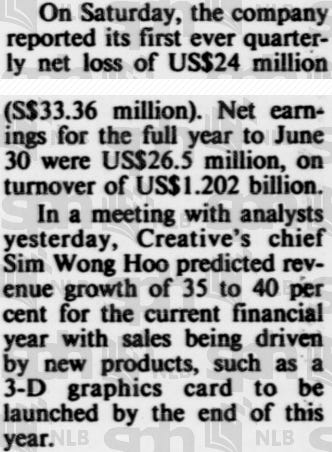
Things went from bad to worse. Wong Hoo decided to go for 3D graphics cards and predicted revenue growth of 35—40%. Instead, they reported its first ever quarterly net loss of $24m in Q3 1995.
Creative launched their 3D Blaster graphics card in 1995. But it arrived at a time when other graphics cards like 3Dfx held the high ground. It was a bad venture but Creative nevertheless kept it in the market until the early 2000s. 3Dfx itself would go bankrupt in 2002 and was acquired by Nvidia.
Despite these setbacks, Sim Wong Hoo was recognized as a hero in his home country, hailed as Singapore’s own Bill Gates.
Singapore’s founding father, Lee Kuan Yew, gave a speech at NUS in 2000 and lauded Sim Wong Hoo:
While I encourage our young to be more entrepreneurial and to take risks, please do not simply rush into dot.com companies. Remember that in certain areas you will go into head on competition with the brightest and the best of millions of young Americans, plus Indians and Chinese already in Silicon Valley.
A few can make it like Sim Wong Hoo, and he has to make tremendous efforts to stay ahead of the competition.
Eventual Demise
What killed Creative’s business would come from technological advancements. This is the fate of most tech companies due to the industry’s rapid changing nature survivors have to find new transition phases to ride.
In 1995, Windows 95 was launched. Microsoft and Intel decided that audio was too important to be left to third-parties.
Intel's chips had gotten fast enough to handle some of this signal processing. So in 1997, Intel developed audio codec 97 (AC97), a landmark in PC audio systems and posed an existential threat to sound cards.
Subsequent sound cards, the SoundBlaster Live (1998) and Audigy (2001), still produced good sales, but it was clear that ordinary consumers no longer needed a sound card, causing the lower end of the market to collapse.
Creative wouldn’t die without a fight. In 1998, they created Environmental Audio Extension (EAX). EAX was a library of sound effects written and compiled by sound cards. The aim was to create more ambiance within video games by more accurately simulating a real-world audio environment.
EAX was used in many popular titles of its time like Doom 3, Counter-Strike and Half-Life.
A similar competitive situation like the earlier AdLib emerged. This time the competitor was Aureal Semiconductor whose product was called A3D. In comparison, A3D was the superior product. Creative retaliated with multiple legal suits, suing Aureal for patent infringement and false advertising, Aureal won in 1999 but went bankrupt from legal costs. Creative eventually acquired them in 2006 for US$32.3m in cash and stock.
This life line didn’t save Creative as the company continued to make poor capital allocation decisions. For example, in 2005 they made MP3 players called ZEN.
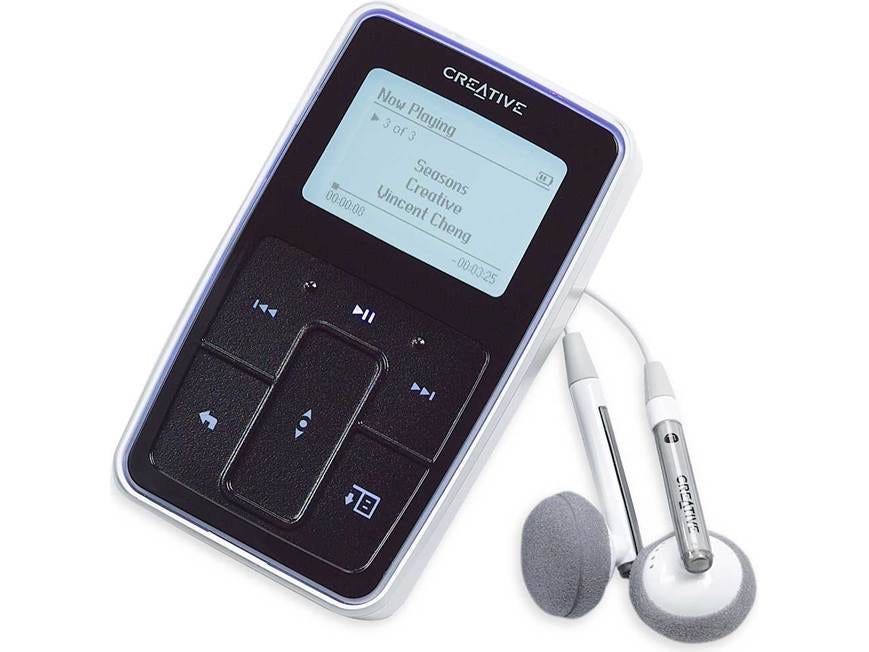
Although Creative’s MP3 players boast relatively larger storage capacity, but Apple’s iPod was too strong of an opponent. Sales of Creative’s MP3 players decreased significantly after 2005, while the iPod dominated with 76% market share in the US by 2006.
Creative went back to legal battles, suing Apple for patent violation which they just settled for $100m and moved on. Ten years later in May 2016, Creative played the legal game again suing 7 smartphone makers using ZEN’s patent. Among the alleged were Samsung’s phones containing the Google Play Music app with “the capability of playing stored media files selected by a user from a hierarchical display”. This suit was invalidated in the courts.
An even more frustrating decision was to go into e-commerce. Sim Wong Hoo imagined an ecosystem of internet businesses selling low margin entertainment products under his umbrella. Of course, Amazon would completely destroy such attempts.
The death blow came in 2007 when Microsoft dropped support for EAX, killing off access to the sound card. Video games quickly followed, removing support for EAX.
Also, the rise of game consoles (PS, Xbox, Nintendo) moved developers away from the PC. These consoles have their own audio standards. Creative didn’t go bust immediately but was left behind and forgotten by the tech world.
Put to Rest
Creative stock was delisted in 2007 but continues to trade on Singapore’s stock exchange. Today, the company is worth just S$46m, a mere shadow of its past having lost 98% of its market value since IPO.
The future doesn’t seem bright either after Sim Wong Hoo unexpectedly died in 2023 at the age of just 67.
At the junction of delisting from NASDAQ in 2007, he started taking running seriously and had completed more than 50 marathons, including at least a dozen ultra-marathons.
Although Creative is a loss making business today, we cannot deny that Sim Wong Hoo was an amazing entrepreneur who brought a local firm from a small island state with scarce resources, onto the world stage. Creative was the first Singaporean company to IPO in America, and Wong Hoo was at one point in time the richest man in Singapore.
He will be remembered as the person who gave computers a voice.
Readers who made it this far probably understand why we shy away from tech investments. We simply don’t have the expertise to navigate the fast changing nature of tech — a seemingly enviable position like SoundBlaster can be quickly toppled by changes we can’t see.
There are many similar examples like these we have written in the past:
We’re not saying it’s a bad idea, it’s just that there are people who can do this, but we’re not one of them.