
History: Costco Japan
Intro
In August of 2024, Costco opened its first store in Okinawa. There was a 5 hours long car line just to get into parking and another 3.5 hours long wait to get into the building.
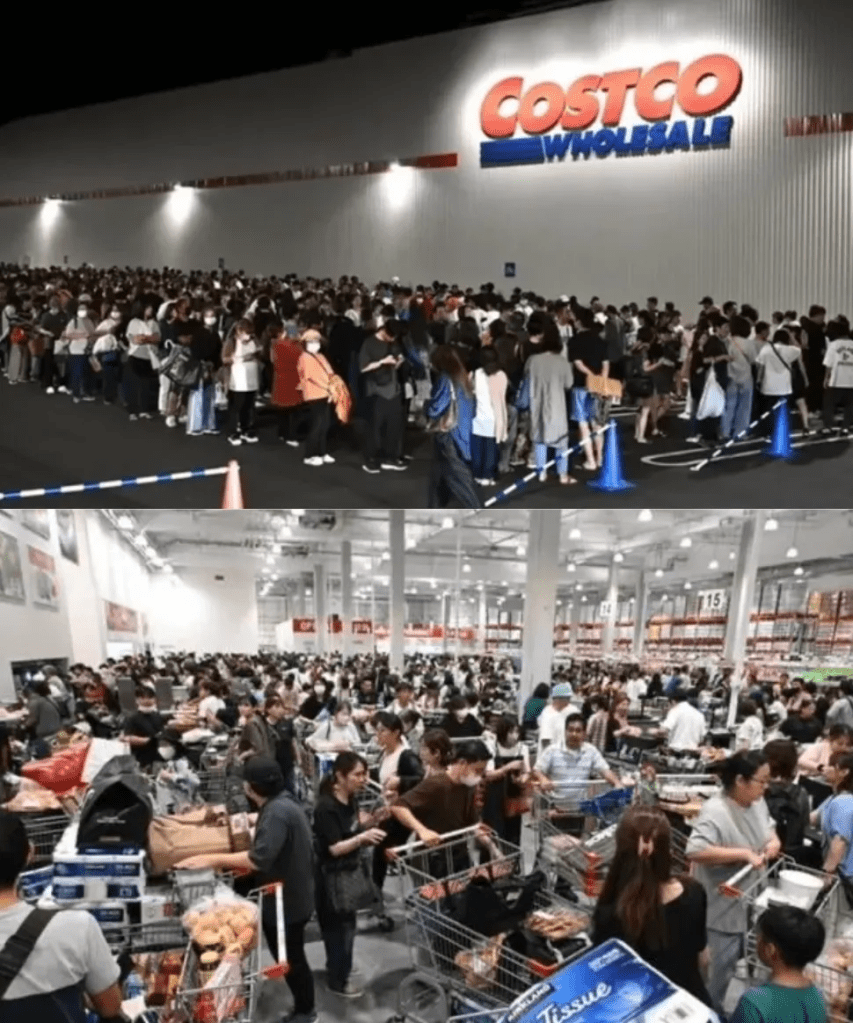
The hype is not surprising, Japan is actually the largest Costco market outside of North America. But the retailer’s presence in Japan is impressive because of how hard it has traditionally been for foreign grocers like Walmart, Tesco, Metro and Carrefour to find success there.
History: Before Japan
The first Costco Japan store opened in 1999. It was located in Fukuoka. However, Japan wasn’t the first Asian country that Costco expanded into. Back in 1993, Costco merged with Price Club and took their warehouses into South Korea (1994) and Taiwan (1997).
In the Far East, there was the lure of a fast-growing middle class with a fascination for Western products, but there were also challenges on implementing Costco’s bulk purchase model in smaller asian homes. They had to contend with limited real estate for commercial use, land laws and zoning regulations too.
Costco had to find local partner in these markets to break in.
For South Korea, they approached Shinsegae (신세계) and agreed that Shinsegae would own operations while Costco would license its name and run the show. On October 7, 1994, the first Korean warehouse opened, in Seoul’s Yangpyung (양평) neighborhood, under the well-known Price Club banner (even though by that time, Prices had left the merged company). At 94,000 sqft, Yangpyung is the second-smallest warehouse in the Costco system, with parking above the main retail floor.
For Taiwan, Costco sent Richard Chang who’s a Taiwanese-American. The local partner was President Group, which owned Talee’s Department Store (高雄大立) which was the first department store chain in Taiwan (it was a JV with Isetan of Japan in 1992).
They opened the first Taiwan warehouse in 1997, in the same year that the Asian Financial Crisis struck.
The recession depreciated South Korea’s currency and Shinsegae sold off its majority stake to Costco, eventually they were completely bought out in 2017. Taiwan’s President Group fared better, holding a 45% stake in the JV until selling it all back to Costco in 2022.
Entry into Japan
When the Asian Financial Crisis came, Japan was still reeling from the effects of their asset bubble collapse in the 1980s.
Despite these challenges, Japan was still the second largest economy in the world. There was also an interesting characteristic in the Japanese retail market; trends catch on fast and can grow very large. For example, in the mid-1990s, at the same time when Costco was planning to enter, Hello Kitty unleashed a powerful trend in Japan. These types of trends are juicy margins for retailers who can capitalize on them.
So many Western companies attempted to capture some value for themselves. Brands targeting a single industry (Toy R Us, McDonald’s, Office Depot) found success while supermarkets (Walmart, Tesco, Metro, Carrefour) flopped.
Japan’s retail market would prove to be more difficult than Taiwan and South Korea.
Costco entered Japan by partnering with a local land developer called Torius that was pushing the envelope on Japan’s land use rules.
The main difficulties were:
Limited land: Buildings had to go high or go underground. This is not the typical Costco warehouse blueprint.
Converting farmland: Through agricultural co-operatives, Japanese farmers have a lot of political power. To entice farmers to turn rice fields into commercial space, Torius proposed to lease rather than purchase the land, allowing aging local farmers to earn five times more money by signing a contract than they would straining their backs in their fields.
Landlord requirements: Torius eased financial concerns by offering flexible and relatively inexpensive terms to tenants. Instead of a fixed monthly rental, retailers could pay a % of sales.
Fortunately, there was a particularly onerous regulation that was changed. The Japanese government relaxed a notorious large-store retail law that had previously made it very hard for foreign competitors to enter the country.
Under this onerous regulation, large retailers had to “first gain the approval of every local store in a neighbourhood” and also “stay closed almost a month each year so as to be less of a competitive threat.”
These laws were made to encourage post-WW2 rebuilding efforts by protecting local businesses. However, as times have progressed, the 1990s wasn’t a period for protectionism. Japan had to open up quickly.
Leveraging on Torius expertise and a changing economic environment, Costco’s business model had a chance to success in Japan.
Unique Characteristics
Michael, the son of Costco’s founder Jim Sinegal, was entrusted to open Costco Japan.
This was how Jim Sinegal recounted the idea in 2015:
One of my sons, Michael, we sent him and his wife to Japan. They lived there for 15 years. They started the Costco business in Japan, and their two daughters were raised in that country.
As you might imagine, he became very fluent in the language. After about 15 years, I asked him if his wife — who I thought had been a real trooper with the kids, living there for that long — I said, “Would you guys like to go live in France? Because we’re thinking of opening up in the continent, in Western Europe.”
Since he was fluent in French and Spanish and had [opened a Costco in a country], we thought this would be a great opportunity. He went over there and he’d been over there for about a year, and he came to me and he said, “Pop, I’ve decided that I want to go back to school, and I want to become a physicist.”
I said, “How do you spell that?”
When Costco opened its first Japan store in 1999, it was a small commitment in the grand scheme of things. Costco already had over 300 locations and was generating $24b annually.
Nevertheless, it was an opportunity that Michael seized well. At that time, the Japanese consumer was very budget conscious. Costco’s cheap prices played perfectly into that.
Urban Landscape
Costco adapted well into the geography of Japan, building multi-level warehouses with giant moving ramps to ferry customers and pallet elevators for merchandise. Steel piling, driven deep below the ground, provided extra stabilization to improve earthquake resistance.
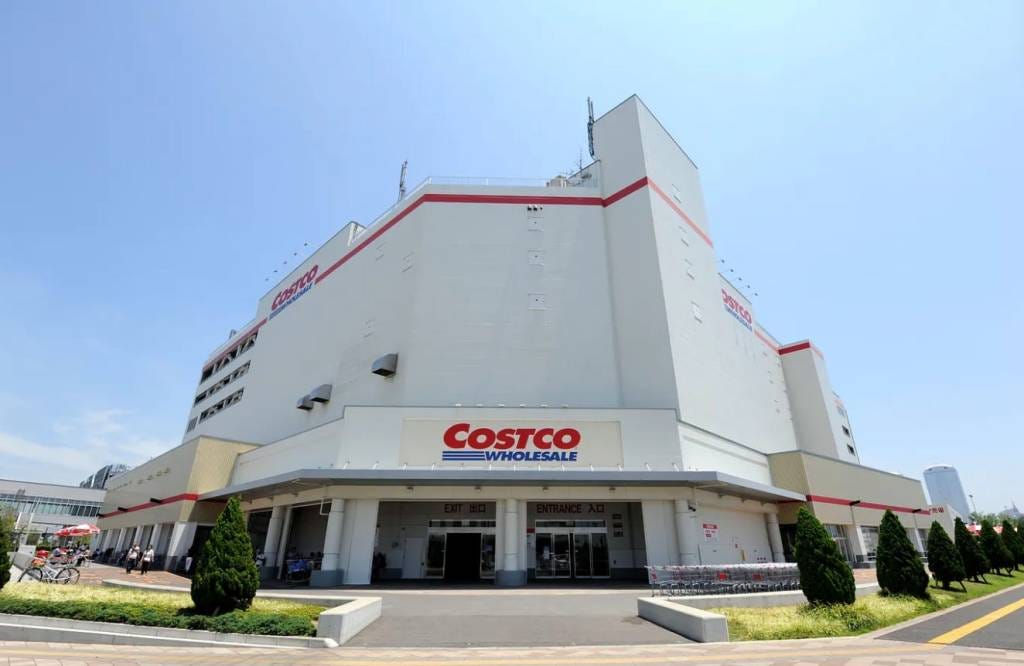
Distribution Network
However, there were areas where Costco brought in ideas from the US model. One important example is going directly to suppliers.
Most major stores in Japan operate on a consignment basis, with the risk and inventory costs assumed by wholesalers. Japanese retailers are often closer to the middlemen than their customers.
Following the successful US model, Costco Japan cuts out the middlemen wherever possible by negotiating directly with manufacturers and selling in quantity to its members.
Local & Foreign Products
Another example was how Costco Japan sold 90% of Japanese products at the beginning, then slowly shifted more towards Western products (especially their Kirkland brand).
Typically, foreign retailers are successful because they conform to local products. Strangely enough, the lure for going to Costco Japan is because they slowly moved away from localization.
Carrefour stuck with localized goods, and the Japanese eventually lost interest because there were no French products. There was simply no difference in the shopping experience.
Jim Sinegal provides some insight in 2011:
One of the things they told us when we went into business in Japan is that the taste for Japanese sweet goods is different.
“They’re not going to buy the bakery products you have.”
We almost changed to a different product. But we said no… we’re going test it and see how it works.Well, today the penetration of bakery products in our Japanese warehouses is greater than any other country where we do business. So we obviously go into these countries with an eye toward what is necessary, what really works. We’re not so arrogant as to assume everything we’re going to do will work just the way it does here.
But we test things and try to figure out solutions. One of the things that makes our business attractive in places like Mexico, Japan, South Korea or Taiwan is our mix of US goods. They like US goods. So we do a very good job of selling American products there.
This balance between local/foreign goods can only be gained through operational experience. When foreign retailers localize too much, they run the risk of losing customers.
Bulk shopping
Despite having smaller homes on average, Costco Japan members deal with bulk shopping by splitting with other members. This helps to explain why Japan has more members per warehouse than the US.
America has 70m members across 626 warehouses = 112k member per store; Japan has 6m members across 36 warehouses = 162k members per store.
Costco Japan Resellers
During the 2020 COVID pandemic, an interesting phenomenon arose where small retailers would buy Kirkland products and resell them in smaller quantities.
To slow the spread of COVID, Costco enforced a companion limit from April 2020 to October 2022, during then only a member’s relative and one child under the age of 18 could enter the store. Although the member could share items, the appeal of the Costco experience ended up being greatly diminished if a shopper could not visit the store. This policy spawned the cottage industry of Costco resellers, who bought items at Costco and resold them.
Costco Japan was okay to let retailers resell their products at a mark-up. It made economic sense because Costco Japan can only move so fast on warehouse openings and has strict requirements on where it can open. It needs a population of at least 500,000 within a 10km radius, a land lot around 50,000 square meters (including space for a gas station), a parking spot for 800+ cars and a long-term lease of 40+ years.
Resellers were helping Costco Japan gain mind-share for no extra cost, expanding the brand’s reach and penetration.
Well Paid Employees
It is no secret that Costco pays their warehouse employees much better than most major retailers. The trend also extends into Japan.
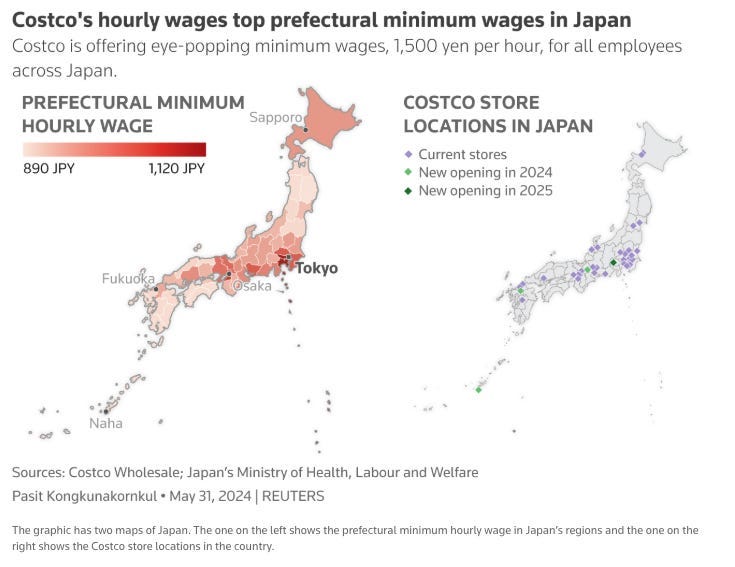
A Reuters report found that Costco Japan pays 30-60% more than the local minimum wages. Since Costco operates in many rural areas, the higher wage offers do crowd out small retailers.
While some of these smaller shops are unable to match the wages and have had to close up, others are raising their salaries to attract workers. The higher wages help to revitalize the rural locations and create a virtuous cycle for Japan, which has struggled with low wage growth for decades.
This map shows Costco Japan store locations compared to prefectural minimum wage:
Costco won in Japan
Costco Japan has certainly solved the retail challenges in Japan, but it wasn’t an easy journey from the start.
Japan is probably the most expensive market for us to enter in the world, for any of us who are responsible for business in countries outside the US and for regions within the US, there’s only so many dollars you’re competing for.
You have to be able to generate the same type of returns even though costs might be higher in Asia than a comparable location in the US. And Costco is spending a lot more on capital investment.
If we make it work in Japan, it’s a pearl.
Richard Chavez, SVP Business Development, 1999
Japan has definitely become a pearl and Costco is now trying to find similar success in China. After more than a decade of research and trying an e-commerce pilot program with Alibaba, Costco opened its first China warehouse in Shanghai in 2019. Today, they have 6 stores.
Alibaba closed their Costco-clone supermarket, Hema X, citing that they were unable to compete with big retailers like Costco and Walmart.
Finally, Costco Japan still plans to expand its footprint from 35 to 60 stores by 2030. It’s a promising future!