
History: Buffett’s Arcata Arbitrage (1981)
Intro
While at Graham-Newman, I made a study of its earnings from arbitrage during the entire 1926-1956 lifespan of the company. Unleveraged returns averaged 20% per year. Starting in 1956, I applied Ben Graham’s arbitrage principles, first at Buffett Partnership and then Berkshire. Though I’ve not made an exact calculation, I have done enough work to know that the 1956-1988 returns averaged well over 20%.
Warren Buffett
In 1977, Buffett’s net worth was $67m and 4 years later, in 1981, his net worth ballooned to nearly $350m.
Consider this was achieved during the bleak early 1980s.
Inflation was high at 10%.
Interest rates were at their highest in recent history at 15%.
Unemployment rates in late 1982 was nearly 11%.
However, within all this chaos, Berkshire managed to exploit an arbitrage on Arcata Redwood Company. During this period, the leveraged buyout (LBO) boom was on its way and no firm is more synonymous with it than Kohlberg Kravis Roberts (KKR).
This is where the story begins.
KKR bids for Arcata
The history of Arcata dates back to 1905 when a group of investors purchased approximately 20,000 acres of redwood timberlands in Humbolt County, CA.
By 1981, Arcata was the second largest printing services organization in the US. In addition, Arcata owned 77,500 acres of Northern California timberlands, which it used for timber harvesting, reforestation and milling.
Unfortunately, the owners of Arcata became tired of the potential litigations with the US government, and decided to put the company up for sale. KKR made a bid to buy Arcata. The stock was trading around $33/share at the time of the deal announcement. KKR offered a reasonable premium at $37/share.
What was the litigation that motivated the sale?
In 1978 the US government had taken title to 10,700 acres of Arcata timber to expand Redwood National Park. The government had paid $97.9m, in several installments for this acreage, a sum Arcata was contesting as grossly inadequate. The parties also disputed the interest rate that should apply to the period between the taking of the property and final payment for it. The enabling legislation stipulated 6% simple interest; Arcata argued for a much higher and compounded rate.
Because of this, Arcata was faced with this issue of future litigations. To solve this problem, KKR offered $37/share plus 2/3 of any additional amounts paid by the government for the redwood lands.
Buffett also buys Arcata
The initial announcement said that KKR offer of $37/share would be paid in January 1982. Therefore, if everything had gone perfectly, Berkshire would have achieved very good returns on price alone, without the redwood claims as bonus.
So, Berkshire began buying shares in September 1981 at $33.5/share and over the course of 8 weeks, they bought 5% of Arcata.
Things didn’t go perfectly.
In December, it was announced that the closing would be delayed a bit. Nevertheless, a definitive agreement was signed on January 4, 1982.
Encouraged, Berkshire raised their stake, buying at around $38/share, even higher than KKR’s offer. Buffett clearly believed that the redwood claims would be substantial. They now own 7% of Arcata.
The Deal Takes a Turn
On February 23, the lenders said they were taking a “second look” at the financing terms in view of the severely depressed housing industry and its impact on Arcata’s outlook. The shareholders’ meeting was postponed again.
On March 12, KKR said its earlier deal wouldn’t work, first cutting its offer to $33.5/share, then two days later raising it to $35/share.
On March 15, however, the directors turned this bid down and accepted another group’s offer of $37.5/share plus 50% of any redwood recovery.
On June 4th, the Arcata deal closed. Berkshire made $1.7m instantly (received $24.6m on investment of $22.9m), earning a 15% annualized return.
Redwood Claims
So, Buffett made a tidy profit in less than 9 months, but that’s not the end. There was another small payment of $0.65/share received in September 1983 related to the Redwood payout.
The government had paid $97.9m for the timberlands. Arcata argued their case that the compensation should be $215m plus market interest.
Arcata went to court in San Francisco.
The judge appointed two commissions, one to look at the timber’s value, the other to consider the interest rate questions. On August 1986, the first commission determined the redwoods were worth $275m and the second commission recommended a compounded, blended rate of return of 14%.
On August 1987, the judge upheld these conclusions, resulting in $560m to be paid to Arcata former shareholders. This marked the end of a complex 10-year court case.
In 1988, the claim was settled. Consequently, Berkshire received an additional $20.1m.
Summary of Transactions
Below is the cash flow by year on per share basis:
Sep 1981: Initial purchase -$33.5
Apr 1982: Arcata sale $37.5
Sep 1983: Redwood payment $0.65
May 1988: Redwood payment $27.5
Nov 1988: Redwood payment $1.33
Jul 1989: Litigation settlement $1.5
Plug this series of cash flows and you get a 31% IRR!
Actually, while the IRR was impressive, we have to understand that Berkshire earned it with very little risk taken. Take a look at Arcata P&L prior to the deal:
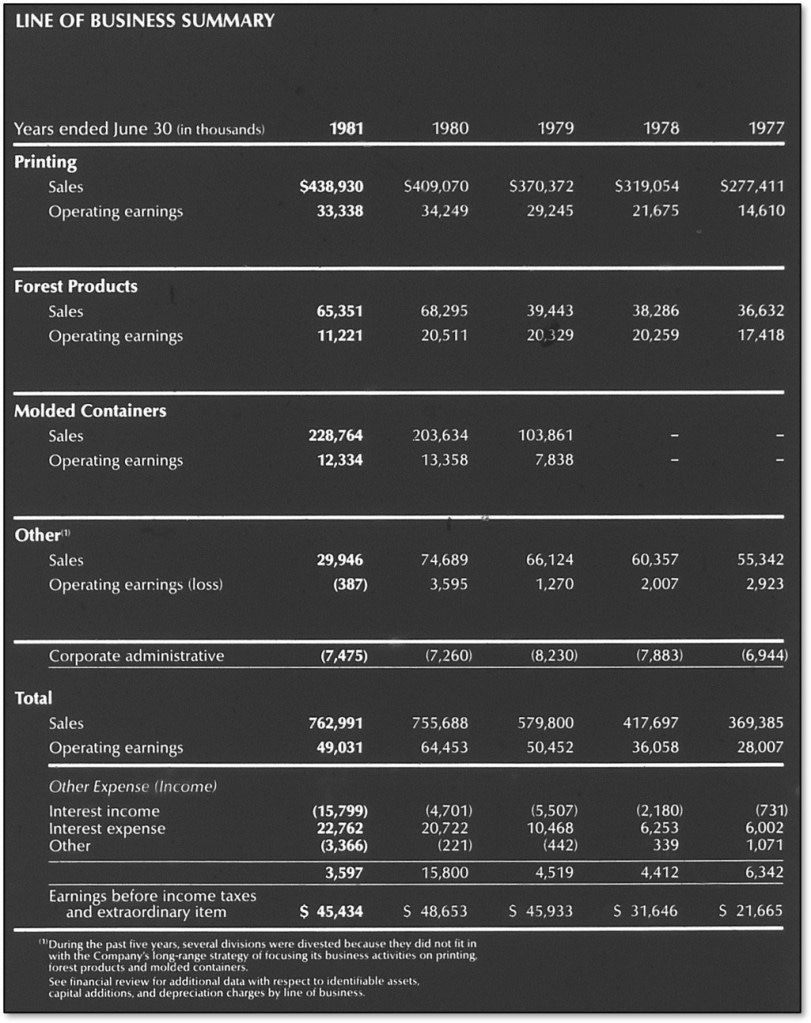
Arcata had a strong business and had no problems covering its interest expenses. The price it was trading at was just 10x earnings, excluding any potential of redwood claims.
If the acquisition was called off and redwood claims were zero, the business itself wouldn’t even be expensive to begin with.
Since it was known that Arcata’s management was shopping around and announced their intentions to sell the company, it shouldn’t be surprising that the deal price was struck above Berkshire’s purchase price.
Buffett further boosted his margin of safety with the redwood claims.