
HEI: Heico (2)
Preface
We wrote about HEI here and ended the post with unclear knowledge about the Parts Manufacturer Approval (PMA) economics. This post will revisit this gap with more study notes.
Legal Standard Requirements of PMA
The PMA is a combined design and production approval by the FAA for replacement parts for aircraft, engines and propellers. In fact, the law states that all replacement and modification parts must either have a PMA or be approved via one of the following exceptions:
A part produced under a “one-time only” supplemental type certificate or a field approval should not get a PMA. This part is produced to return only one aircraft to service. If you are going to make parts for more than one aircraft, you need a PMA.
Original Equipment Manufacturer (OEM) don’t need a PMA. If a supplier wants to sell parts without the OEM giving permission to bypass them, the supplier will need a PMA.
Aircraft owners may produce parts for installation on their own aircraft. They must prove these parts comply with standards, and they cannot sell the parts unless they have a PMA.
Civil air carriers may produce parts for themselves without PMA. This is a good way to reduce costs if they have internal manufacturing capability. To sell the parts, they need a PMA.
FAA certified repair stations can produce parts during course of repair. They cannot sell the parts without a PMA.
Standard parts such as nuts and bolts that conform to standards don’t require PMA. OEMs typically buy such hardwares and apply huge market-ups. If an airline is willing to invest in the research to find the standard equivalent to the OEM part numbers, they can save some money.
Parts produced under FAA technical standard order don’t need a PMA.
Note that the legal requirement and modification parts is the PMA, and OEM parts are an exception to the PMA requirement. As far as the FAA is concerned, there is no difference in legal requirement between a PMA/OEM part.
The common understanding of an OEM is that they sell new aircrafts or engines, however, in practice OEMs have never manufactured every part of the product they sell. They rely on both internal manufacturing and external suppliers. Over the last 2 decades, OEMs have emphasized outsourcing to the extent that they have become system integrators rather than manufacturers.
PMA Certification Process
Airworthiness Standards Stage
The primary legal basis for PMA is identical to the standards of the original design. At the beginning of the PMA process, the applicant must identify the airworthiness standard to the FAA, regardless whether this is OEM or PMA, the process is identical.
For example, if you want to produce a PMA part for manned free balloons, then you must meet all the criteria of “14 CFR, Part 31, AIRWORTHINESS STANDARDS: MANNED FREE BALLOONS”, which is the same standards for original product certification.
Design Approval Stage
Once airworthiness requirements are identified, then the applicant must identify the basis for design approval. There’s 3 standard paths to take:
Identicality with License Agreement.
Often an OEM will decide that a portion of their certified product is not a core part of their business, and life would be simpler if they were no longer responsible for supplying it.
This part may have always been provided by an external supplier, or it’s a low dollar value part, or it’s at the end of the product life cycle. The OEM can license another PMA supplier to produce the part and notify the FAA.
Since the OEM is providing a design that has already been approved by the FAA to the PMA supplier, there is no need for the FAA to reinvent the design approval.
Identicality without License Agreement.
The PMA applicant proves to the FAA that the part is identical to the OEM. If the applicant doesn’t have the OEM part drawings, identicality is difficult to prove. And if they have the drawings but no license, then the applicant can expect a potential lawsuit from OEM. Many suppliers obtained part drawings from the Air Force using the Freedom of Information Act, but the Air Force stopped buying designs from OEMs years ago, so fewer PMA applicants are choosing this method.
Test and Compute.
The PMA applicant proves that the parts are equal or better than the original approved version using analysis and tests. Only minor changes or improvements from the original parts are allowed in a PMA design. This method is also known as reverse engineering, most PMA parts and virtually all complex parts now use this method for approval.
Criticality Stage
Every possible way the part could fail is examined and the consequences of failure are assessed. Based on this analysis the part is classed as critical (affecting airworthiness of the aircraft), important (affecting the performance of the aircraft or engine), or not critical/important (all the rest). Most PMA parts fall into the last category.
They must also identify all Airworthiness Directives (AD) and unresolved service difficulties pertaining to the original part. All these must be cleared as the FAA does not want a PMA part that duplicates and perpetuates a known problem.
If the part is critical or important, the FAA needs a Project Specific Certification Plan. This is a plan for the FAA to manage the testing process. This is a very rigorous plan including these factors:
Test purpose
Physical and functional description of setup
Number of units tested
Unit identification
Test conditions and duration
Test success and failure criterias
Test instruments and data collection
Safety controls
Control of test procedures
The benchmark to test against is usually a sample of the OEM part.
There are also chemical, metallurgical and physical tests to prove the materials are suitable in a simulated operating environment.
When all these PMA testing plans are approved, the authorities will audit the PMA manufacturing facility to ensure that they have an effective fabrication system.
Manual Instructions Stage
We’re not done yet!
The PMA applicant must also demonstrate that they have inspection and repair instructions for their part (Instructions for Continued Airworthiness). They can often simply state that the PMA part is maintained according to the OEM maintenance manual, but if their part is different from the OEM, or if the OEM does not provide instructions, the PMA supplier must provide instructions to the airlines on how to inspect and repair.
There must be a Continued Operational Safety (COS) plan that includes detailed records of the manufacturing cycle, ways for identifying possible failure, corrective actions and ways to perform them quickly.
The Modification and Replacement Parts Association (MARPA) is the non-profit trade association that represents the PMA community, which works closely with the FAA to develop the COS requirements for PMA.
PMA Operational Performance
Without even going into the details found in the regulations, we can already see the approval of PMA parts are as robust as OEM parts. But how does PMA parts compare in actual operations?
Reports suggest they are as safe as OEM parts, it makes sense because of the robust testing requirements needed for a PMA part to be fitted on a plane.
MARPA did a review from all AD for transport aircraft engines from 1992 to 2024 and found 287 cases, out of which 286 were OEM problems. There were 3 AD associated with PMA parts, 2 of which were clones of OEM designs that exhibited same design problems.
In 2008, in response to lobbying from OEMs who claimed that PMA parts are less safe, the FAA studied the operational performance of PMA parts and reported:
… the team did not find substantive evidence of failures or unsafe conditions arising from non-OEM holder developed data. The general population of PMA parts and non-OEM holder repairs, alterations have increased substantively in past years particularly in the commercial aviation sector yet the occurrence of service difficulties and airworthiness directives on such parts for design or compliance shortfalls have not increased proportionally.
The arrival of PMA parts in competition with OEM replacement parts is a relatively new phenomenon. Although PMA was established by the FAA about 50 years ago to enable pilots to repair obsolete WW2 military aircraft, it didn’t take off commercially until the 1990s.
The growth of the PMA market meant that instead of acting as a passive customer and accepting replacement parts as a fixed and increasing expense, airlines can now proactively shop for the best value proposition.
Economics of PMA
Aircraft maintenance expenses are significant for airlines which costs can be reduced (thanks to PMA) but are unavoidable due to flight safety regulations.
In 2023, it was estimated that maintenance costs were $1,499 per flight hour and $4.6m per aircraft. Maintenance & repair spending is about 12% of total expenses, with the long-run drivers being an increasing fleet count:
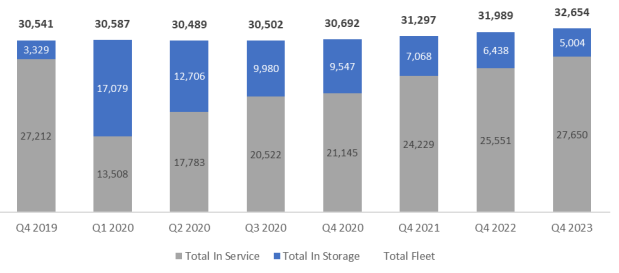
Aircraft fleet age is also increasing especially for UPS and FedEx, where cargo planes don’t care that much about comfort compared to passengers. They have an average age of 21 and 17 years respectively, compared to 11 years for commercial airlines. Older planes need more maintenance which is another economic driver for PMA providers.
Outsource Maintenance
The trend among airlines is to consider maintenance to be a non-core activity and outsource it. Once maintenance is outsourced, an airline doesn’t need to do things like procurement and inventory management.
There are good and bad consequences of outsourcing.
If it’s outsourced to an OEM, then there is basically no cost savings, unless the airlines is a very big customer. One way OEMs block PMA players is to control the maintenance market. We know that the operating lifespan of an aircraft can stretch for decades, and so the maintenance market is important.
With little cost savings, there’s still upside in the engineering skills of OEMs. So how do airlines weigh the pros and cons?
If it has a per-hour maintenance contract with performance guarantees, then the materials cost are transparent. This type of airline cares about maintenance cost per flying hour.
Airlines that fly aircrafts operated in the US can quickly determine whether their costs are competitive using data that US airlines submit to the Department of Transportation.
The types of contracts that benefit PMA suppliers are time & materials contracts (paying based on time spent and materials cost), where a PMA provider could save up to 60% in an engine shop visit.
Leasing
Globally, there is an increasing trend of leasing aircrafts:
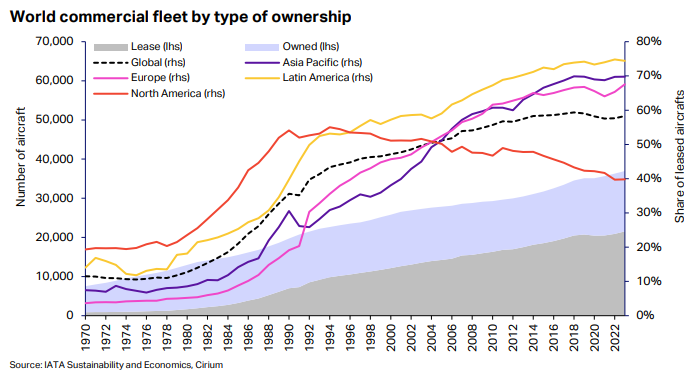
Leasing is currently a challenge for PMA. This is a classic example of how a new way of doing business can intrude on an existing business structure.
Lessors have two major problems with PMA, but both of these problems are diminishing over time. Every lessor has a horror story about not being able to place an aircraft at the end of the lease. The lessor is stuck with the aircraft payments but has no supporting flow of revenue.
Firstly, the concern is that PMA can block an aircraft transfer because not all regulatory agencies and not all airlines will accept an aircraft with PMA replacement parts, particularly if the parts are complex or important.
Fortunately, this problem is getting smaller every year because of the operating success of PMA.
The strong regulatory structure established by the FAA is also winning over other aviation authorities, and good progress is being made with the Bilateral Aviation Safety Agreements to enable seamless use of PMA throughout the world.
Second concern with leasing is that PMA parts have lower dollar value than OEM, and lessors are finance people who think that the aircraft’s residual value will be lowered. For example, they worry about end-of-life value of PMA and OEM parts.
However, we think this doesn’t make economic sense because people buy an aircraft for its capability, not the dollar sum of parts. The price of an aircraft capability depends on demand and supply, not what parts are used. We also think that there is little difference in scrap value because the underlying materials are commodities.
OEM Competition
Obviously, OEMs don’t like the existence of PMA and they have lobbied heavily to limit PMA adoption. In 2008, an engine OEM even ran an advertisement showing an Elvis impersonator with the headline “Let’s face it, lookalikes never perform quite like the original”. This campaign led to an immediate response by the FAA confirming PMA parts are treated equal to OEM parts.
This claim is onerous due to the logic that OEMs get approval for the entire aircraft or engine and don’t have to prove every individual parts. Engines alone can have between 20,000 to 40,000 parts, a fully assembled Airbus A320 consists of ~340,000 parts and a Boeing 737 has ~500,000 parts.
Considering that PMA providers have to prove every part they sell, if OEM parts were perfect we wouldn’t see so many Airworthiness Directives.
Another argument OEM use is that they understand the relationships that exist between different parts of the engine because they built the whole thing. A small change somewhere can have dire consequences.
However, this is also not true based on the logic that OEMs don’t design the entire engine! Different parts of an engine are designed and built by different companies in different countries. Also, any mass produced items uses dimensionally controlled parts that are interchangeable, it is not uncommon to have an OEM part manufactured by multiple external suppliers according to the blueprints.
PMA suppliers act in the same way, but they don’t receive the blueprint, instead they reverse engineer the products.
OEM try to deter customers from purchasing PMA parts by threatening to not honor their warranty. However, this also doesn’t change the economics of PMA providers because the most important warranty from the OEM is the new product warranty. It provides replacement of all parts that fail during the warranty term, so in the first place nobody will buy a PMA part when they can get free parts from the OEM. In fact, this warranty system puts the OEM on the hook for airlines to extract value for free.
The shocking increase in maintenance costs come when these warranties run out, that’s when PMA parts play a role in lowering expenses.
Summary
To condense the economics of PMA parts:
Long runway: Fleet count and age are increasing, logically this trend will not reverse. Combine this with maintenance and repair costs being a significant chunk of airlines profit, there are incentives for them to derive cost savings from PMA parts.
Predictability: Engines and aircraft are complicated machines that have zero tolerance for failure and PMA parts are mission critical. Once a part is FAA approved there are high barriers of regulatory protection.
Safety: PMA parts are as safe as OEM ones, the approval process is as rigorous.
HEI has over 19,000 FAA approvals and produce 500 new parts annually, consider that a big plane has ~500,000 parts it would take over 900 years for HEI to PMA those parts. Although this is just a gross calculation because HEI focuses on niche parts (which explains the low 2% market share), we take that to directionally imply a very long investment runway.
The safety record is also impressive, as of July 2025, HEI has delivered over 87 million parts with zero records of Airworthiness Directives!
Valuation
In the past 6 years, HEI stock grew at 17% CAGR, with PE ratios CAGR 7% and slightly higher share count, implying business performance CAGR ~10%.
If we try to estimate the intrinsic value growth over the same period, HEI delivered 9%. Note that the attribution is largely due to the high reinvestment rate from M&A. ROIIC is not high at only 9%, and ROIC averaged 12%. This is not surprising as we knew HEI is a serial acquirer.
Since 2019, impairment of intangible assets was $7.5m, this is negligible compared to $3,697m of shareholders equity.
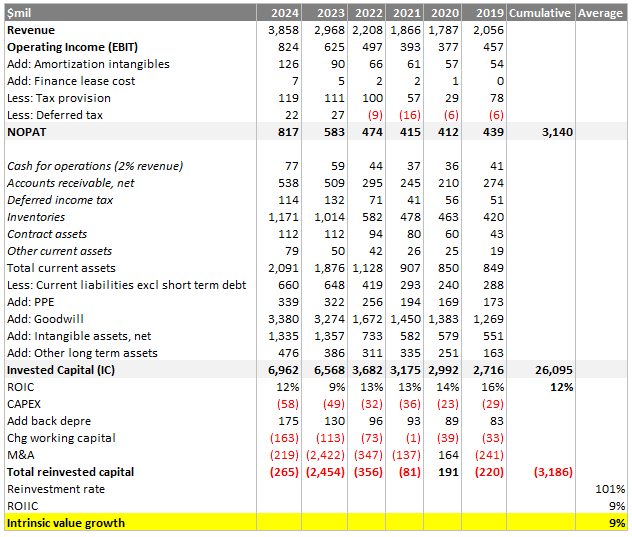
We think the current market cap of $39.2b is too expensive for a 9% intrinsic growth to trade at PE of 75x.
Update FY Q2 2025
HEI reported good results for Q2 2025:
Sales +15% YOY primarily driven by strong +14% organic growth across all product lines and the beneficial impact of profitable acquisitions.
Operating income +19% YOY with improved operating margin of 22.6% (vs. 21.9% in Q2 FY24). Net income also increased +27%.
Cashflow from operations went up by +45% YOY.
Net debt-to-EBITDA ratio improved to a healthy 1.9x as of Q2 2025, down from 2.1x at Q4 2024.
Business Segments
Flight Support Group (FSG)
FSG had exceptional results, with net sales growing +19% and operating income climbing +24%. Key drivers included +14% organic growth driven by +16% organic growth in PMA businesses.
Organic growth in component repair was +11%, and specialty products grew +9%. Management attributed this strength to accelerated market acceptance of their products, quick turnaround times, and the ability to offer a compelling value proposition combining OEM parts, HEI parts, and repairs through their 21 component repair stations (the largest independent network in the world).
The continued success of the Wencor integration, operating as a standalone business with further bolstered performance.
Notably, organic defense net sales increased +18%, benefiting from defense spending, particularly in missile defense manufacturing, where significant backlog was reported. The FSG operating margin improved to 24.1% in Q2 2025, with a cash operating margin (EBITA) of 27%, an increase of 110bps YOY.
Electronic Technologies Group (ETG)
ETG reported +7% increase in net sales with +4% organic growth, mainly attributable to increased demand for space, aerospace, and other electronics products. While defense product net sales were slightly down this quarter (Q2 2024 saw +20% organic growth in defense), management highlighted record backlog in ETG, particularly in defense, which points to strong anticipated growth in the second half of 2025.
ETG maintained strong underlying profitability with an operating margin of 22.8% (26.7% before acquisition-related amortization).
Acquisitions
HEI remains highly active in its acquisition strategy, completing its fourth acquisition this year with the purchase of Rosen Aviation LLC in April.
The company designs and manufactures in-flight entertainment products (principally cabin displays and control panels) for business and aviation markets. It is expected to be profitable within its first year. The purchase was funded by cashflow from operations.
Pricing Comments
Management reiterated their commitment to long-term customer relationships. While acknowledging the opportunity to raise prices more aggressively given OEM price increases, HEI intentionally restrained price hikes beyond cost pass-throughs.
This strategy, cultivated over decades, aims to foster customer loyalty and continuous increased business, ultimately benefiting shareholders.
We like this approach as it aligns with the concept that true pricing power is leaving consumer surplus while increasing willingness to pay.